

I am a shareholder in neither, but congrats to those who were. You made a good decision and probably had a good morning.
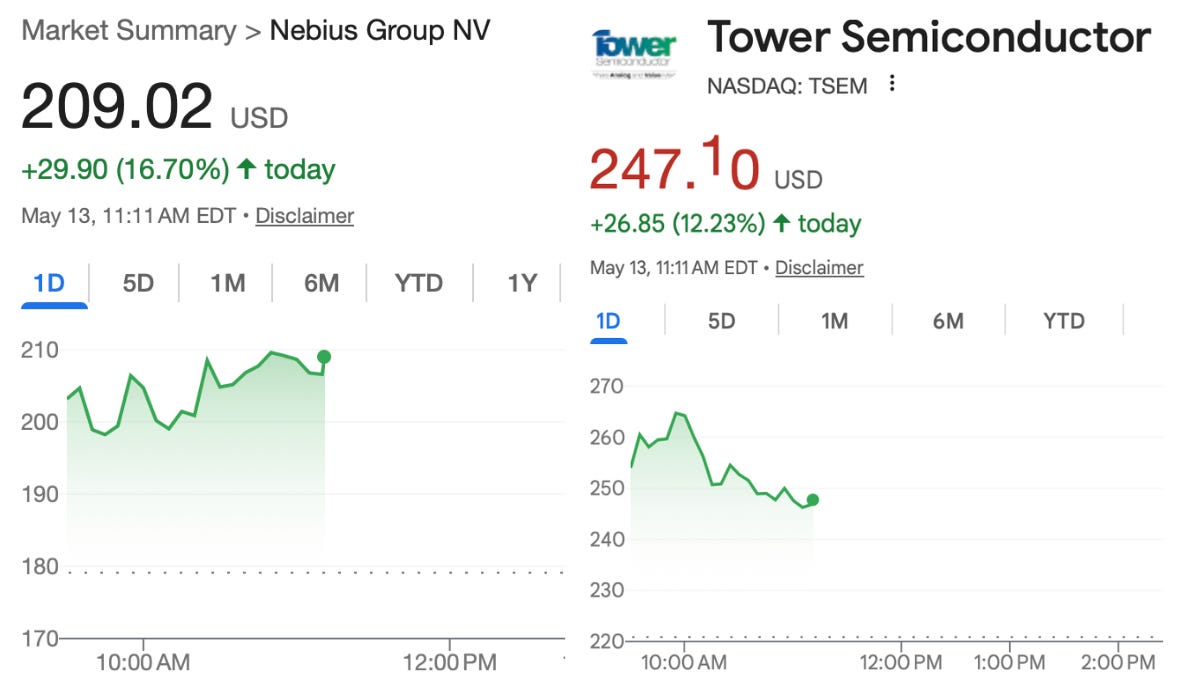
Anyways, both of them had massive beats and are looking great. Let’s review the earnings for both today, as we can learn a lot from them in terms of both individual company performance, but more importantly, read throughs to their broader ecosystems (neoclouds for Nebius and optics for Tower).
By accessing this content, you acknowledge and agree to our terms and conditions. This research is not financial advice.
Headlines
Nebius
Nebius is the smaller (only revenue wise as their market cap flipped CRWV) sibling of CoreWeave and the favorite child of investors.
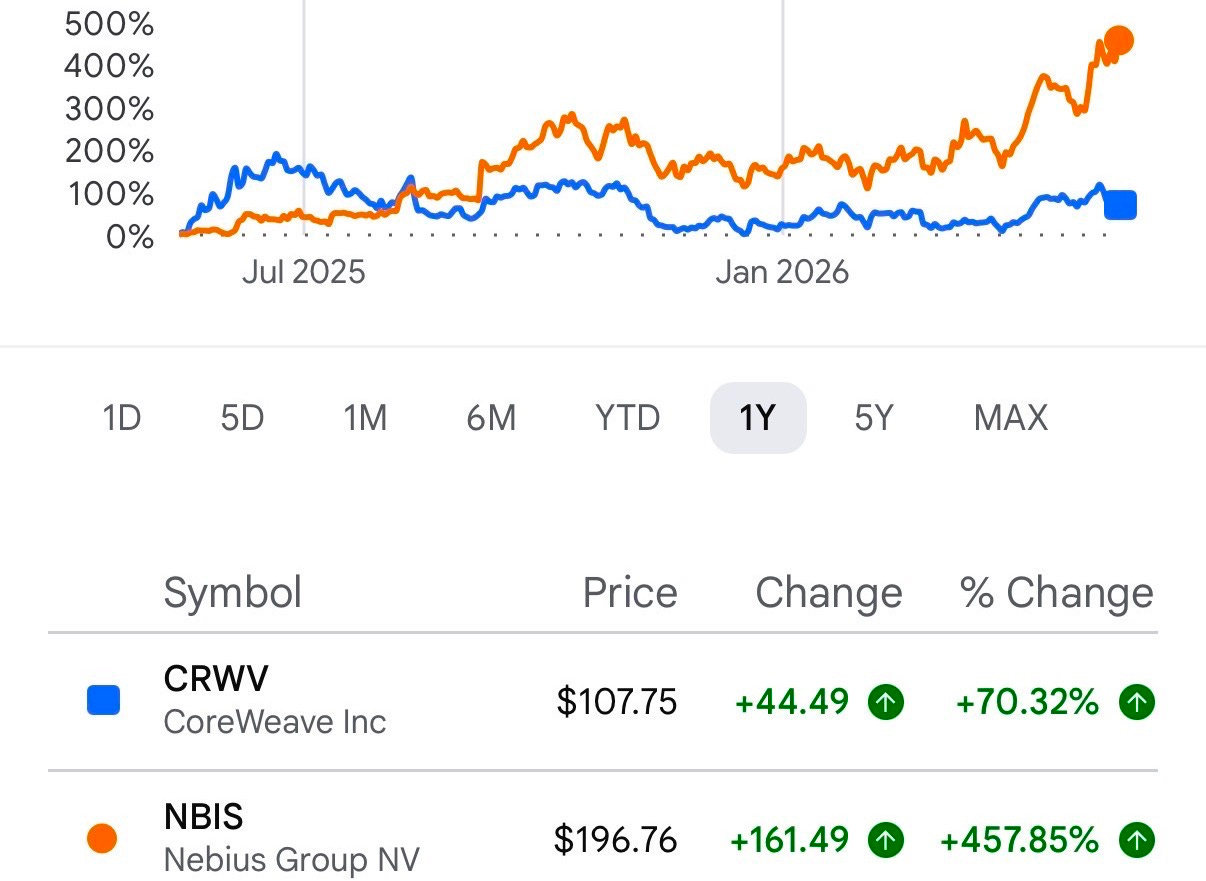
They are better at serving the long-tail of AI demand instead of only signing big deals and are executing MUCH better on several fronts (and thus have the Super Ultra Premium Valuation). I am biased towards CoreWeave due to my positioning so this is objective. Very rarely do I make a call that contradicts share price momentum.
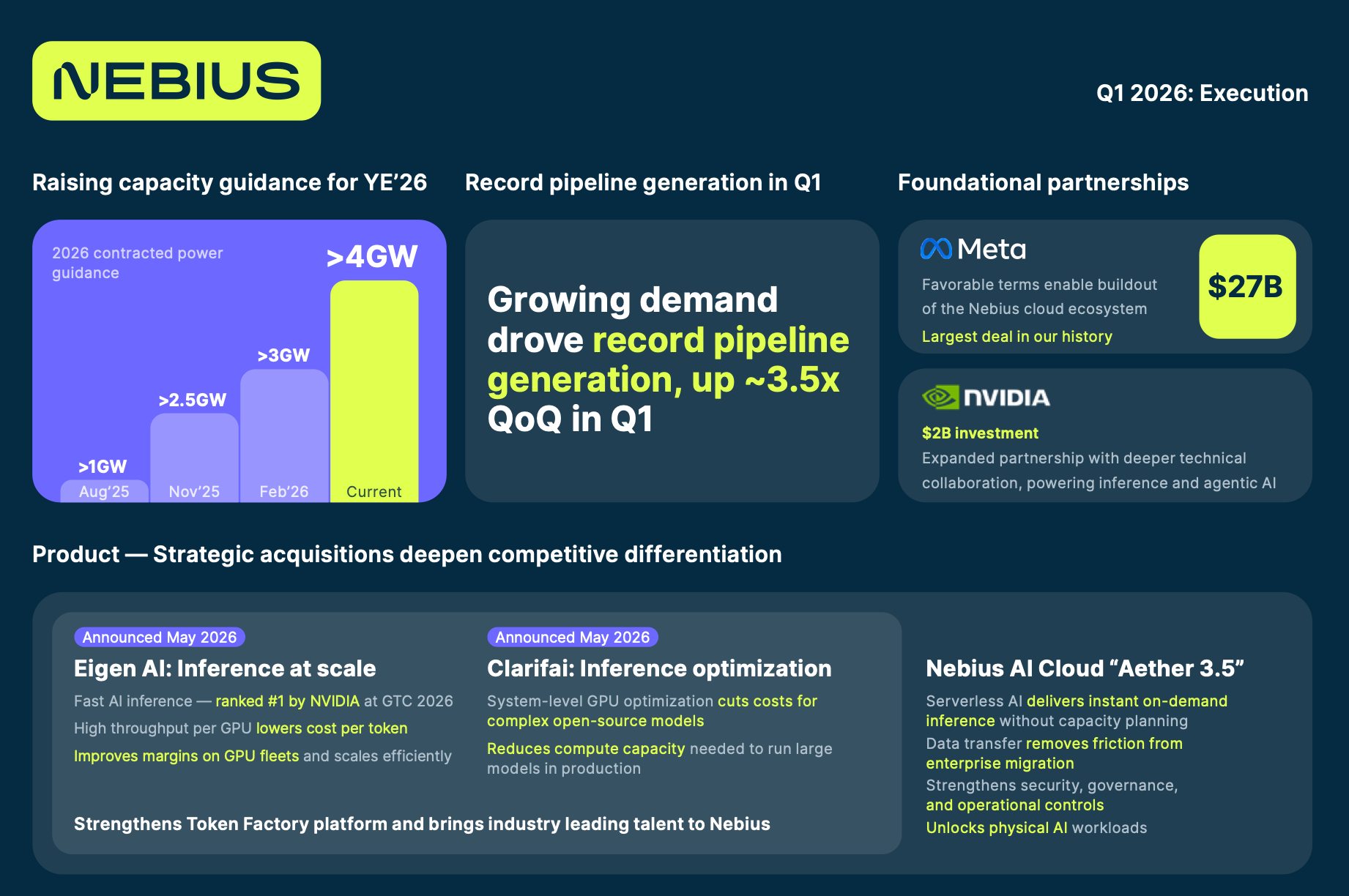
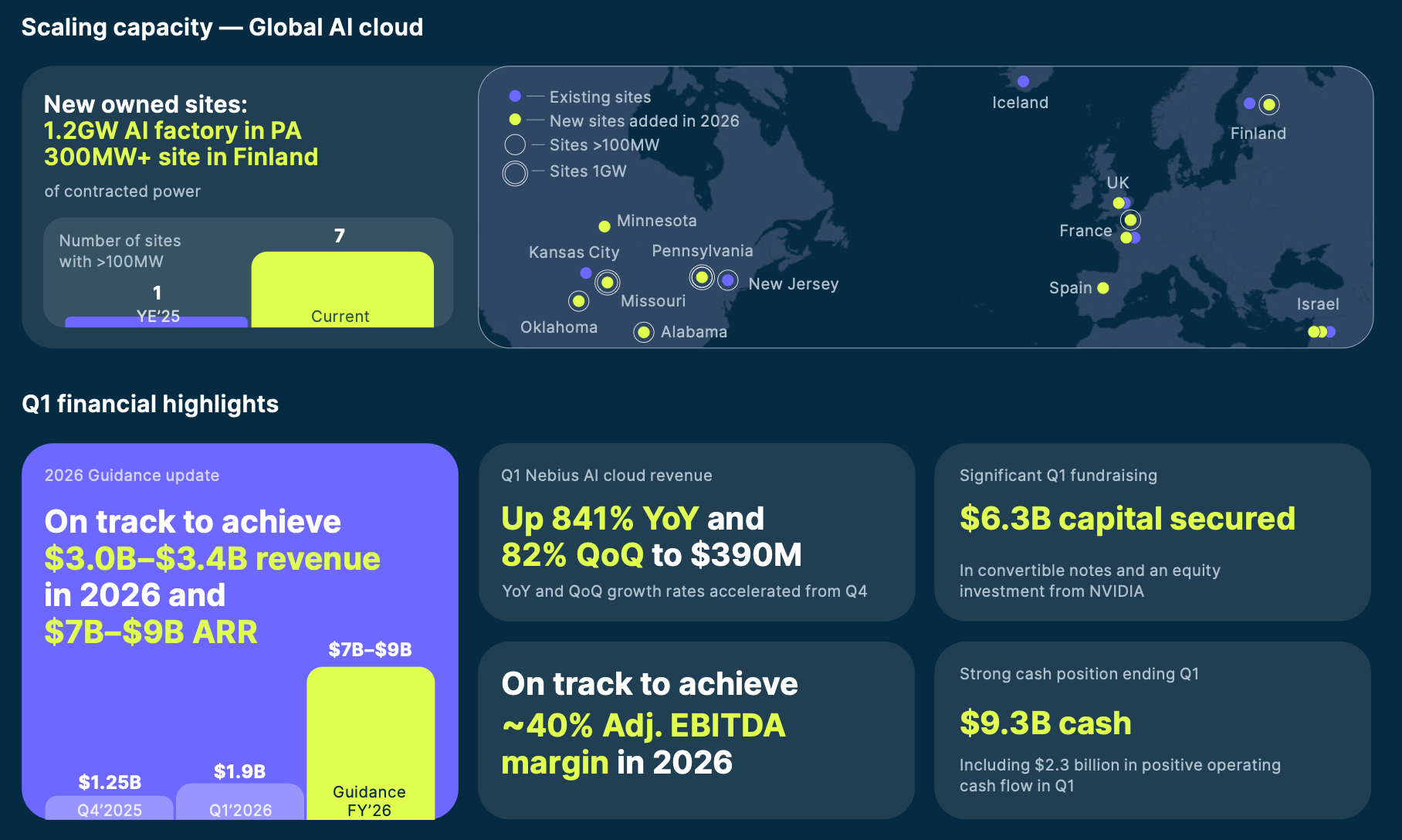
First, they reiterated their $8b and $3.2b guidance for YE26 ARR and revenue respectively (compared to CoreWeave’s $18.5b and $12.5b). They guided their EBITDA margins to 40% for 2026 (vs 60% for CoreWeave due to scale). They are sold out for 2026 capacity as well.
Now on to how they’re executing really well.
Nebius significantly raised their contracted power guideline to 4 GW. This is an entire gigawatt more than what they gave for their Q4 earnings release. Despite having a smaller (less than 50%) base than CoreWeave today they’ve contracted more power. As a read through of Neoclouds in general, it shows that contracting power is really never the issue anymore, as both public Neoclouds surprised to the upside on their contracted power. Nebius also tends to self-build a lot more, and they have a big 1.2 GW site coming online in Pennsylvania.
Next is their increase in capex from a midpoint of $18 billion to a midpoint of $22.5 billion. Unlike for CoreWeave, this is due to higher projected 2027 revenue rather than cost increases, though they did cite around 3-5% of cost pressure for 2026 from component pricing (memory lol).
For financing, they raised $4b from converts and $2b from equity in the quarter, and are now tapping into debt as they can sign asset-backed loans with their much larger contracts, like the new $27 billion deal with Meta.
Tower Semi
Tower had a pretty sizeable beat on the Q2 guide.

But the real story is that they signed $1.3 billion of Sipho revenue for 2027. This is a massive revision upwards from sell-side and SemiAnalysis projections. It is actually quite close to my own projections from my original long thesis ($1.44b) before I got peer pressured to revise it down lmao.

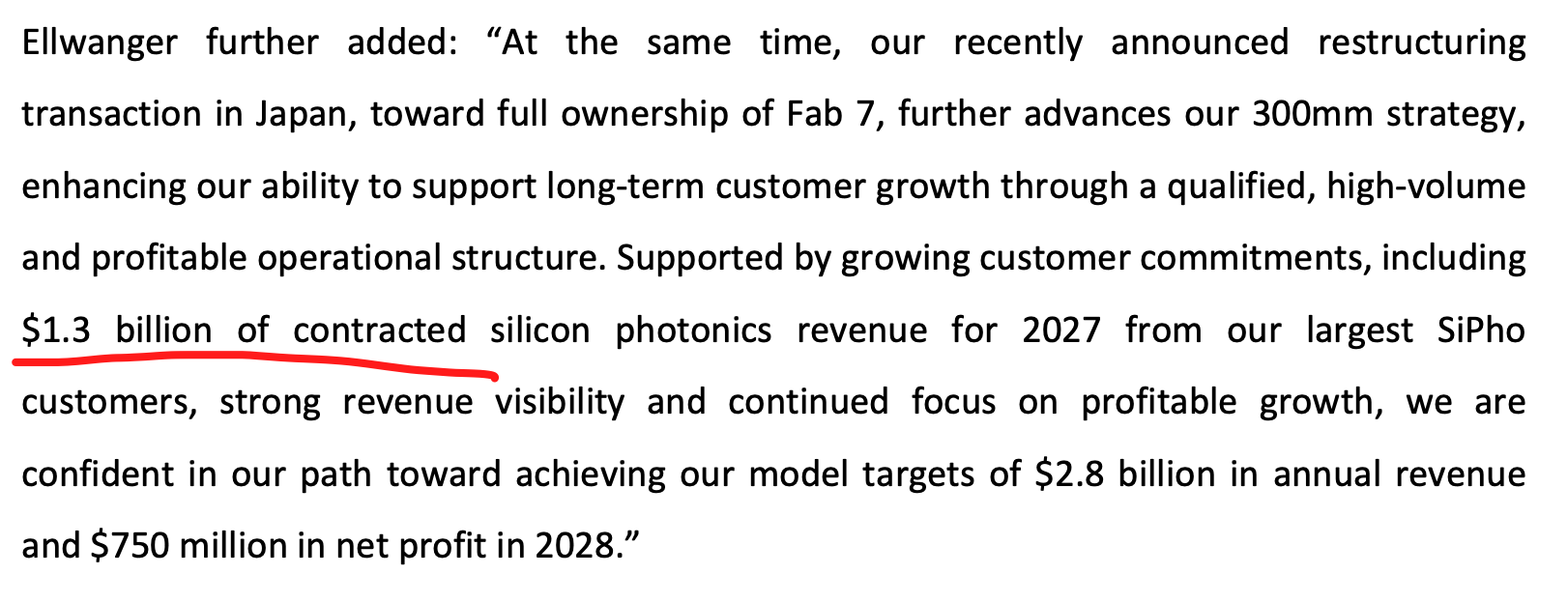
On the call, they said that they are backed by even more contractual revenue in 2028. Pretty crazy stuff.
They are continuing on their goal to 5x Q4 2025 shipments by year-end 2026 and are on track to execute their $920 million investment plan. Today, their fabs are running mostly clustered around 60 to 80% utilization, which means that they’ll most likely hit capacity limits soon and join Lumentum in the sold-out club.

Call Takeaways & Read-Through
Now on to the meat of our analysis, which is on their Q&A and the read-throughs that we can glean for the rest of their peers.
For Nebius, I talk about the effects of stronger GPU pricing, timing of their capacity additions at their Pennsylvania campus, and the structure of their Meta contract.
We read this through to CoreWeave and Neoclouds in general for what this means for future contract structures (with my own speculation) and whether or not there is a real cap on capacity. I share how this changes my view of and positioning on CoreWeave.
For Tower Semi, we discuss their interesting comments on their content in CPO versus plugables and a little bit of reading of management’s tone, clarify the $1.3 billion commitment with more granular details, unpack their market share comments, discuss pricing power, and talk about their positioning against TSMC COUPE.
We then read this through to the rest of the optics ecosystem and give one lesson I learned that we can take away and apply to how we view our favorite names.
Nebius
Let’s start with Nebius. One obvious question that came up in the Q&A was how they were going to capture the stronger GPU pricing and whether they had shorter-term contracts that could benefit. Funny how the discussion turned very, very quickly from depreciating junk chips to scarce, appreciating golden compute, right as agents started taking off.
Their answer was that they raised prices and are still selling out. Their contract lengths are extending out, and prepayments are becoming more significant. Nebius is still contracted, so customers that lock in their capacity are still getting the upside from the value of compute appreciating. However, it is when they sign new contracts that they can exercise their pricing power, so Neoclouds having long-term contracts do not prevent them from getting upside from their compute as we see more and more deals signed for 2027 and 2028. I still think that we see massive upward revisions due to GPU price increases. It just will not be reflected in 2026.
Next is the timing of capacity additions for Pennsylvania. This is a 1.2 GW site, and they said that they will have the lights on by the end of 2027 and will be adding 300 MW each year up to 1.2 GW total.
Finally, on the structure of the Meta contract. This one is very interesting, and I think this is something that Nebius did really well and could be used as an exemplar in future Neocloud deals for other Neoclouds. This is a five-year contract for $27 billion total. It is split up into $12 billion for regular capacity, just like all of the other deals, while $15 billion of it acts as a backstop. They can build all that capacity, sell it out for a higher price if they can, but if they cannot, they can simply take the deal with Meta and get $15 billion as a floor. As a result, they have all of the upside, and the management team was pretty excited about this, which they should be, because it is a very well-structured deal. Good job, Nebius!
Now, on our lesson and takeaways for the broader Neocloud ecosystem:
First is, of course, that higher compute prices do matter. 2027 and 2028 revenues still have plenty of upside revisions to go.
More importantly, I think a lesson that we can learn from their hiked capex guidance and deal structure with Meta is that there is really no cap on capacity for the Neoclouds. The more deals they sign, the more capex that they’re able to support and finance, the more their revenue grows. I do not think that there is a cap in terms of how much of the compute scarcity upside that Neoclouds can capture. This is an overall bullish read-through, and I am now more positive on the Neoclouds ecosystem.
A bit of a speculation is that if compute gets even more scarce, we should see more meta-like deals from the other Neoclouds too. Eventually, maybe their deal structure can even reflect that of the memory vendors right now if compute demand goes full singularity and gives them immense negotiating leverage. That is, there’s literally a floor on the price with no cap at all.
Tower Semi
First, Tower affirmed that the $1.3 billion commitment is wafers delivered and not wafers started, which is good. Also, though they kept their 2028 guidance the same, they did hint that they would probably raise it in the next few quarters, which is also good.
For market share and pricing power, Tower absolutely mogged everyone. They said that they heard some really interesting claims from the other players about their market share that made no sense. They are by far the leading market share, and there’s no reason why that should change. For pricing power, they mentioned that they were “re-evaluating the value of their platform” for pricing and that it would not come from capacity constraints. Again, incredibly bullish.
However, Tower had really strange comments when it came to their content in CPO, which was obviously a question they were going to be asked because it’s one of the main concerns of investors, myself included. Here, they actually defended plugables quite a bit. They highlighted NPO and XPO and reminded us that pluggables would remain dominant through the early years of the next decade.
This might explain some of the fade in their stock after the call.
This is concerning because Lumentum and even Coherent describe scale-up CPO as the biggest opportunity that they have ever seen in their lifetimes and won’t stop talking about it and claim it’s an order-of-magnitude increase in content. Tower kind of dismisses it and just deflects to talking about pluggables. The CPO content is growing really fast, even with pluggables, with port count up 4.5 times from 2025 to 2028. They mentioned on the call that CPO is going from something like 70 million to 230 million, while the overall pluggable port count is going from 130 million to 300 million. Faster growth.
When talking about competition against COUPE, they said something similar. The very first thing that they reiterated was that NPO, XPO, and pluggable stay the primary demand vector. They also talked a lot about NPO and XPO rather than CPO, which obviously does not match the ratio that investors talk about it in which is mostly CPO and very rarely the bridge solutions, as CPO is the obvious end game.
However, they mentioned that for COUPE although they can’t compete with TSMC on their logic their big value add is the PIC, and in theory there’s no reason that TSMC can’t buy their PIC. It would be a fascinating sort of source of upside if that is the case, that TSMC changes their model from being fully vertically integrated to sourcing it from externally, but of course no indication that that should happen as it goes against TSMC’s stated strategy, and Tower’s management did say in theory.
The lesson and read-through to optics here is to never underestimate the power of revision. Bottoms-up capacity builds would have shown Tower’s Sipho revenue not reaching anywhere near $1.3 billion by 2027. Given those estimates, they would have been severely overvalued. However, when an ecosystem has a high demand for a certain product, they will find a way to get it. In a lot of cases (like today), it is pre-payments, capex backstops, and other sorts of guarantees.
Thinking about the rest of the ecosystem (especially Lumentum), we can conclude that it is not right to simply use a company’s current capacity, management’s guidance, and sell-side estimates to triangulate an out-year EPS estimate. If the demand is there and their competitive positioning is excellent, there is no reason why the ecosystem won’t use all of its resources to push that number higher until demand is met.
This is why momentum stocks keep running. This is why the winners keep winning, and I only think this phenomenon gets more common from here.
Sounds like you wouldn’t chase Tsem here until you get clarity on CPO content and COUPE positioning ?
On the active MW power for Nebius, I couldn't find any numbers. For the last FY, Nebius reported 170 MW, exceeding 100 MW target. The guidance for 2026 is 1000 MW. Now, I don't see any execution risk questions for Nebius. On the contrary, with more experience, CRWV is at around 1000 GW and needs to add 700 GW more to reach its guidance. Why is market not seeing that?
Any thoughts on this @Jason ?