

The most important concept to understand when analyzing the CPO supply chain is the power of e x p o n e n t i a l.
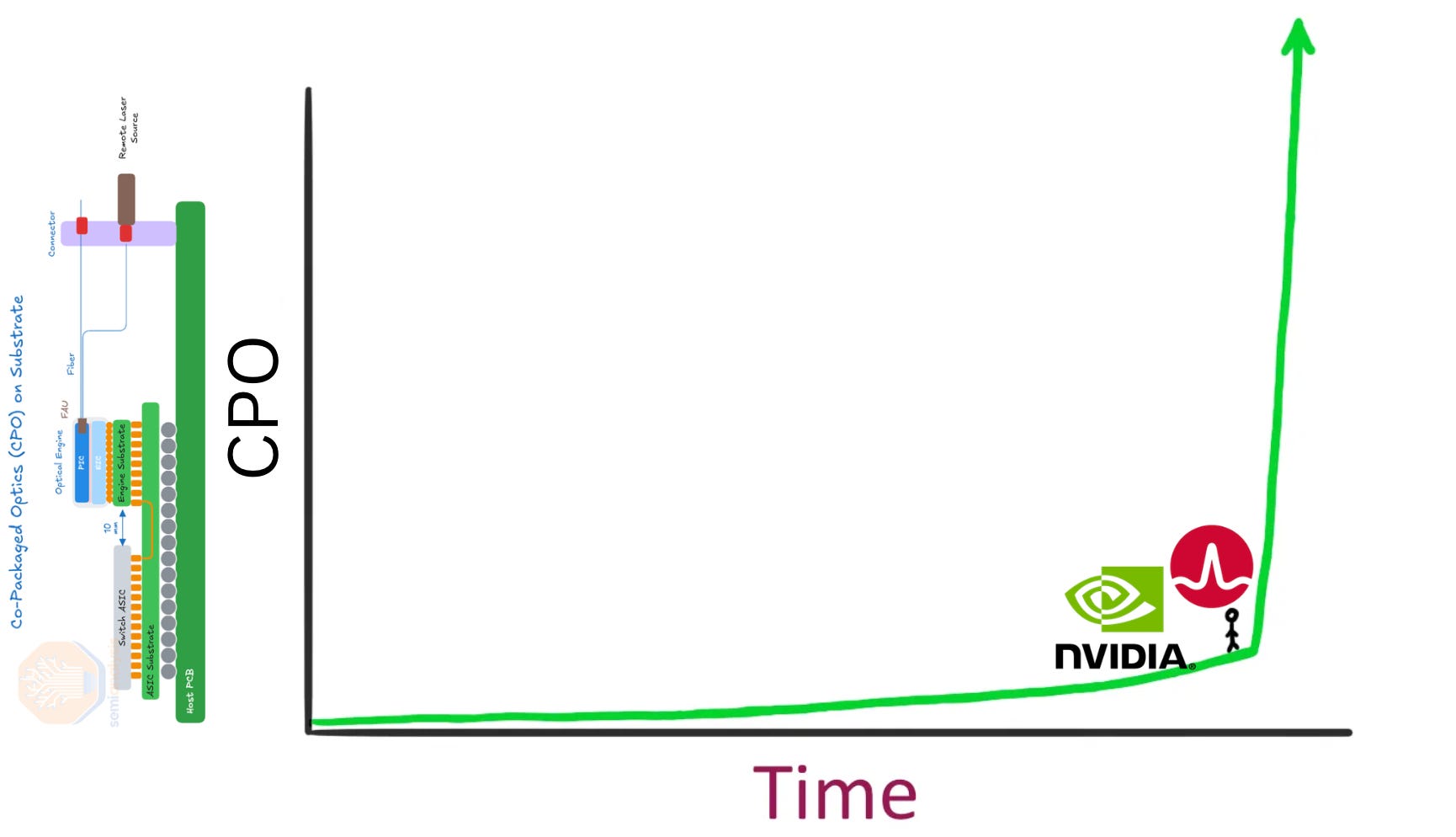
Please don’t tell us that we’re going to overbuild because we double the capacity of optical widgets.
There are two layers to this exponential.
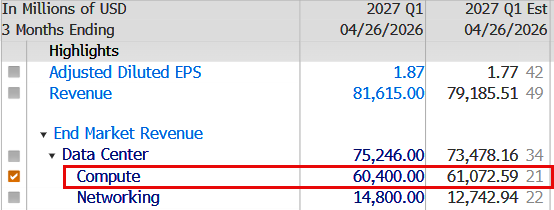
First, I think networking will grow as a share of the BOM over compute over the long run. You can see this specific value-add transition in NVIDIA’s earnings, as they missed on compute but massively beat in networking.
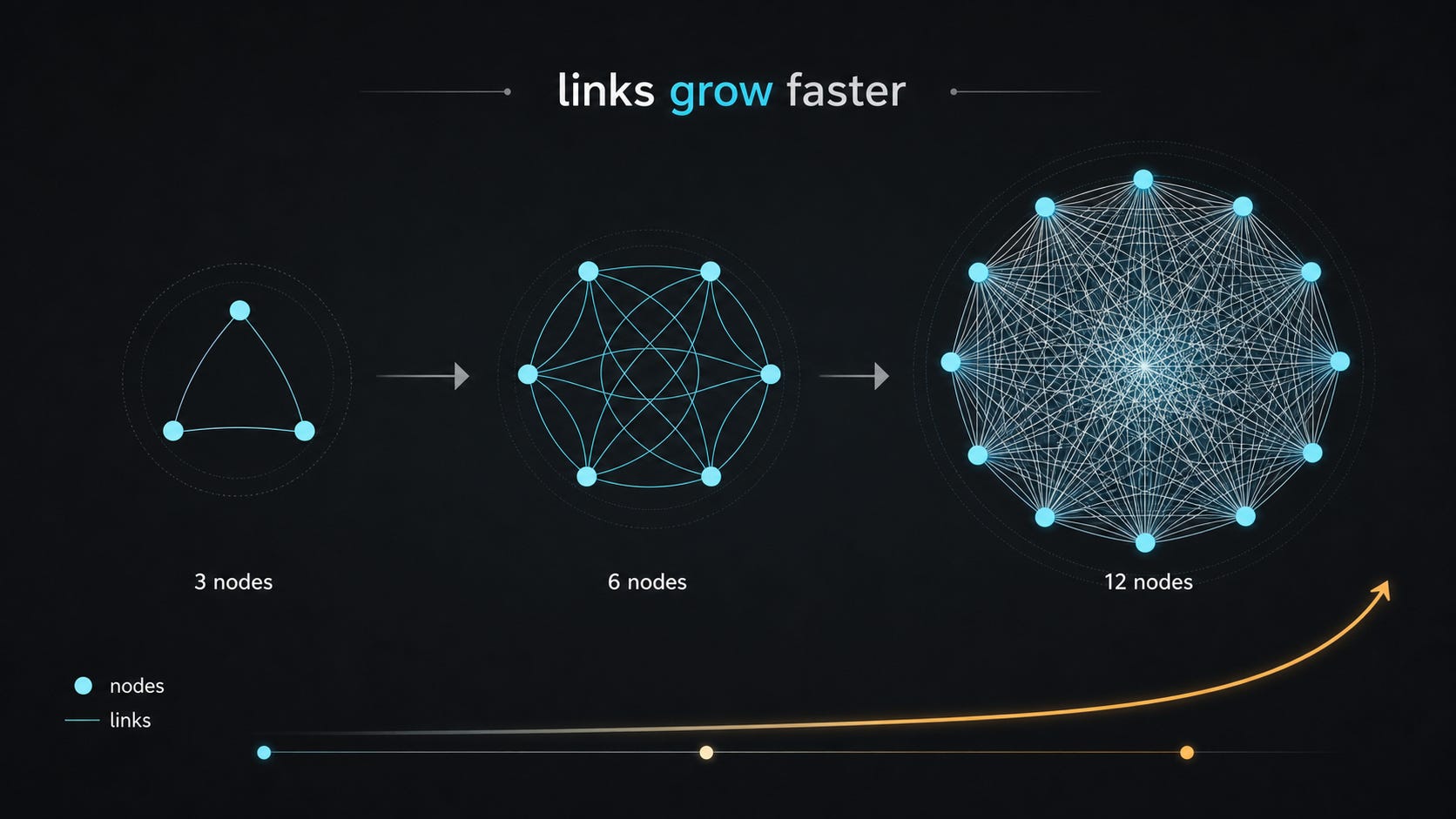
It’s a pretty simple concept, and I’m unsure why this isn’t talked about more in general. If we are hitting the limits of Moore’s Law and traditional dies can only be so big (sorry Cerebras), the only way that we get more powerful compute units is by linking them together. This means that the networking BOM is about proportional links:chips (inside a rack) or links:rack (inside a DC). And according to graph theory, the number of edges will always grow faster than the number of nodes.
The second layer to the exponential is the CPO copper replacement story itself. Within this layer, there are three more sub-layers. That is, we can split CPO adoption into three phases, each with half an order of magnitude more CPO content than the last.
Phase 0 is scale-out CPO. This actually doesn’t add any new optical content for the total market, but it does add CPO content for the CPO vendors. In Phase 0, transceivers that connect switches in the scale-out network are replaced with CPO. Though it’s a little bit confusing because the ramp happens first but happens the slowest. This does not mean that transceivers will all of a sudden disappear.
Phase one is inter-rack scale-up CPO. This is the art of taking multiple racks, which are usually their own scale-up domain (one coherent piece of compute to the software), and linking them together with optics to make an even larger scale-up domain. This is represented by NVIDIA’s NVL576 Oberon solution for their Vera Rubin platform.
Phase two is intra-rack scale-up CPO. In this final phase, we are ripping out all the copper SerDes and interconnects of a single rack and replacing it all with CPO. As you may imagine, this has by far the most CPO content out of any of the phases, but is also very far away.
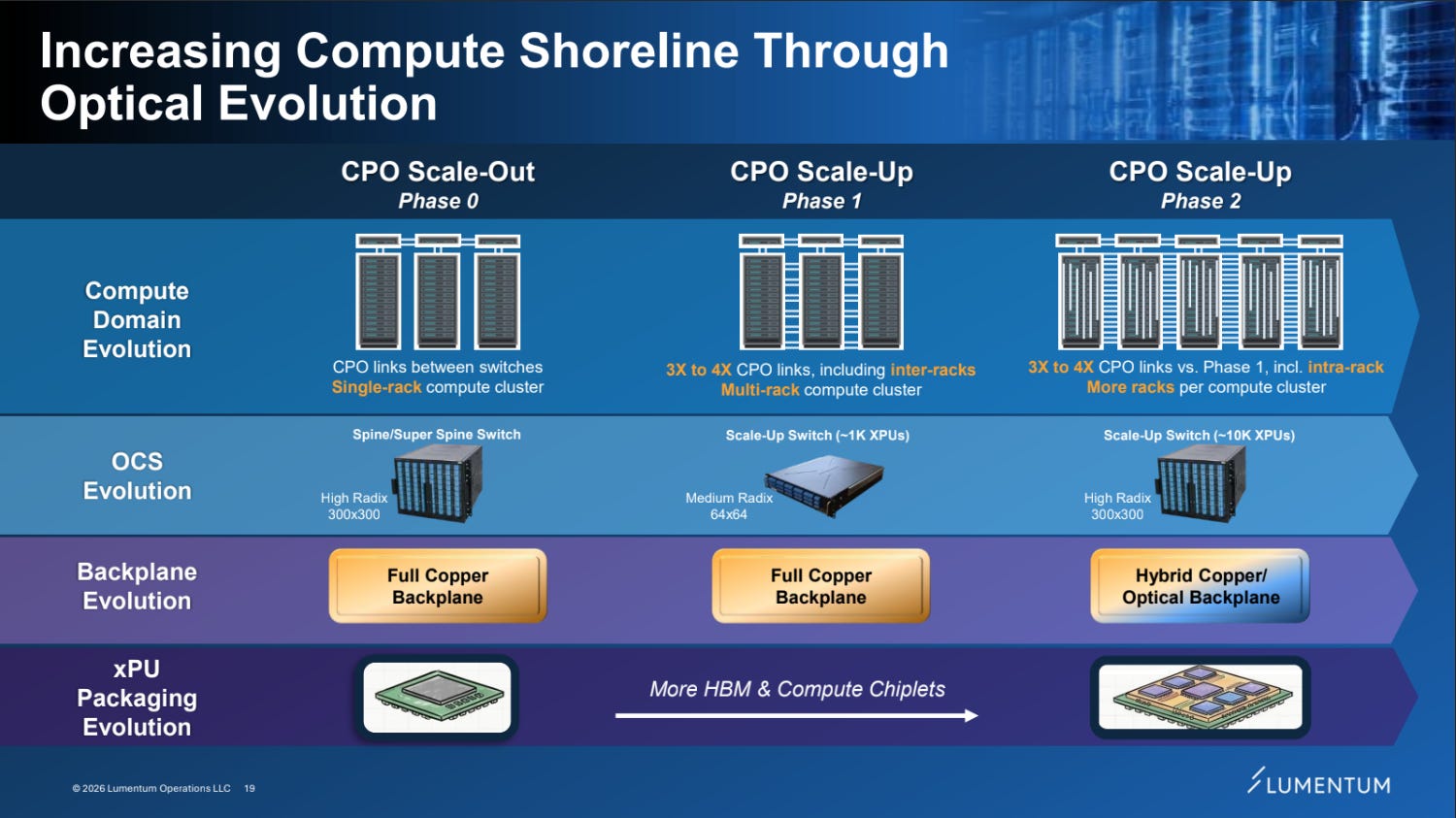
Lumentum has this slide at OFC which describes it. They are very excited, as you may imagine.
The timing is also important. CPO is not going to happen as soon as the most optimistic bulls think.
Volume shipments of phase one scale-up CPO will not occur until the Feynman generation. This is despite Rubin Ultra having the NVL576 Oberon 8-rack system, as this will ship in far less volume than regular Kyber NVL144 and Oberon NVL72.
But I’ve, of course, been a very vocal CPO bull. So where do I stand on this?
I think what is underrated about CPO is, instead, its inevitability and sheer VOLUME. People simply do not understand how much CPO will be needed once it actually does ramp.
Anyways, let’s talk about all of the widgets needed for CPO and the different widget makers in the CPO supply chain.
Contents
InP Substrate
Epitaxy
Laser
Optical Engine
Conclusion
AXTI
Aixtron
Lumentum
Coherent
Soitec
Tower Semi
My Ranking (and Positions)
SemiAnalysis Giveaway: The first person to subscribe using the paywall on this post will be selected to receive one free month of SemiAnalysis (sent to your email).
By accessing this content, you acknowledge and agree to our terms and conditions. This research is not financial advice.
InP Substrate
InP is the pure laser raw material. Indium + Phosphide is a III-V (named after periodic table columns) compound which has a direct band gap, meaning that it can emit light, unlike silicon.
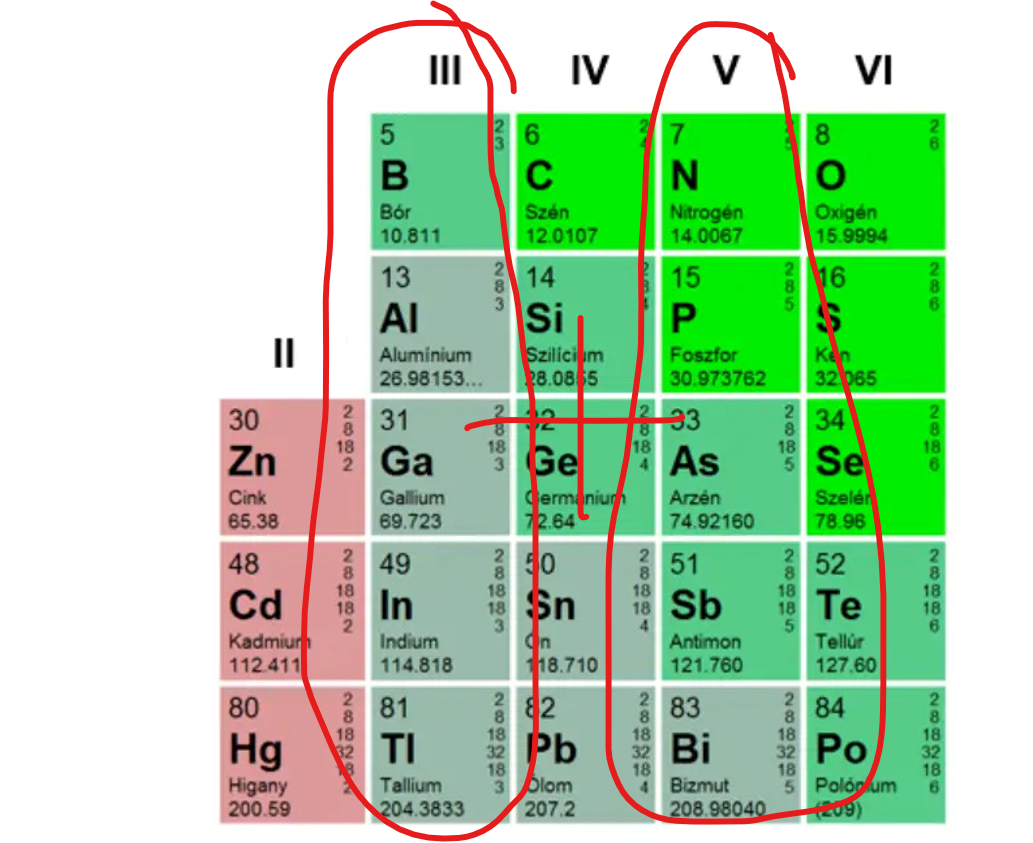
This chemical is very hard to make. You must refine high-purity indium (99.99999%) and phosphorus and then grow this compound into an ingot. It’s really hard to grow this stuff. This isn’t memory, where it’s a commodity. You gotta get qualified and develop proprietary processes (like AXT’s VGF).
InP substrates are the bottleneck to end all bottlenecks.
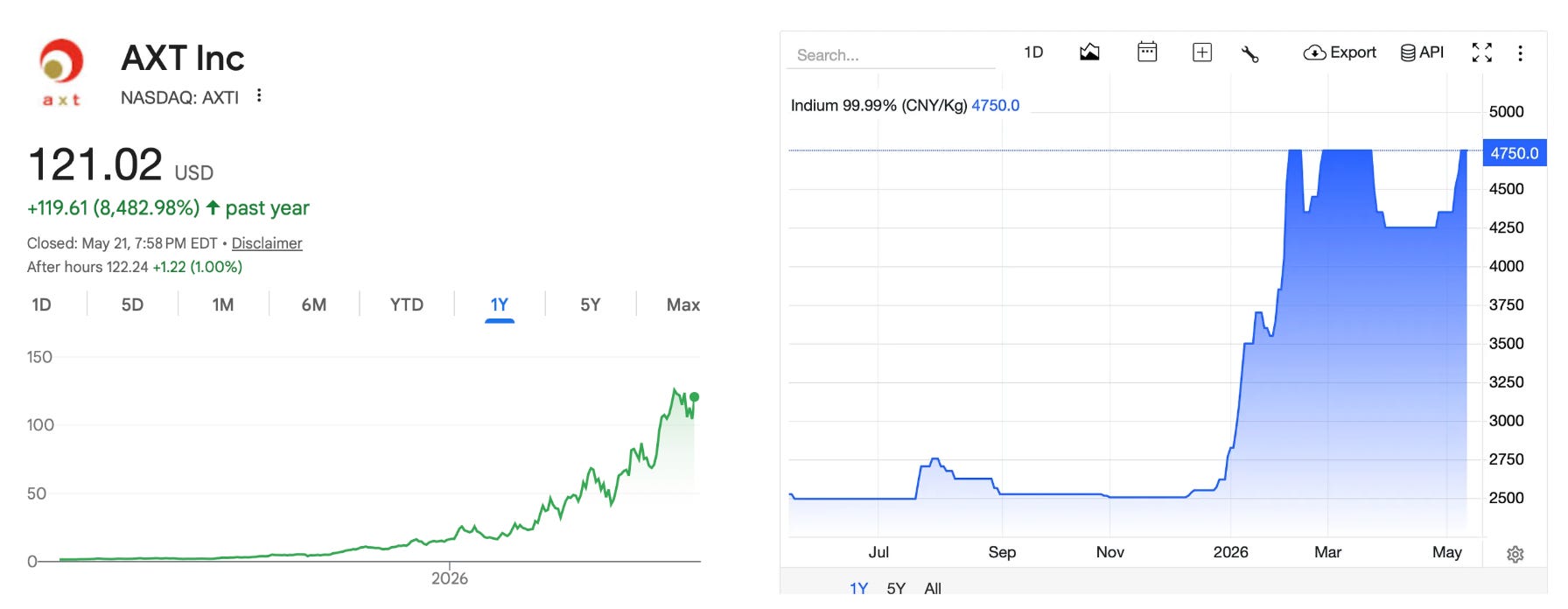

AXTI, the poster child, actually doesn’t have majority market share. They are only the second-place player with roughly 36% share, while Sumitomo Electric holds 42% share. However, I believe AXTI will soon become the largest player here, as they have the most expandable capacity due to their ability to convert gallium arsenide capacity into indium phosphide via brownfield switcheroo.
The relevance for CPO is simple: CPO lasers are high-power CW lasers that require a much larger cavity in order to be so powerful. This means the die area is much larger, and each laser a b s o r b s much more InP substrate. And then you get these lasers to grow exponentially across three phases, each with half an order of magnitude of content increase. Today, despite having no CPO ramping at all, indium phosphide is so constrained that Lumentum is 30% behind demand in just traditional EMLs. See the problem here?
The question for this market is how big the price hikes are going to be. AXT trades at something like 30x exit 2027 ARR, which is ridiculous by any traditional measures. The management team has obviously not announced any crazy memory price hikes, but we all know that eventually they are going to raise the prices. The market is obviously discounting for some level of price hiking, but we just don’t know how much it’s going to be. Bulls will say the ASPs are going to 10x. Bears say it’s only going to 2x.
Epitaxy
Epitaxy is the next layer. In order for indium phosphide substrates to be turned into real lasers, you have to perform a process of crystal growth called epitaxy to turn them into epiwafers first. It’s an intermediate stage.
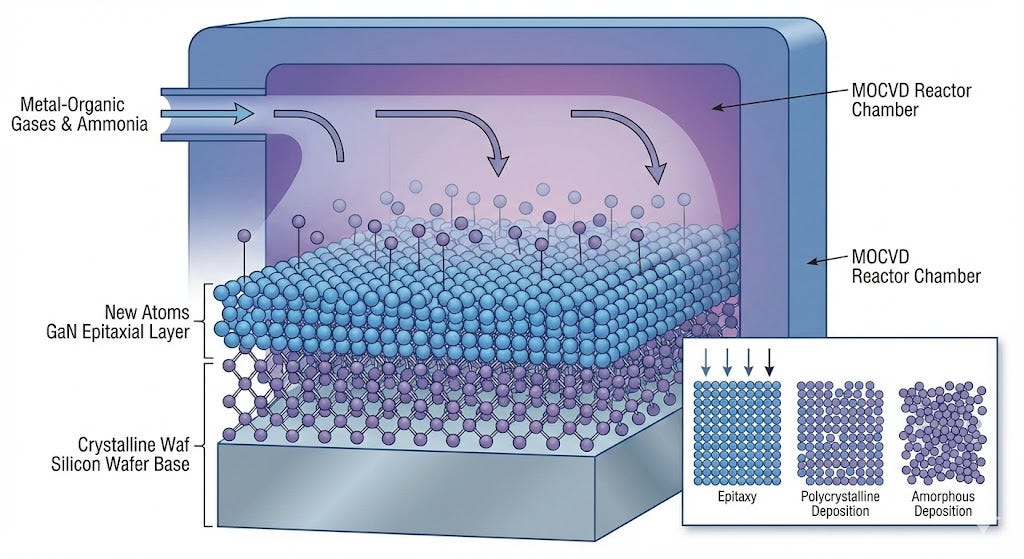
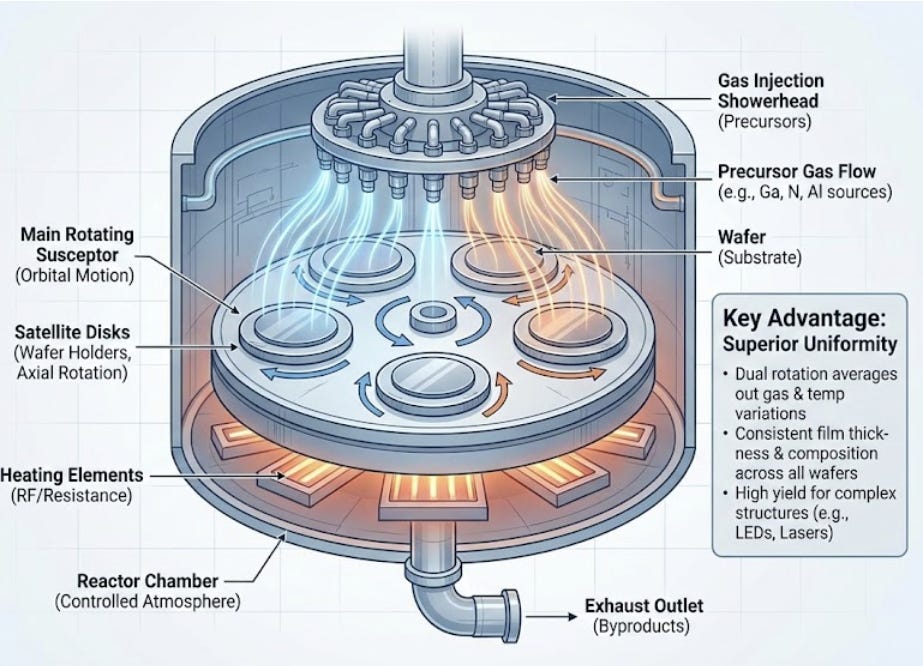
To do this, you use Aixtron’s MOCVD (metal organic chemical vapor deposition) tools. Aixtron has a proprietary process called the planetary reactor, which allows you to batch this activity. Because of this, Aixtron has a literal monopoly on this whole market. They claim “well north of 90% market share,” which is just a kind way of saying this. If you want Veeco tools, you have to throttle your throughput because you won’t have planetary reactor. Aixtron is a monopoly. You have no other choice.
Then there are the buyers of these tools and those who actually do the epitaxy-ing.
Lumentum and Coherent have this process vertically integrated, but for anyone who doesn’t, you can buy from IQE.
They are a pure-play epiwafer maker.
Laser
Once you grow the epiwafer, it goes through a more traditional compound semiconductor fab process with lithography and etch to get turned into the final laser. This is purely the domain of laser manufacturers like Lumentum and Coherent.
Since we’re only looking at the indium phosphide supply chain today, which is the vast, vast majority of CPO anyways, we are only going to consider DFB lasers and not VCSELs.
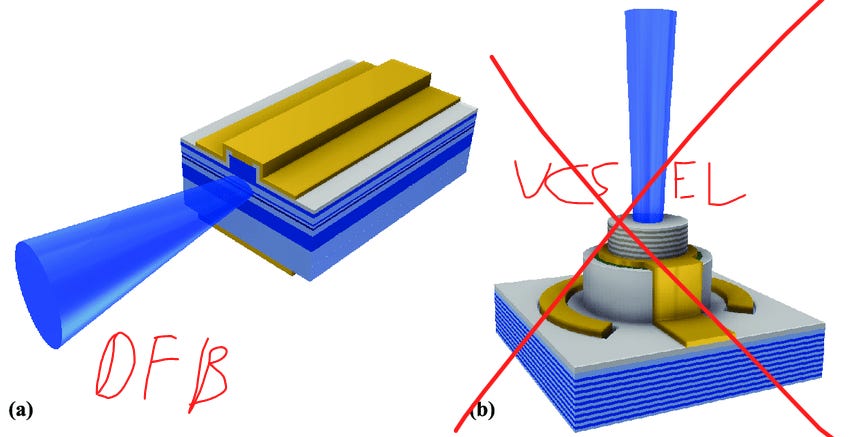
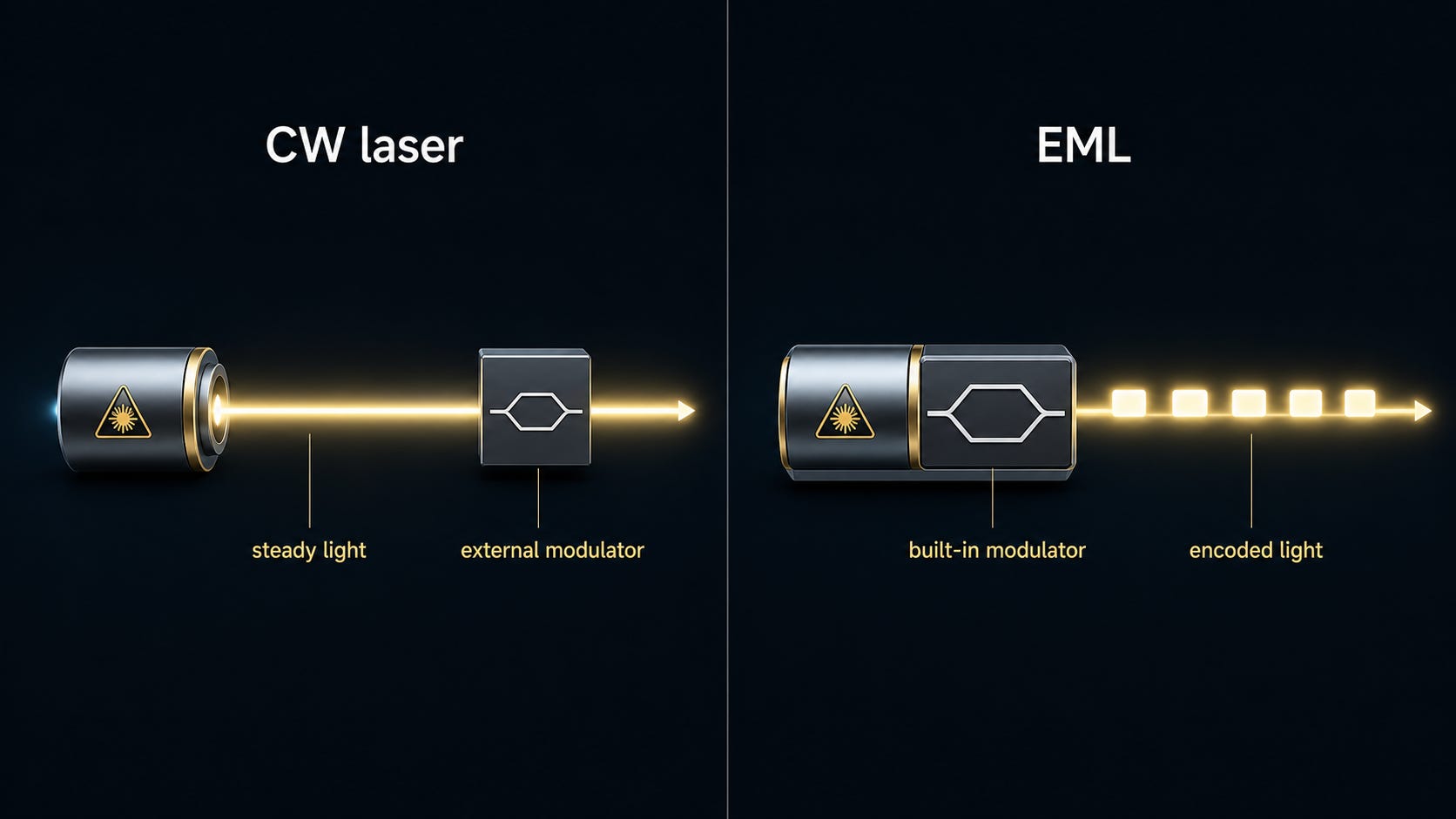
CPO lasers are high-power continuous wave lasers. This means that they have two important characteristics:
Being continuous wave (rather than EML)
Being high-power (rather than low-power)
CW lasers are lasers that just stay on. It produces a continuous stream of light, like a light bulb or flashlight. A CW laser can provide a steady beam that gets modulated (gets the signal put into it) somewhere else.
EMLs are lasers plus a built-in light switch. EML stands for electro-absorption modulated laser. The laser creates the light, and an attached modulator rapidly changes that light on/off or high/low to encode data.
Lasers for CPO must also be placed far away from the optical engine because CPO literally stands for co-packaged optics, which means the optics are co-packaged with the chip and the chip is really hot, so if the laser is right next to the chip, it overheats and breaks and stuff.
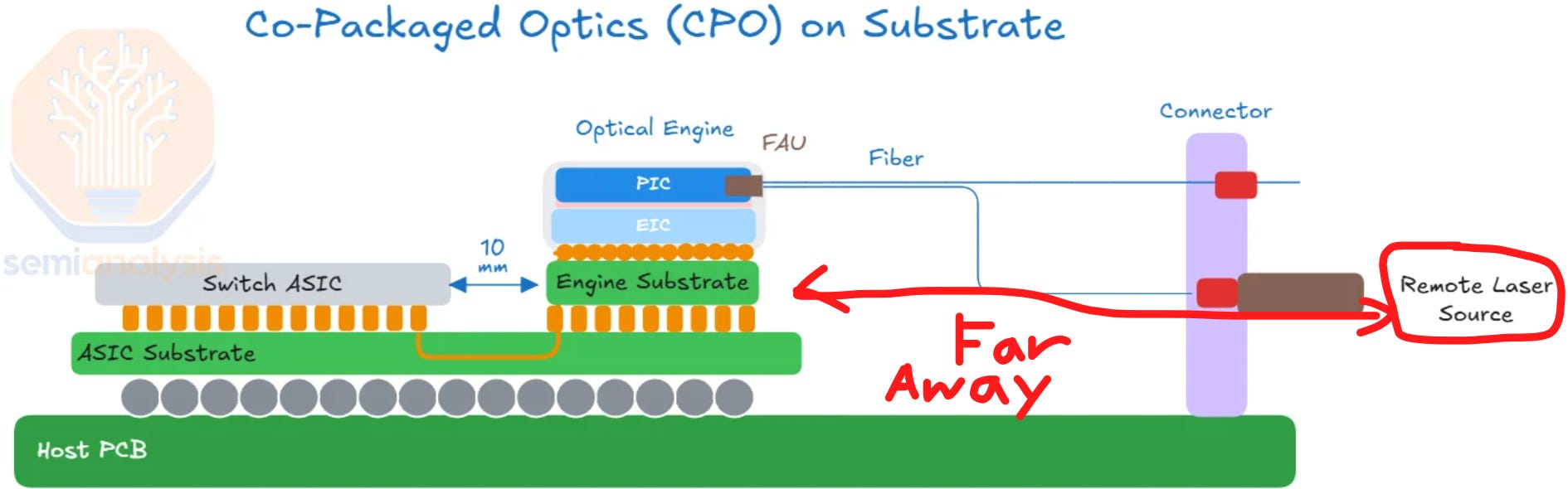
Because this laser is so far away, in order for the light to reach the optical engine, it needs to survive a lot of coupling loss. Thus, the starting power of the light must be very high. For CPO, this means generally in the range of 400 mW rather than 30 to 70 mW of traditional CW lasers for SiPho transceivers.
The higher the laser power, the harder it is to make. These lasers must meet critical thresholds on two noise specs: linewidth and RIN. This is essentially the purity of the light. I won’t go into much more detail on noise specs, but if you’re interested, I talk more about them in this article.

High-power CW lasers are currently a market almost completely dominated by Lumentum.
Optical Engine
CPO lasers are CW, which means that in order to actually use it to communicate signal and not just be a flashlight, you need external silicon photonics components to do something with the light.
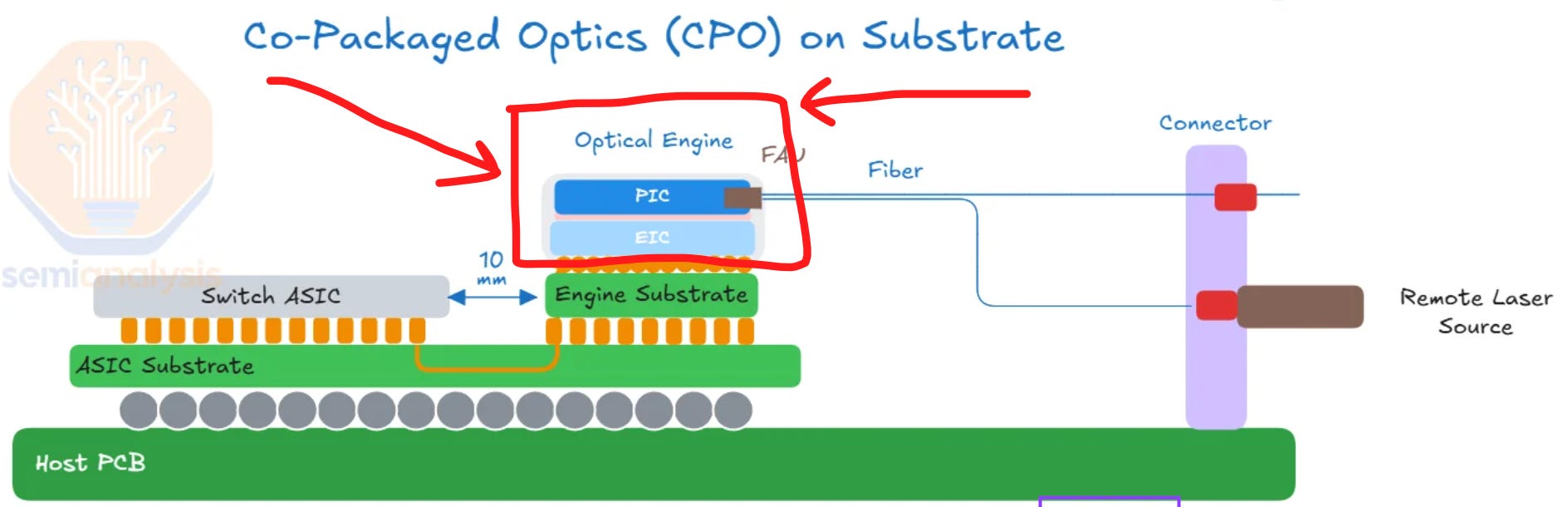
The optical engine is what you can see in the above diagram of the CPO. It is made up of a photonic integrated circuit, or a PIC, and an electrical integrated circuit, or an EIC, hybrid-bonded together (using something like TSMC’s COUPE). The EIC is your standard logic chip. The PIC is a SiPho chip. It is the SiPho PIC which actually modifies and modulates the light, but both of them come in a package whenever we are thinking of CPO. Here is an article if you want to go deeper into SiPho.
There are three layers to making an optical engine:
Making the SOI wafer
Fabbing the PIC in a foundry
Hybrid bonding the PIC to an EIC
SOI stands for silicon on insulator. It’s basically a silicon sandwich and needed to contain the light waves as they travel through the waveguides.
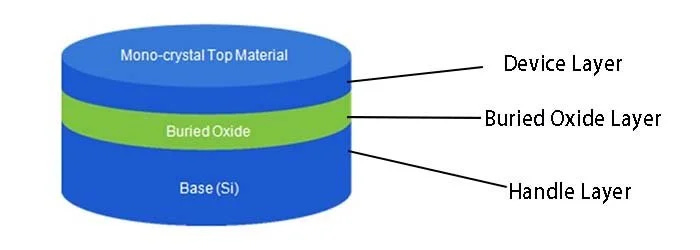
Soitec is a monopoly here. They control the majority of the IP needed to make these wafers, which they call Smart Cut. Just like with indium phosphide, this is a very difficult process.
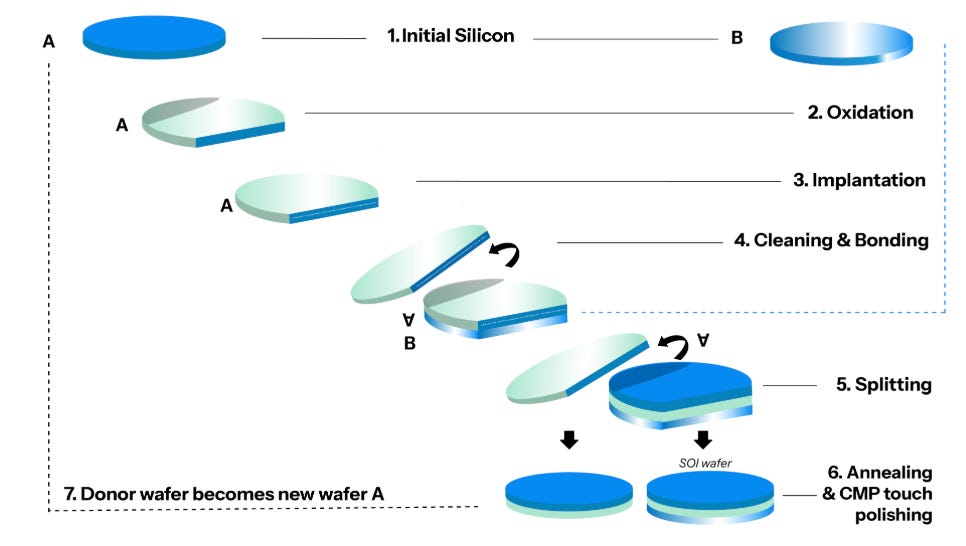
I cover this topic a lot more deeply in this article.
Tower Semi is the leading silicon photonics foundry.

Soitec provides the starting wafers that go through Tower Semi’s specialty foundry manufacturing process to become a fully fledged PIC.
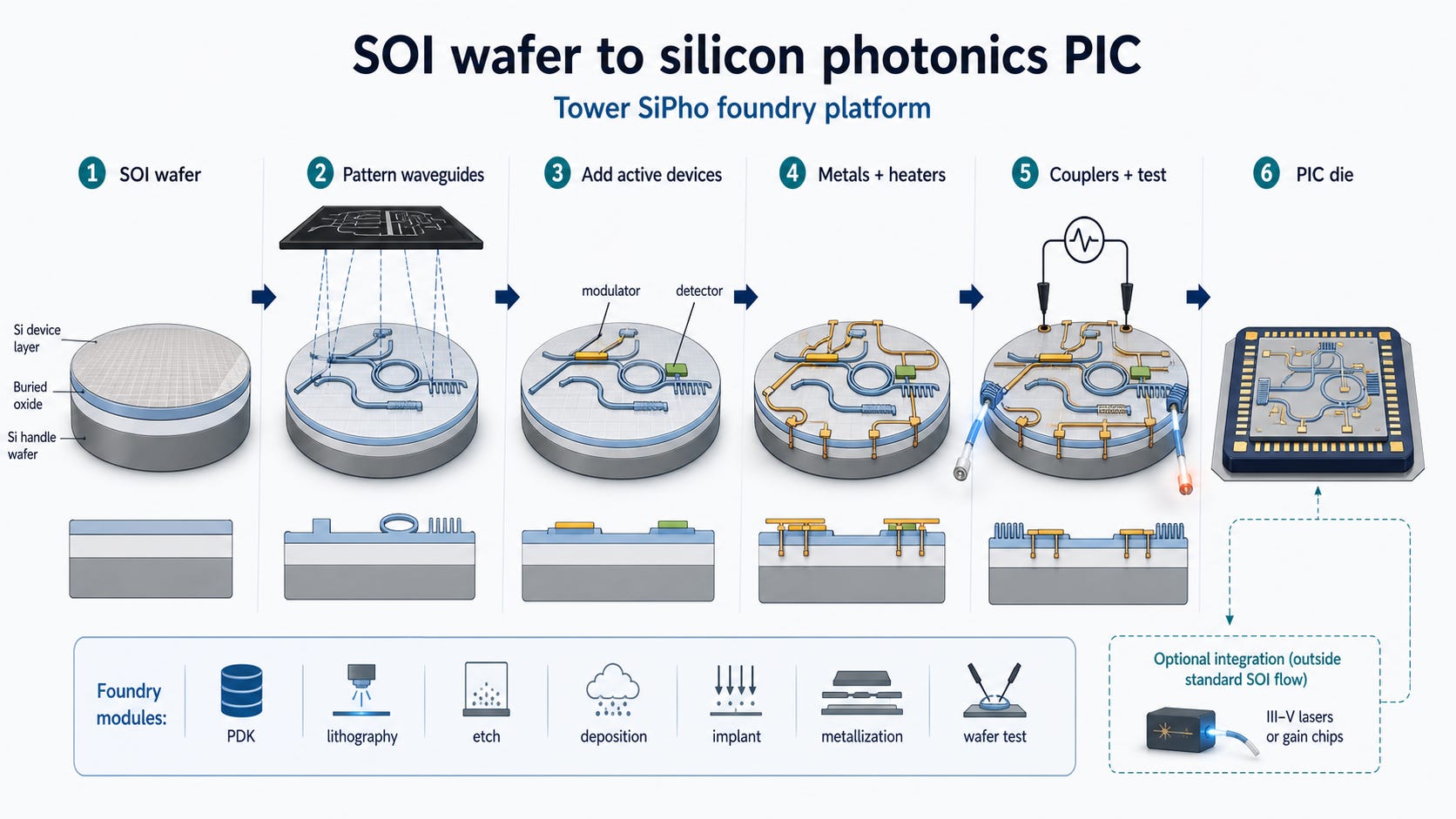
They are the best at it. Globalfoundries and TSMC also play in this market, but Tower CEO has specifically flagged and quoted that they have by far the highest market share.
When Krish Sankar of TD Cowen asked Russell about market share, Russell said:
“There’s other people that claim very high market shares. I don’t see how it’s possible at all.”
LOL
Finally, the PIC and the EIC need to be hybrid-bonded to form an optical engine, and the leading platform here is TSMC’s COUPE. TSMC did something really smart here, which is that they require that the PIC is fabricated at TSMC in order to use their COUPE packaging. Now their customers have to choose between the superior PIC manufacturing of Tower Semi and the superior EIC and packaging capabilities of TSMC.
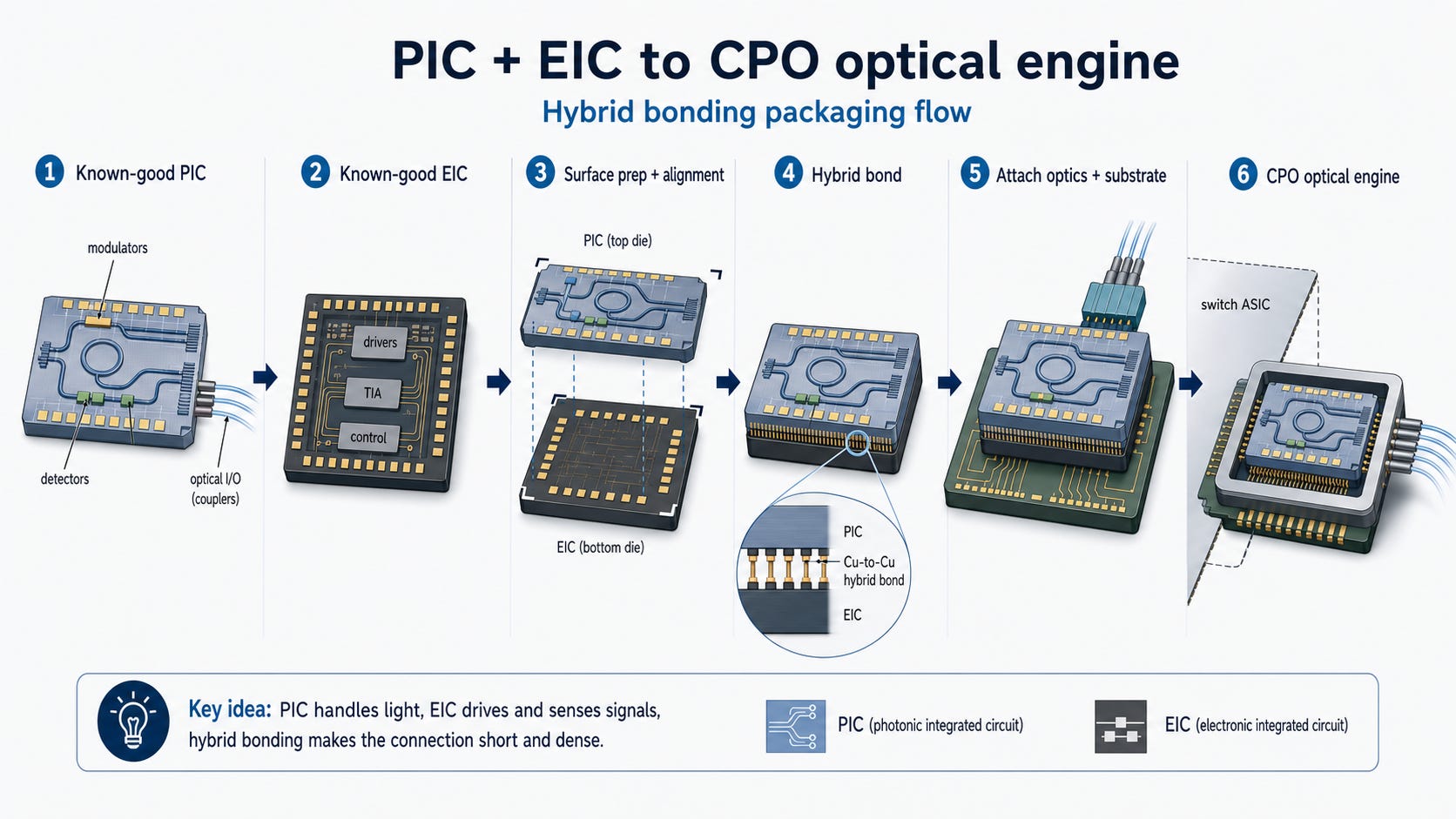
Currently, it is COUPE that has won NVIDIA CPO ramp.
Conclusion
The big takeaway you should have here is that every step in the CPO supply chain (especially the raw materials) is physical and linear. Nothing here is built to handle exponential demand. Everyone has capacity limitations.
However, refining indium phosphide substrates, building MOCVD machines, growing epiwafers, manufacturing lasers, and fabbing PICs all have different capacity dynamics: different speeds of adding shipment volume, different capital intensity, and different substitutability. It is by understanding these dynamics through a lens of perpetual supply constraints and exponential demand, you can identify which companies stand to benefit.
Below I will give my opinions on AXTI, Aixtron, Lumentum, Coherent, Soitec, and Tower Semi, give you revenue builds/EPS estimates for all of them (making the same assumptions about the total industry-wide unit shipments), and share my personal ranking based on my opinion and the positions I have.
Yes, you heard that right. That’s six models!
I also call out why AXTI could still have the most upside, how I modeled the bombshell Aixtron dropped on their last earnings call, why Coherent management speak makes me believe they are uncompetitive, and a very interesting (!!!) component ratio dynamic between Soitec/optical engines and Lumentum/ELS.
AXTI
This is NOT my model. It was simply shared on X. If you are the original creator of this, please let me know and I will credit you.
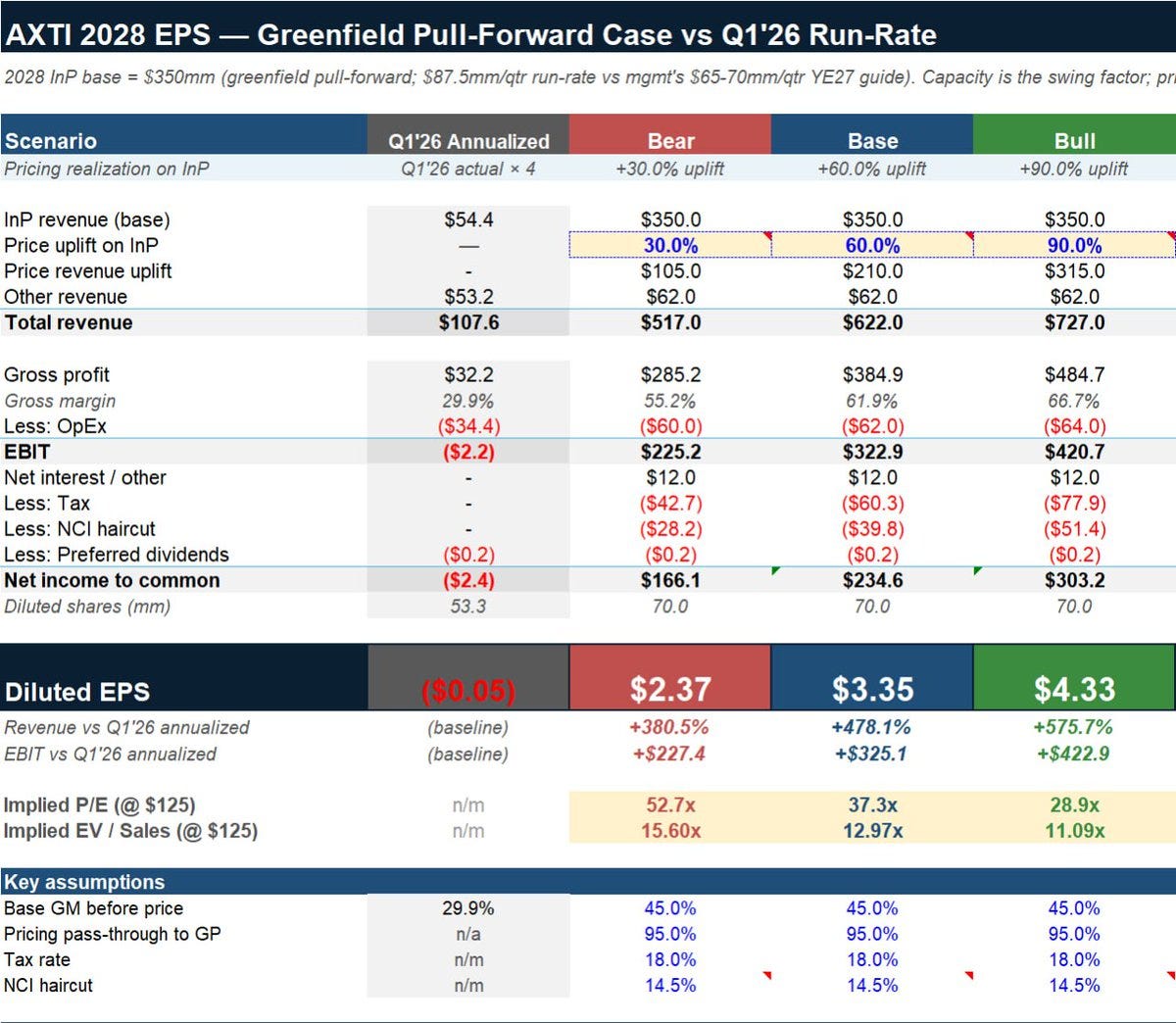
Anyways, as we can see, the market obviously assumes significant ASP uplift, but we all know they’re going to hike prices. The only question is how much. It’s always been correct to be bullish on everything AI infra related, so we probably use the bull case here, and in this case, with a 90% ASP uplift, AXTI trades at 29x 2028 EPS.
This is a bit rich for me, just because if this scenario can fully play out while the stock stays completely flat for the next two years, there’s a very, very probable chance that we get a much higher ASP uplift as well. AXTI could really work as a stock. I’m probably more bullish than bearish, however, I have no idea how to estimate the ASP hikes that are included that will occur, and doing so would take me dozens of hours of research, which I’m not going to do now.
I’m a big fan of parabolic charts. However, I like to stay around the 10x parabolic chart range rather than aping into an 80x like AXTI is. I could easily see this changing if I see different evidence. CPO is really going to make the indium phosphide shortage go apeshit, as it’s literally an exponential market coming into an already backed-up, supply-constrained industry.
Aixtron
Aixtron dropped a bombshell on their last earnings call.
“80-100 tools is a good approximation of Opto tools needed every year.”
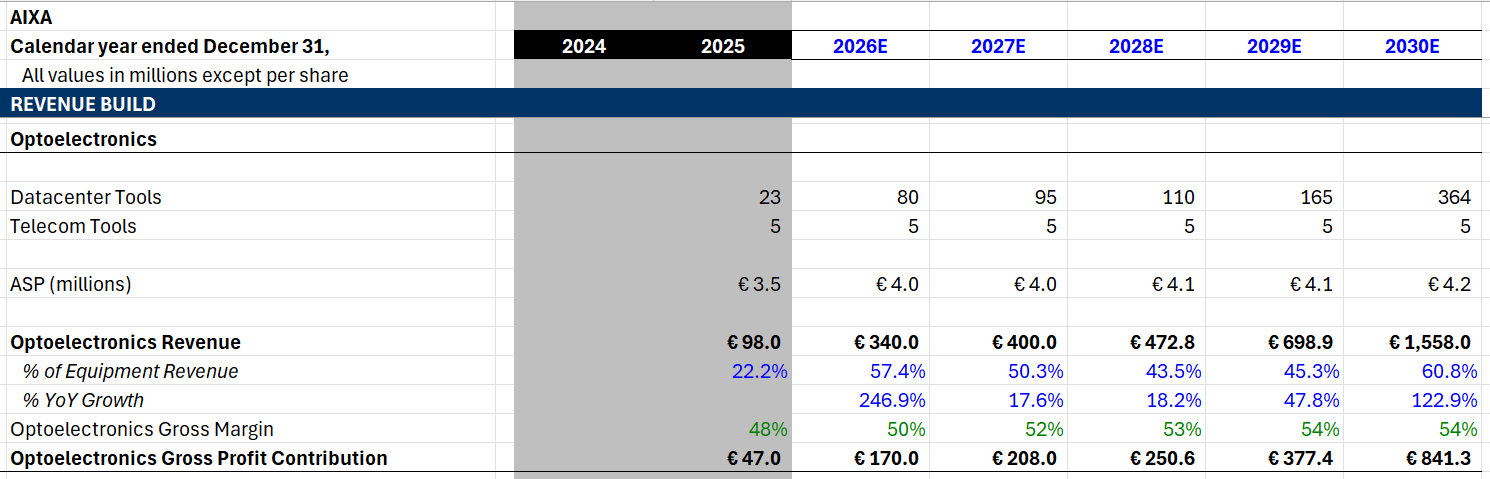
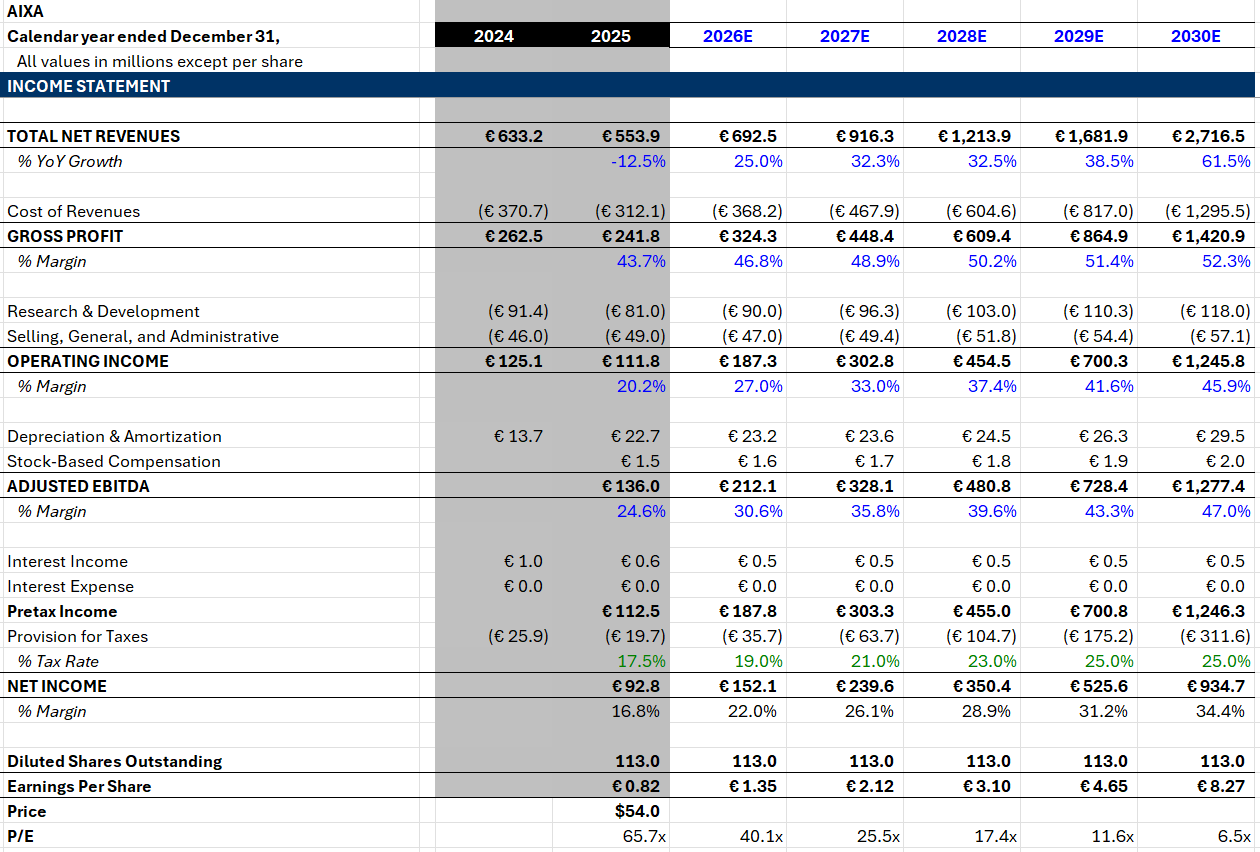
Based on the call comments, they trade out a cool 17x 2028 EPS multiple.
I haven’t released my opto tool intensity model yet, but this upward revision is hyper bullish, as it basically communicates that epi intensity for non-cpo lasers is a lot higher than we thought. When CPO lasers start ramping, which have a much larger die area, the intensity will be even crazier. As you can see, that is why my out-year tool shipments grow so fast.
Lumentum
Lumentum is the star of the CPO show and the center of the CPO universe as they make the highest ASP component of the CPO, the UHP CW lasers that take up nearly 50% of the ELS module BOM.
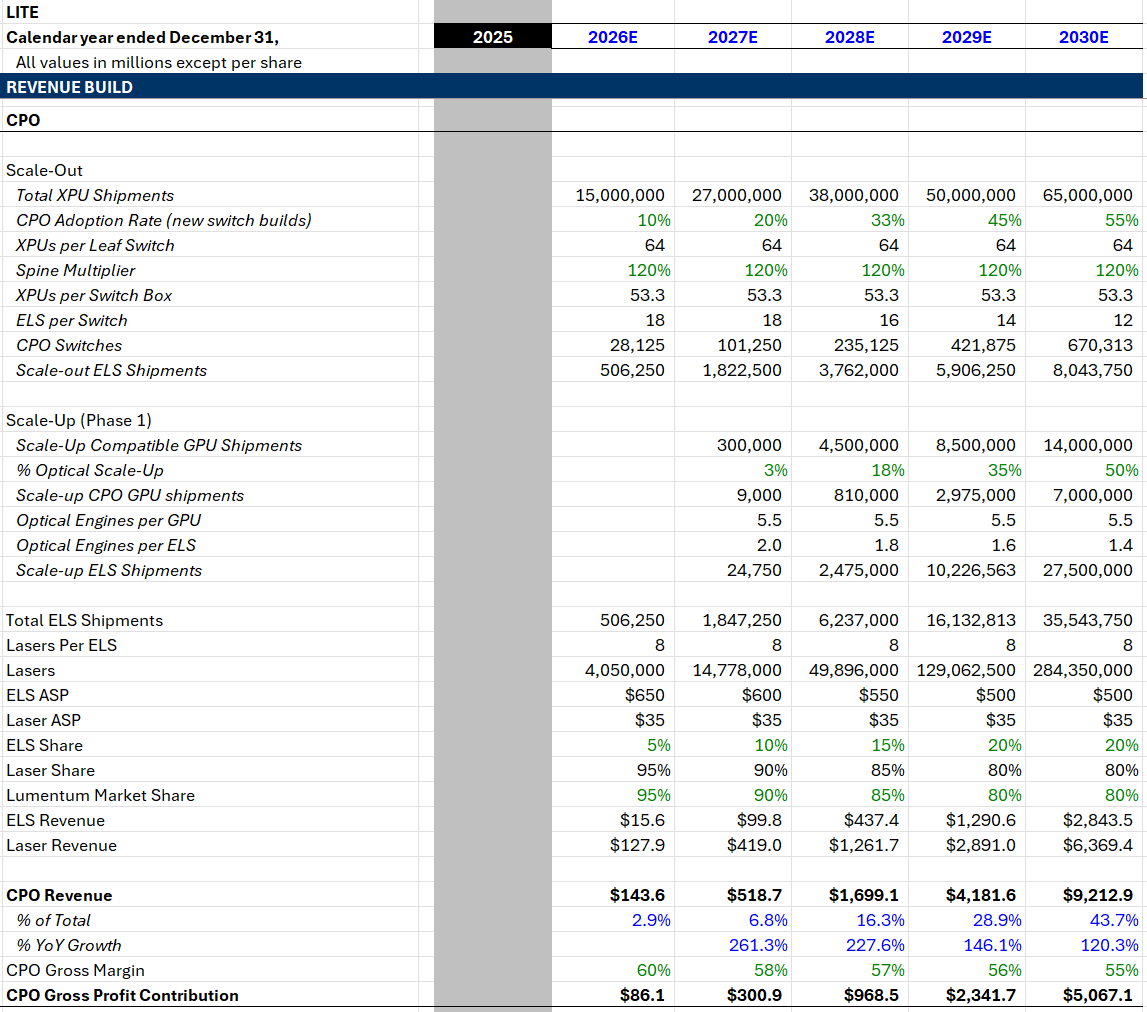
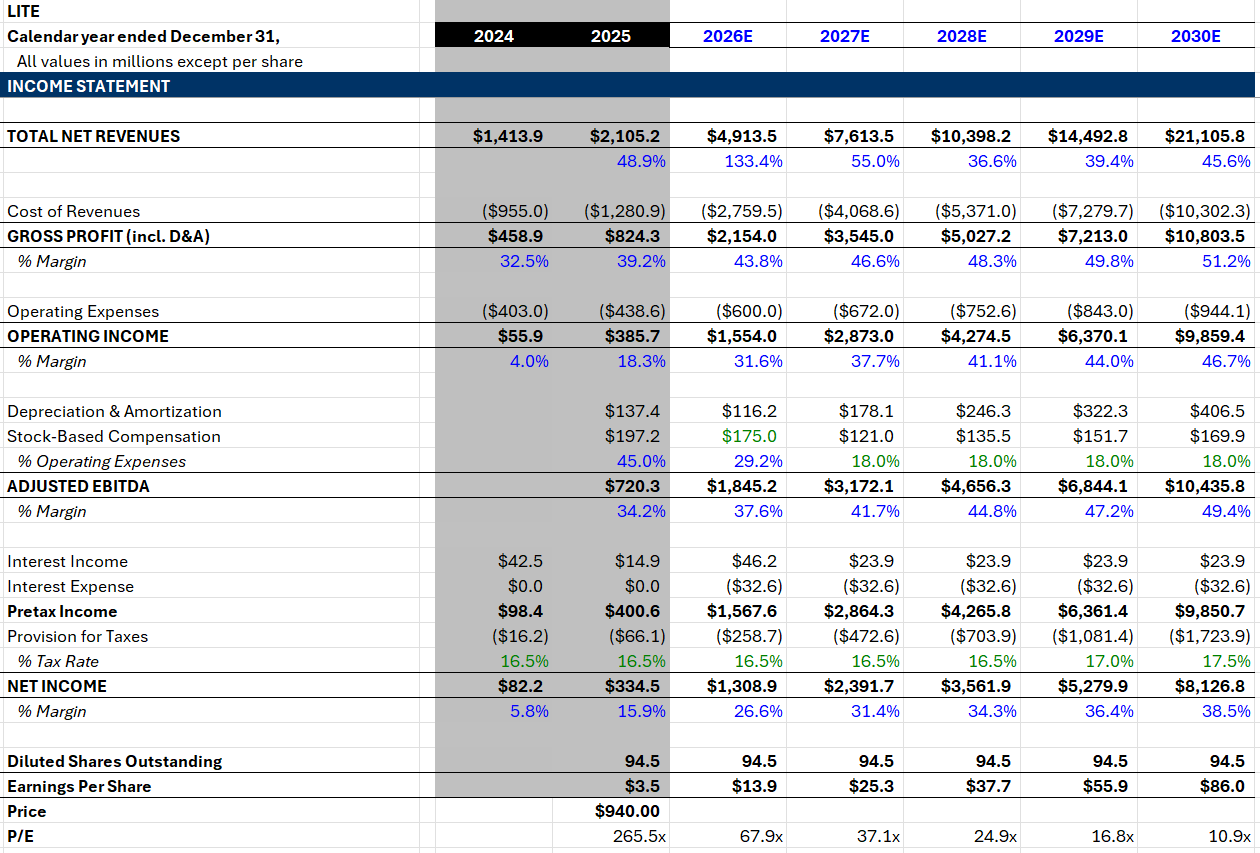
Besides CPO, their earnings are also driven by four other optical business lines:
transceivers
EML lasers
OCS
scale across
All of which are growing like gangbusters, especially OCS and scale across. I have my full Lumentum model in this earnings review, which you have access to.
Also I am low-balling Lumentum pretty hard here. My estimates are pretty much in line with the sell-side, and every business line I think will be revised upwards soon. Here’s just one example:

Lumentum could be making 80% gross margins on their CPO lasers. Irrational Analysis thinks this can be highest 87%. This is a nearly 8x markup! In my model, I’ve assumed 60%. This also means that the ASP probably pushes $50-100, while I’ve only assumed $35. This is around what consensus thinks, so yeah, revisions. But until the guide comes, I won’t move my numbers up just yet.
Even with this much low-balling, they trade at a very reasonable 25x multiple on 2028 numbers.
Coherent
Coherent is the sheer transceiver and laser capacity play. If 6-inch works (and doesn’t only yield photodiodes lol), then everything that they say about capacity math becomes true.
What did they say about capacity math? Well, 6-inch wafers have four times the number of dies at half the cost.
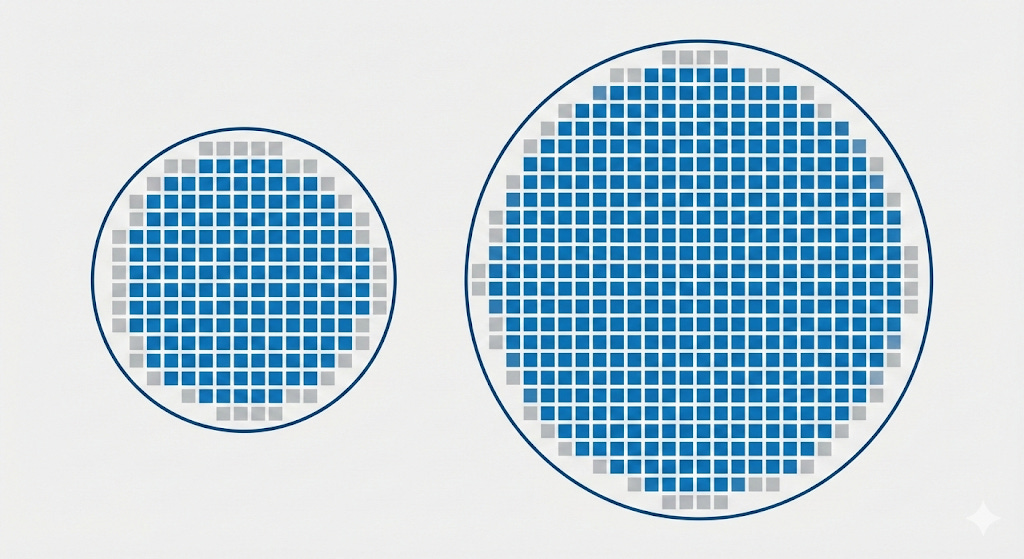
Problem is, people have a lot of critiques about 6-inch wafer uniformity, basically meaning that these larger wafers are a lot harder to make uniform across the entire circle. They tend to be a lot more brittle and harder to handle.
There is probably a reason why Lumentum and AXTI generally focus on 3- and 4-inch wafers instead, and Coherent isn’t putting much counter evidence to this. Their gross margins are still not above 40%, while Lumentum’s have exceeded that long ago. In their earnings calls, they talk a lot about gross margin uplift, but it’s funny because they talk as if their gross margins have gone up 20 percentage points, but in reality it’s something like 170 basis points.
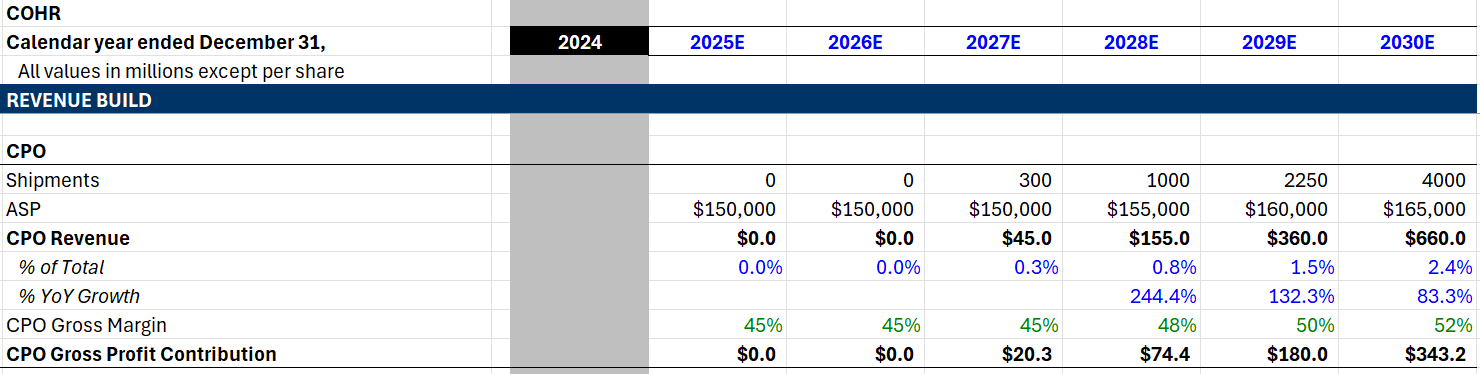
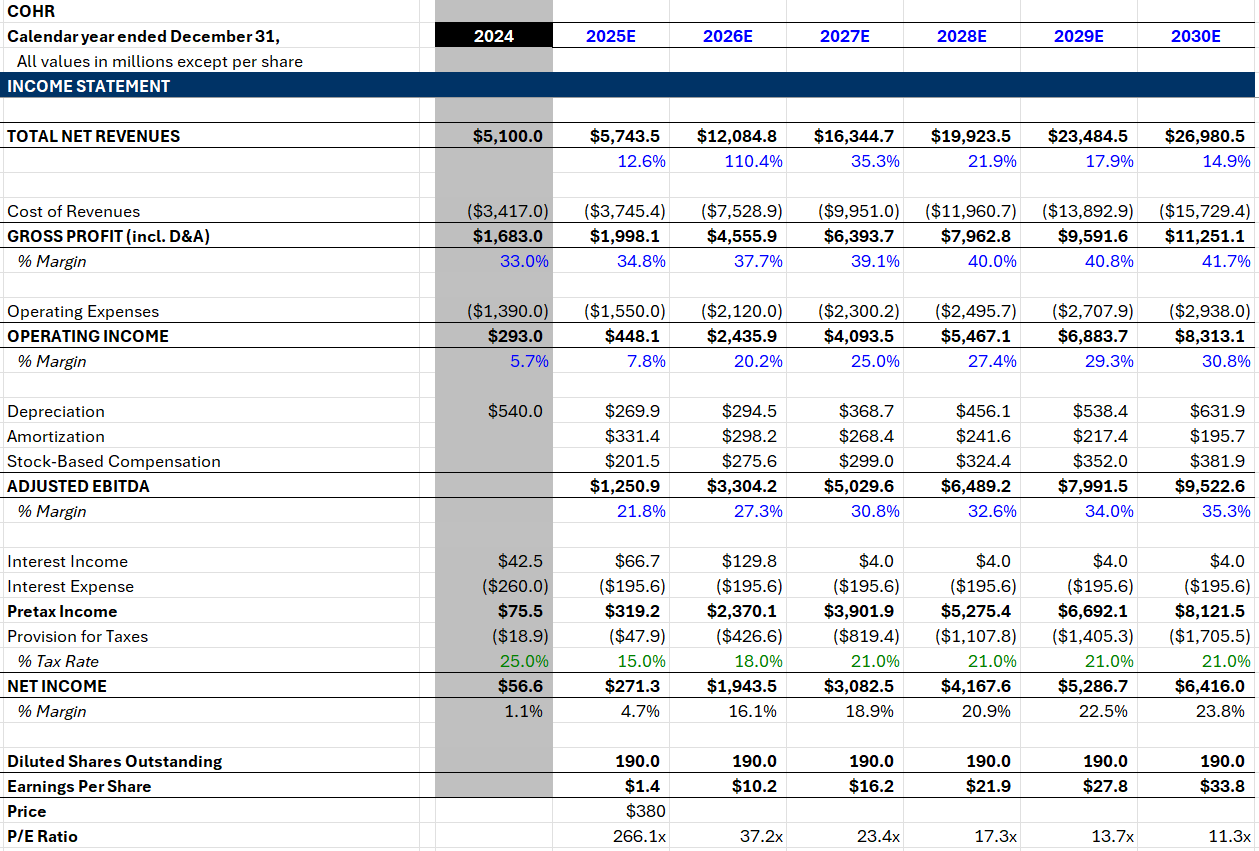
Yes, I really don’t think coherent will get much volume from CPO at all. They aren’t much of a CPO play. Most of their revenue comes from vertically integrated transceivers.
On earnings calls, management loves to talk about TAM, telling investors that they have a massive $15 billion addressable market rather than giving revenue forecasts and purchase order sizes. It is quite clear that they are uncompetitive and unable to capture much of the market.
Again, high-power lasers must have very competitive noise specs, which are really hard to achieve. That is why Lumentum has majority market share.
Soitec
My original thesis has played out almost perfectly.
The Soitec Series | Part 1: Introduction to the French Photonics Substrate Monopoly

Opinions are my own and do not represent past, present, and/or future employers. All content is based on public information and independent research. This newsletter is not financial advice, and readers should always do their own research before investing in any security. I am invested in the semiconductor industry. As of the date of this publication, I…
We already know why we invest in optics. Transceiver demand is off the charts, CPO begins replacing copper in just a few years, and we are headed to an endgame where every chip communicates through light.
But what is the best name to play this theme? I believe it is Soitec, a French manufacturer of Silicon-on-Insulator (SOI) substrates required for silicon photonics applications.
Soitec benefits from the three largest demand inflections in optics with ramps perfectly staggered sequentially to create one decade-long unrelenting growth runway, a characteristic shared by no other public company.
2026-2027: The near term ramp of SiPho 1.6T transceivers.
2027-2029: The medium term ramp of scale-out and switch tray level scale-up CPO.
2029+: The long term adoption of GPU-to-GPU optical I/O.
It is also a near monopoly with no other competitor manufacturing SOI substrates specifically for photonics at scale.
Meanwhile, its valuation is compressed because of underperformance in its large legacy segment. Millions of wafers are stuffing the mobile market’s inventory channels in a classic cyclical trough. We are at the rare inflection point where photonics revenue is becoming meaningful enough to impact the financials while the market still sees Soitec as a legacy RF mobile company.
Management confirmed photonics revenues will be €100m in the fiscal year ending March 2026. In just 2 years as 1.6T and CPO ramps, I project this number surpassing €400m, with high contribution margins as no extra fab builds are needed thanks to fungible capacity.
With a current enterprise value of only €1.6b, Soitec represents the cheapest yet highest quality exposure to the optical interconnect supercycle.
Something that is underrated here is that the capacity between legacy RF-SOI and photonics SOI is mostly fungible, creating a similar capacity dynamic AXTI enjoys. There doesn’t need to be much incremental capex to expand capacity.
Soitec has incredible business characteristics but is the most expensive of the bunch (although I think it should probably be valued on EV/EBITDA, unlike the others on P/E).
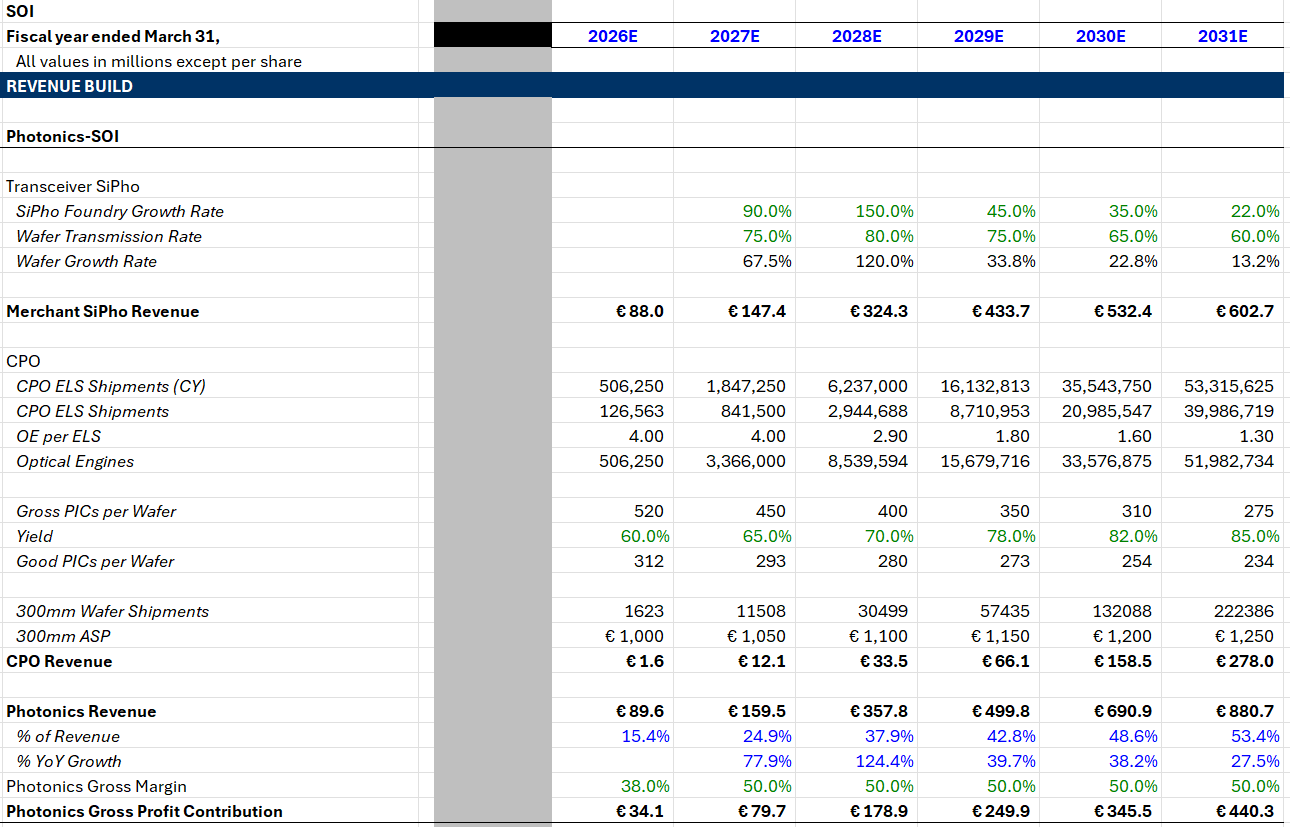
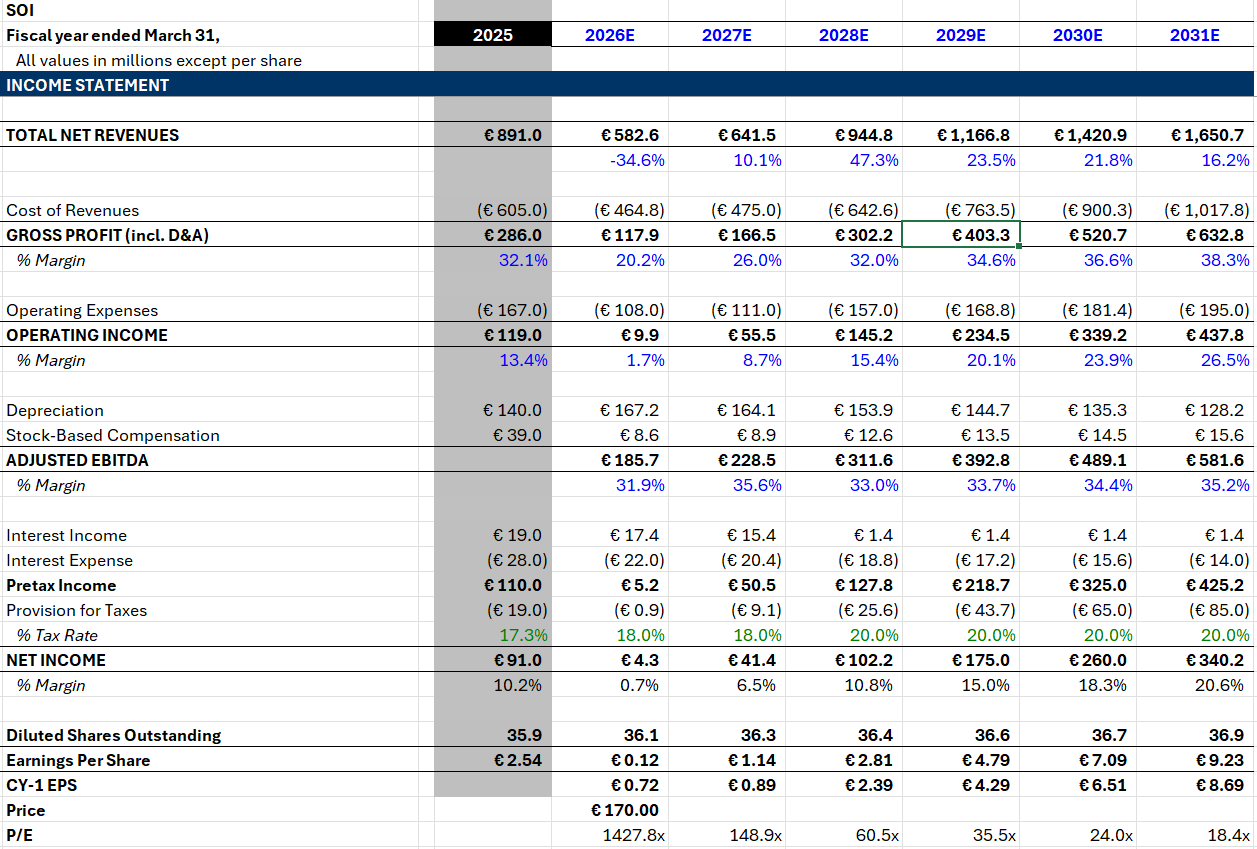
There is an interesting dynamic in the revenue build that I’d like to call out. Soitec’s CPO revenue is based on optical engines. Over time, optical engines per ELS shrink as data rates increase because the light requirements grow. This is offset by the size of the PIC growing, which enables more wafers to be sold as you can fit more PICs per wafer.
But it is less attractive than Lumentum, which turns that tailwind into a headwind as the ELS to optical engine ratio rises.
I do want to get a small position back into this one, but the problem is, unlike with Lumentum, I’m much less certain about the unit economics of their participation in CPO. Based on the wafer ASP that they’ve told me and publicly, scrapable PIC areas and stuff, it doesn’t seem to be as strong in terms of CPO content per dollar market cap. However, this can easily surprise me as well, just like with AXTI, just need to wait for their earnings results.
Tower Semi
Tower has unfortunately gotten quite expensive, but they’ve also been a revision machine.
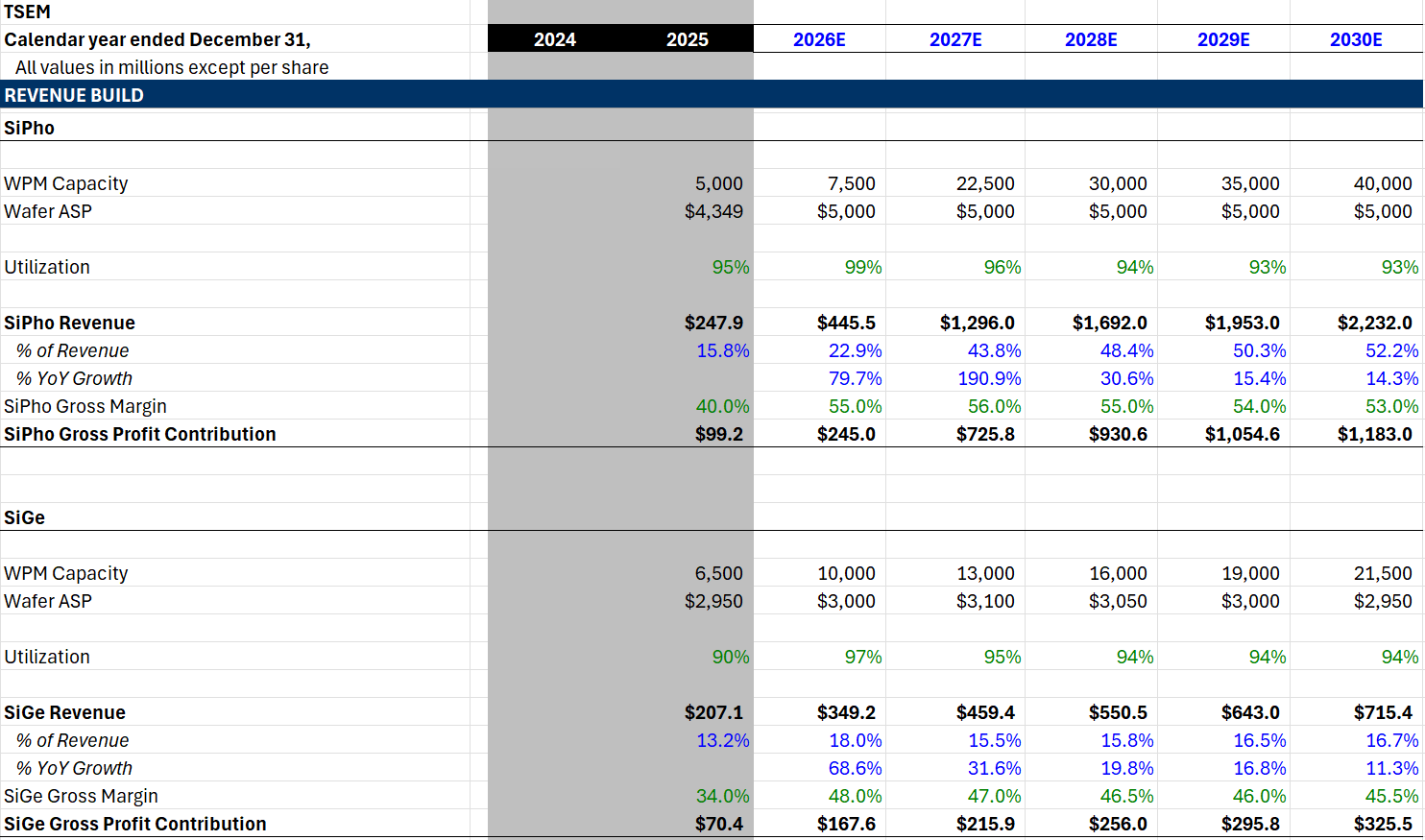
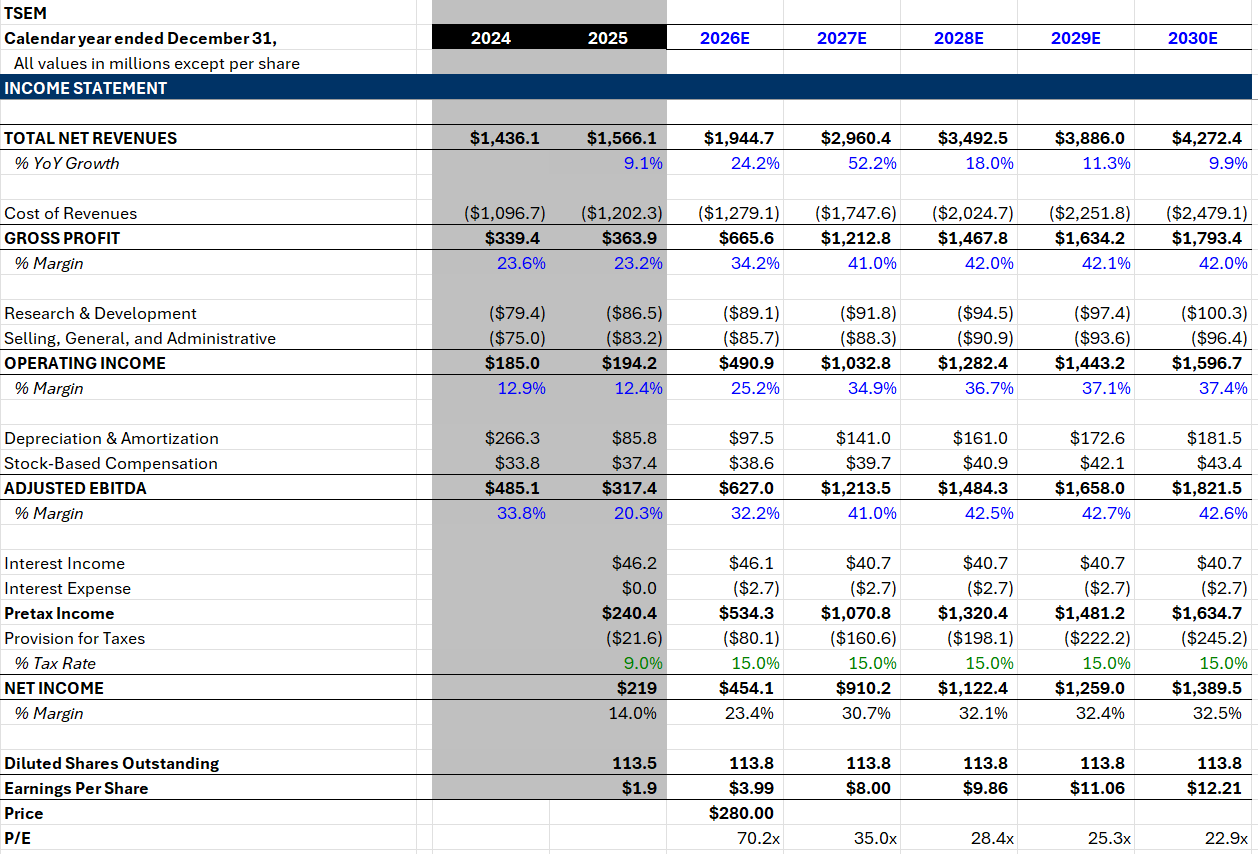
On their last earnings call, they announced $1.3 billion of contracted SiPho revenue for 2027.
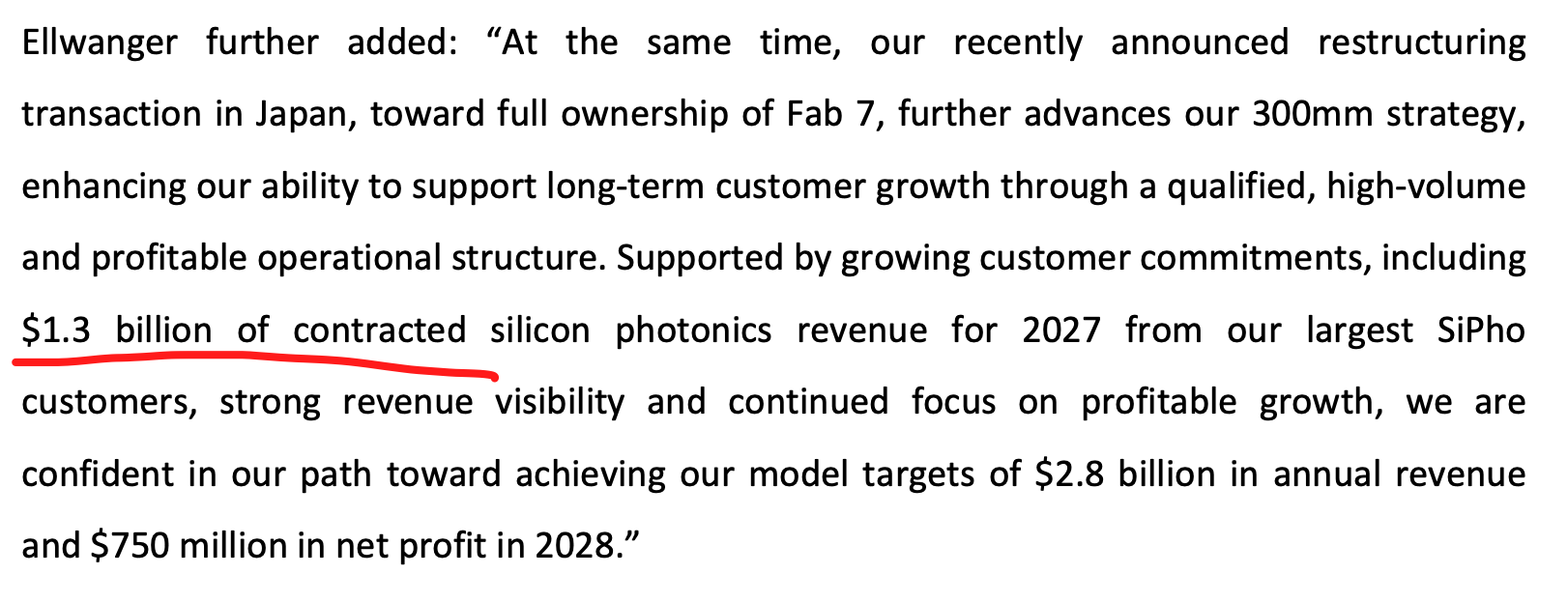
There has been lots of speculation that this could be NVIDIA and Tower could have won a major CPO order, but we don’t know for sure. Tower also has a very competitive COUPE competitor to TSMC. They could win a lot of market share back if they execute well. However, they will never be a monopoly here. TSMC is too good at packaging and EIC, so this would always be a contested market.
My Ranking (and Positions)
My ranking is as follows:
Lumentum
Aixtron
Soitec
AXTI
Tower Semi
Coherent
Lumentum and Aixtron are super close, so this was difficult, but Lumentum is just slightly higher because they are not a semi-cap. Being more downstream allows them to have higher convexity if demand for CPO goes parabolic. Both are the highest because they have the combination of great valuations, high leverage to CPO, and potential for massive revisions every quarter. I have massive positions in both.
Soitec is slightly behind Lumentum and Aixtron just because their unit economic exposure to CPO is slightly weaker. This is because each wafer that they sell contains hundreds of PICs, and even though they are much smaller than Lumentum, the size-to-CPO-content ratio is worse. They also have tons of spare capacity and can convert their shrinking mobile manufacturing lines to photonics SOI lines, which is a massive advantage in a world of capacity constraints. I really like that aspect of them. If I get more certainty that their CPO content is higher than what I have modeled, I will get back in. For now, it’s just too difficult to underwrite the same level of conviction that I have in Lumentum and Aixtron as they haven’t addressed the CPO opportunity publicly and provided visibility in the same way.
AXTI is 4th just because of how much uncertainty there is and how highly the market has already valued them, but this could easily be a super degen winner with 10,000% hidden price hikes.
Tower and Coherent are last because they are not guaranteed to win from CPO. But Tower is ahead of Coherent because Tower has a higher chance of winning CPO market share. They are actually very competitive versus COUPE, while Coherent is farther behind Lumentum.
Winner of the giveaway is @kyl
What do you think about $AAOI?