

AXTI is a funny company.
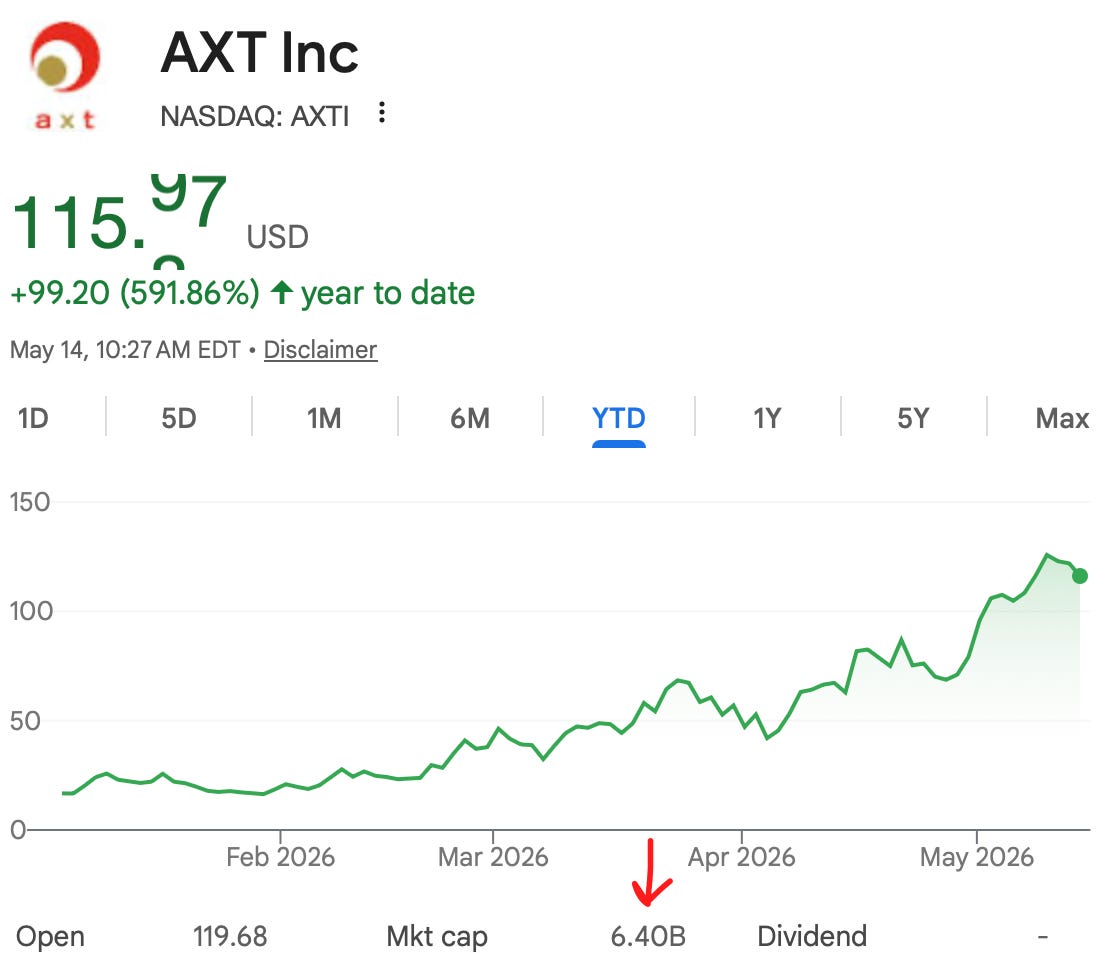
They are worth over seven or eight billion dollars once you account for the dilution. Currently, they’re at about 100 million in revenue run rate. Lol.
But okay okay, let’s forget about any and all numbers for a second.
What if I told you that there is one chemical compound that is needed for all of optics? That there is no way around it, and that it would scale exponentially once scale-up CPO hits, and you will need big massive lasers made out of this compound stuffed deeper and deeper inside of a rack.
And there’s one company that holds a substantial global share of this compound and has tons of brownfield capacity available and can convert capacity from another compound to this compound and can build greenfield once its brownfield capacity is saturated and is basically doubling capacity year over year.
Interested? That’s what I thought.
And that’s what the market also thinks too, as they have returned a cool 7x since the start of this year.
And their 12-month return?

So yeah, they confuse the shit out of me forever, but it is finally time to look at what they actually do. Funny enough, the fact that they have kept running while the general sentiment on X and Substack was extreme skepticism and bearishness probably means that the bull case is underrated. This company makes SNDK look like a stock you would buy after reading The Intelligent Investor by Ben Graham.
Deep coverage on blue chips refers to LITE, BE, INTC, big memory vendors, etc.
Thematic work includes:
industry/tech overviews
investment maps comparing all of the players in an industry
economic style thinking and theory for AI infra
macro
By accessing this content, you acknowledge and agree to our terms and conditions. This research is not financial advice.
Introduction
The agenda for today is simple. We will first talk about the fundamentals of the company and then review their most recent earnings call to see how they’re doing.
AXTI makes indium phosphide substrates, which are the raw materials needed to make data center lasers, such as EMLs (transceivers) and high-power CWs (CPO).
Which happens to be the number one bottleneck in all of AI at the moment. AXTI is the bottleneck of all bottlenecks. The bottleneck final boss.
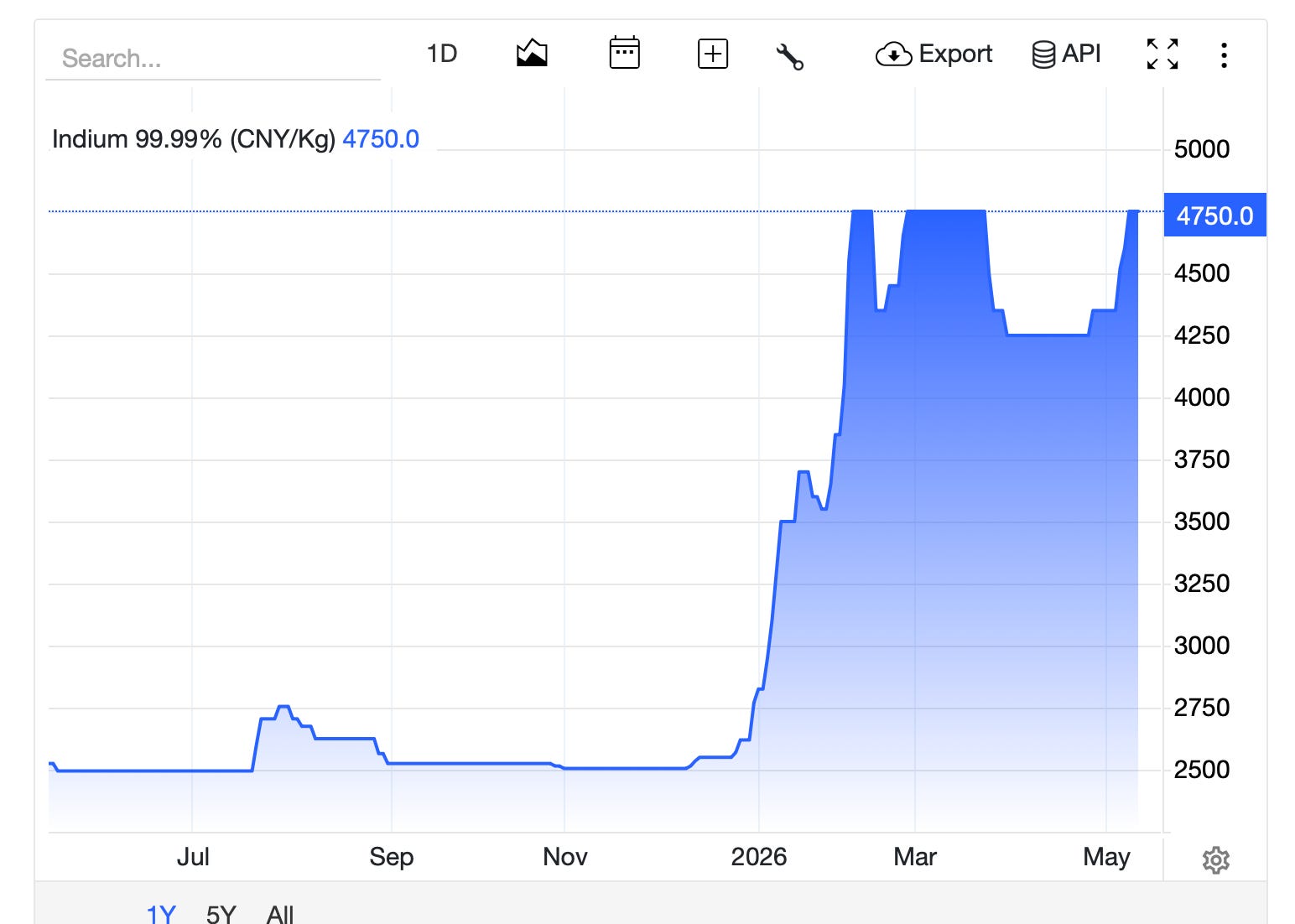
The spot price has ripped, but I think it undersells how bad this constraint has gotten. The chart isn’t even as atrocious as memory today. Let me just say that there is a reason Lumentum is now 30% behind demand on EMLs and probably over 50%, (depending on how you interpret management’s commentary) behind demand on their scale-across laser components.
For an introduction on why indium phosphide is needed for lasers in the first place, please see my Sipho introduction. The gist of it is that there is basically only one semiconductor chemical in the world that’s able to produce light at the required wavelength for long-haul data center communications, and that is indium phosphide. Silicon can’t produce light at all. Gallium arsenide is the other choice, but it will increasingly be relegated to niche shorter-reach use cases. I will skip over a lot of the technical stuff for this article today because I want to mainly be focused on answering the question of why the hell this stock is up so much instead of why this chemical over this other chemical and how the chemicals are made.

AXTI controls roughly a third of this market and has by far the most vertically integrated supply chain out of everyone who makes indium phosphide. Their operations are primarily based in China through their subsidiary Beijing Tongmei, and they control a wide swath of raw materials companies all across the indium phosphide supply chain. They control everything including extracting the stuff, refining the stuff, and making the stuff super pure. This gives them cost and speed advantages.
They process the stuff like this:
Tongmei/JVs source and refine high-purity indium and phosphorus.
AXT combines them into InP source material.
They grow a single-crystal InP boule/ingot using proprietary VGF, or Vertical Gradient Freeze.
They dope it depending on spec, for example sulfur-doped n-type for laser substrates or iron-doped semi-insulating material for other uses.
They slice, lap, etch, polish, and inspect the wafers for diameter, resistivity, orientation, thickness, and low defect density.
And last but not least, their entire destiny is dictated by export licenses, lol.
Earnings
Now, on to the earnings review.
In Q1 2026, they did $26 million of quarterly revenue, half of which ($13m) was indium phosphide. They guided the substrate market to grow approximately five times over the next three to five years.
As expected, they mentioned that the most important input to their guidance is export permits, for which they have $34 million of revenue permitted (not exactly permitted, as some of their revenue doesn’t need permits at all, as they don’t need permits to ship within China). However, they mentioned that they could see significant upside to this number, as this is just what they have right now.
They were unprofitable for most of their life, but in Q2 they expect to see profitability for the first time.
Unsurprisingly, nearly all their customers are talking about long-term supply agreements. This is subject to qualifying wafers with them. You can see this has a signal to indium phosphide being much, much more competitively differentiated than memory, as you must pass qualification.
They mentioned that prices are going to increase without quantifying exactly how much, but they did give a little bit of guidance on gross margins. They said that gross margins are going to go up to, but not quite, 40% (in response to an analyst who was asking if modeling 40% was correct). Currently, their gross margins are mostly due to a mix shift towards indium phosphide in higher volumes, which causes higher utilization. However, management said that we’ll see the price effects in gross margins later this year, which means it could be quite large.
The most important, or maybe even the only important, comments from this entire call have to do with their capacity. This is known as the double-double-double plan.
Currently, AXTI has a ton of brownfield capacity that is used for other non-indium phosphide junk, like gallium arsenide. They have a bunch of capacity to just convert brownfield to indium phosphide and be able to double their capacity from the end of 2025 to the end of 2026. This is the first double. They call this an extremely fortunate position to be in, as other producers don’t really have this option.
Morris talked about doubling our capacity to a rate of $35 million per quarter in Indium Phosphide by the end of this year. Remember, that’s in a brownfield site that was once a crystal growth facility used for Gallium Arsenide. And as we relocated gallium arsenide, we’ve been able to move into that. So we’ve been extremely fortunate that we’re in a position, I think, that nobody else in the Indium Phosphide world is in that we can double our capacity so quickly.
So that’s basically 140 million per quarter by the end of this year by converting this brownfield capacity; however, they’re not done. They get to double again!
Looking into the next growth, as Morris just mentioned, we are, we’re acquiring a facility, which is right next door to us. Again, extremely fortunate., building is already there. And that allows us to double yet again. So by the time we’ve completed that expansion, which should be by the end of 2027, maybe early 2028, we should be at the region, of somewhere in the region of $65 million to $70 million of capacity per quarter. So that really takes us to the type of capacity that we’re expecting to see in our existing locations. And then as Morris mentioned again in his call or in his script, as we talked earlier, we’re now looking at where we need to go from here. So we’re looking at other opportunities and other ways to expand beyond that probably in a greenfield site somewhere else.
That takes them up to $280 million by the end of 2027.
Essentially, the double, double, double plan means that they will grow their market share significantly from their 35%-ish today, as everybody else is a lot more constrained than they are. This is actually very underrated.
Am I Buying This Funny Stock
No.
We’re trading at something like 30 times exit CY27 ARR. So basically, it could work if this is literally the single most constrained choke point bottleneck in all of AI infrastructure, and we can get memory-like price hikes and forced capacity expansion but anything less than that, and you’re kind of cooked.
I am not selling Lumentum to fund this degenerate nonsense. However, I will be keeping track of them very closely in the future because they are incredibly important to the future of the entire photonics industry. If they do end up crashing by 70% or something because of some news or whatever, I would probably take a bite.
Agreed 100% with last paragraph, my thesis exactly. Just begs the question why Irrational Analysis bought in, I don't understand the 30x ARR and even then gross margins are trash compared to even non bottleneck semis
Lovely article especially for someone who is new to this space. Current levels are tempting of 60 $ worth "taking a bite" now ? Also I understand they are increasing their capacity but in line with the demand of the market ?