

Opinions are my own and do not represent past, present, and/or future employers. All content is based on public information and independent research. This newsletter is not financial advice, and readers should always do their own research before investing in any security. I am invested in the semiconductor industry. As of the date of this publication, I may hold long positions in the securities discussed in this article.
I built a tool using Claude Code to automate DCF valuation.
In January 2026 I was up 20.02%. This is while the Nasdaq is flattish, and SMH up 12%. Neither are perfect benchmarks as I am not fully allocated to semis. I do not have a single name in the red (which is statistically speaking very unlikely to last into Feb).
Have many hot n spicy takes to share today. Port reviews will be very casual tone, sharing my crazy personal opinions.
Macro View and Positioning
I personally believe Claude Code was an inflection point in the race to AGI that has virtually guaranteed the arrival of superintelligence within the next 5 years. It is not my job to discuss the societal implications so I will only focus on the investment implications.
And that is hyper-omega-bullishness for all semiconductors.
Besides Claud Code there are two other major macro catalysts for semis.
TSMC capex guidance: TSMC does not mess around. Underutilized fabs means bankruptcy for a foundry. Historically they have been ultra-conservative so for them to hike capex as much as they did means they really have to have done their homework. They probably had some very long conversations with the hypers and realized “oh god… they really aren’t gonna stop spending…”
Hyperscaler capex guidance: Frankly the market reaction is expected. Markets are stupid. They assume 2 things.
Hyperscalers are irrational: Do the hyperscalers have a history of overcapacity? Compute is so constrained AWS is hiking prices for H100 breaking all of Moore’s laws. They’d be stupid NOT to expand capacity.
There won’t be enough ROI: Classic time-series fallacy. Yep, if you compare $650b of capex to the hallucination-filled GPT-4o experience you had 8 months ago, it makes no sense. But datacenters take 1-2 years to power up. Today’s top models are mostly trained on hoppers and TPUv6. The $650b is for 2027-2028 models. If I asked you if the $150b capex from 2023 is worth it for Claude Code, which can automate ALL of software engineering, would that be the same story?
Traditional macro doesn’t matter anymore. Kevin Warsh? Interest rates? Unemployment? I do not think they affect the price action of stocks in the medium term.
The only question is if or if not AI creates 10% GDP growth.
This is obviously contrary to literally all financial wisdom. All or nothing thinking. But I promised strong opinions and this is a paid post (thank you) so I am doing my job. And if I’m wrong at least this is entertainment value.
Key Themes
I structured my portfolio for approximately 3 : 2 : 2 exposure to optics : memory : logic (leading edge). This reflects my extreme conviction in optics and equal conviction in the memory supercycle and foundry shortage.
Optics
80% of my posts so far have been optics related. Not an exaggeration.
CPO is gonna take over the world.

The vast majority of a company’s value is in the terminal value. Especially for a growth company, is the reason beat-and-raise makes the stock rip because of higher earnings for the next year or because it says something about the terminal end-state of the market?
Memory
Memory Moore’s Law running out — bit growth has to come from capacity expansion and not more bits per wafer.
Agents are much more context intensive than chatbots.
The big 3 have PTSD (Post Traumatic Supply Disorder) from COVID and won’t expand.
HBM yields less bits per wafer than DRAM and thus will continue to cannibalize supply.
This time really is different.
Logic

Portfolio
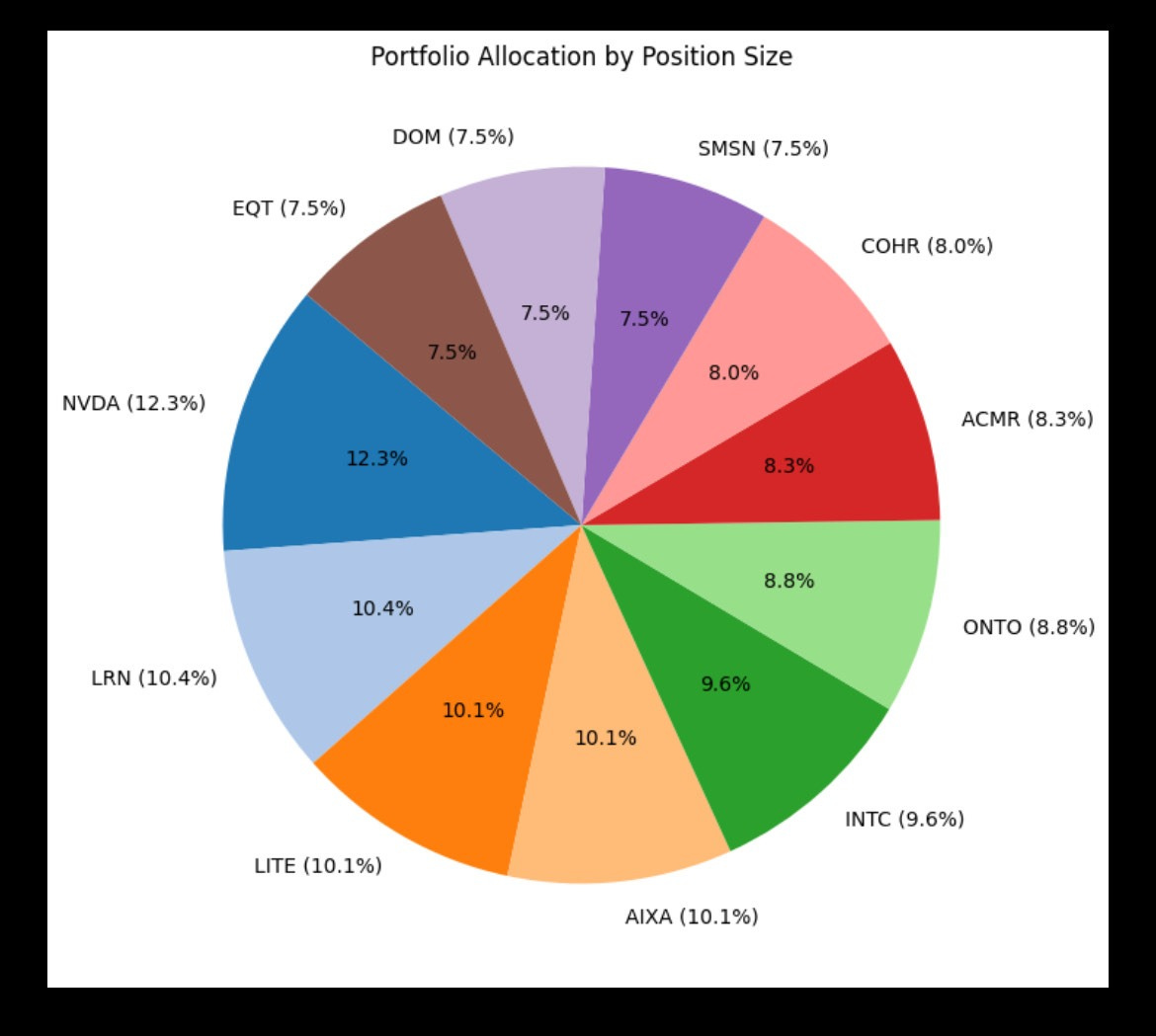
I run my portfolio with relatively equal weighting. My largest position is less than 2x of my smallest. I do express my confidence in my thesis with weights but I frankly don’t understand extreme skews such as the largest position being 8x the size of the smallest. I can hardly imagine a scenario where I would invest in a company I am 1/8th as confident in as one of my other picks.
Nvidia (NVDA)
Portfolio Allocation: 12.3%
January performance: +2.48%
Thesis: This one needs little explanation. I genuinely think Nvidia is currently compressed and will outperform because people are not yet willing to accept the existence of a $5T+ or even $10T+ company and hundreds of billions in AI capex.
Stride (LRN)
Portfolio Allocation: 10.4%
January Performance: +30.29%
Thesis: This is NOT a semiconductor company. Besides semis, I also invest in AI beneficiaries.
Stride is a virtual K12 school operator. 80% market share. Down 65% because of a tech glitch that prevented all students from enrolling and market feared substantial loss of revenue. I bought.
This quarter, all tech issues magically resolved. No reputation damage. A company resolving software difficulties quicker than expected… I wonder why?
Lumentum (LITE)
Portfolio Allocation: 10.1%
January Performance: +6.31%
Thesis: I have extensive coverage on this name.


Aixtron (AIXA)
Portfolio Allocation: 10.1%
January Performance: +11.84%
Thesis: I have extensive coverage on this name.


INTC (INTC)
Portfolio Allocation: 9.6%
January Performance: +25.93%
Thesis: The United States of Fabs will not fail.

Onto Innovation (ONTO)
Portfolio Allocation: 9.6%
January Performance: +27.99%
Thesis:
Take share from KLA in backend CoWoS inspection
Take share from KLA in frontend OCD & thin film metrology
Take share from Camtek at Micron for HBM inspection
WFE supercycle go brrr
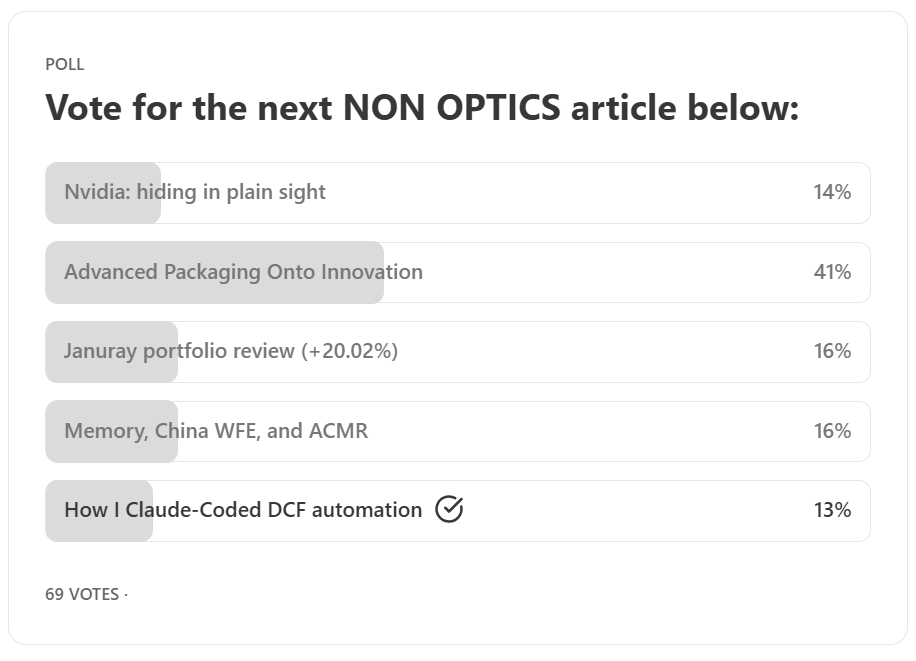
This was also a popular vote for the next multi-part thesis, so been working on that.
ACM Research (ACMR)
Portfolio Allocation: 8.3%
January Performance: +29.5%
Thesis: China WFE player, makes cleaning equipment. A Chinese national champion. Memory supercycle gonna make CXMT and YMTC expand like crazy, and they’re gonna stop buying Lam/Applied and start buying domestic because CCP says so. ACMR eats a bigger portion of a growing pie.
Coherent (COHR)
Portfolio Allocation: 8.0%
January Performance: +14.96%
Thesis:
Samsung (SMSN)
Portfolio Allocation: 7.5%
January Performance: +33.86%
Thesis:
Memory Moore’s Law running out — bit growth has to come from capacity expansion and not more bits per wafer.
Agents are much more context intensive than chatbots.
The big 3 have PTSD (Post Traumatic Supply Disorder) from COVID and won’t expand.
HBM yields less bits per wafer than DRAM and thus will continue to cannibalize supply.
This time really is different.
Global Dominion Access (DOM)
Portfolio Allocation: 7.5%
January Performance: +5.14%
Thesis: Random spanish small cap construction/project management company that works on sustainability, grid, and datacenter projects. No moat but trades at ~3x EBITDA, ~5x FCF. A bet on the infra boom expanding outside of the US.
EQT Corp. (EQT)
Portfolio Allocation: 7.5%
January Performance: +7.71%
Thesis: Natural gas E&P. Vertically integrated, so owns the midstream + upstream. This matters because 1) they can deliver their gas reliably and sign LTAs anywhere across the northeast unlike competitors, and 2) they have the lowest cost of production.
Playing a potential natgas shortage where
Datacenter deman go brrr
LNG exports go brrr
Lack of associated gas from oil drillers