

We have gotten a hilarious amount of discussion in a three-day span about CPO.

The takeaway from all of this news aggregated together is actually massively bullish and incremental positive to optics. NOT negative!! I’ll explain why.
All it takes is some very simple logical deduction.
Contents
SemiAnalysis Note
FundaAI Note
What Is NPO and Why NPO
Does NPO Use InP & ELS
Lumentum at Mizuho
Conclusion
By accessing this content, you acknowledge and agree to our terms and conditions. This research is not financial advice.
SemiAnalysis Note
The (very sad) title of their report was “Powered Down, Lights Off.”
I will skip all of the 800 VDC stuff.
For optics, the gist is that they revised down both scale out and scale up CPO in the near term, pushing out adoption.
For scale out, the downward revision is for Spectrum X specifically, and the reasoning is that the optical engine attach yields are bad. Apparently, optical engine attach yields are 95% today (because there are 32 OEs per Spectrum 6 switch). The entire system has a 19% yield. Therefore, because COUPE is incompetent, these switches are being pushed out two quarters. These are the main scale-out CPO deployments, since Ethernet is shipping in higher volume than InfiniBand, which is why the market got so scared.
For scale-up, SemiAnalysis didn’t provide too much new information, but just reiterated that the deployments won’t come until Feynman and won’t ship in high volume until late 2028 or 2029.
But I’ve been saying this too!

I don’t know who thought scale-up CPO would be ramping in 2027. Just because Jensen announced NVL576 for Rubin Ultra doesn’t mean it would actually ship in volume, and it’s not.
Feynman brings the light.
FundaAI Note
At the very same time, FundaAI published a note claiming that NPO deployments are going to double.
I think the reason has to do with Kyber being scrapped.


Kyber racks require high-grade (M9) CCL (copper-clad laminate) because the per-lane rates are increasing, the layer counts per tray are increasing, and the cableless design pushes these signals through the midplanes and orthogonal backplanes, putting even more pressure on the CCL for M9 CCL. Traditional glass fiber won’t cut it. You need quartz fiber, which is much harder to manufacture and whose supply chain is much less mature.
This supply chain probably isn’t ready.
Therefore, whatever shipments were relegated to Kyber for Rubin Ultra probably switched over to NPO.
Now notice: Mass adoption of NPO plus rumors of CPO delay sounds like NPO is replacing CPO, but actually that’s not what happened at all. CPO was always going to be 28/29, and NPO is actually replacing Kyber, meaning that we have more incremental optical content than before.
The complete opposite of the consensus perception of this “optical illusion”. (get it)
What Is NPO and Why NPO
NPO is Near Packaged Optics. This is like co-packaged optics, except the optics aren’t co-packaged with the XPU. It’s only packaged near the XPU. Easy enough.
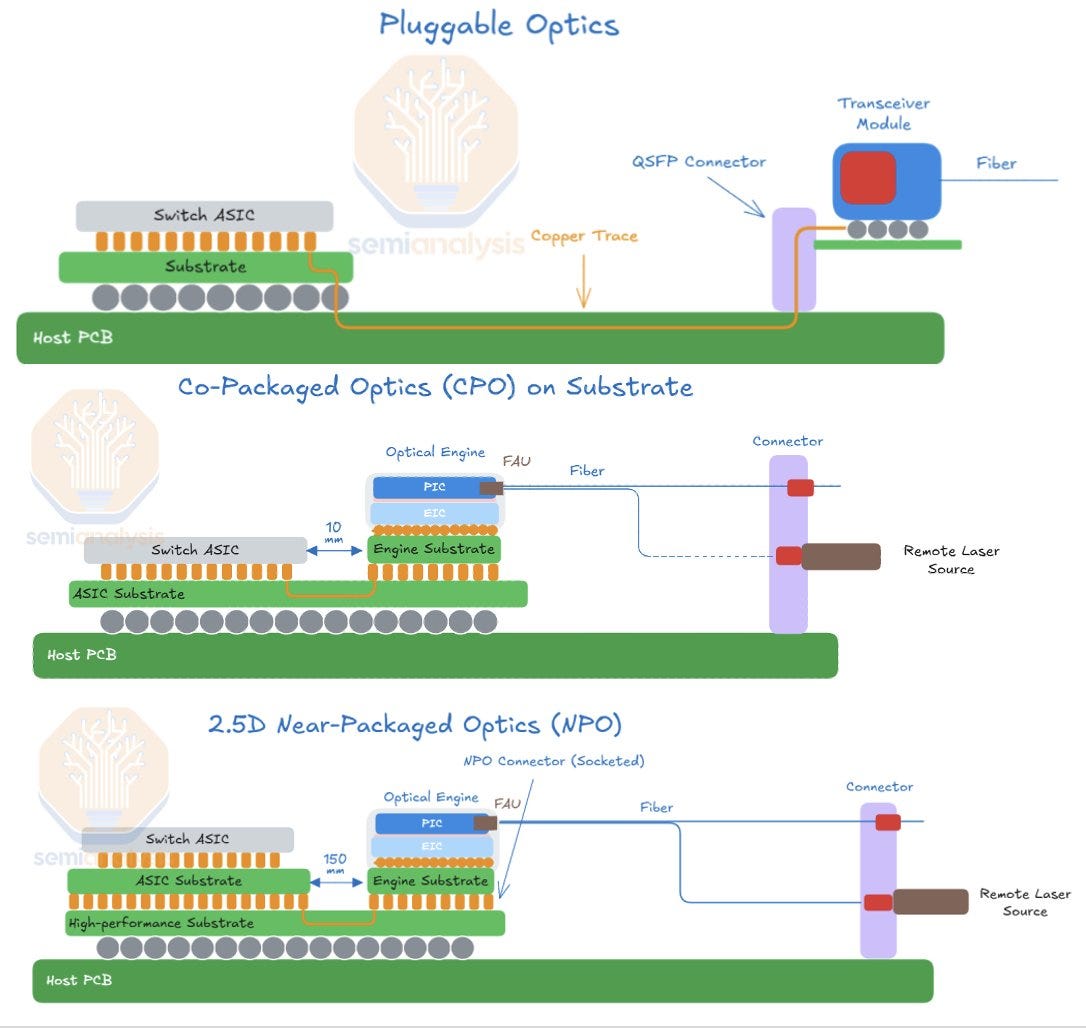
As a result, you would avoid this compounding yield problem that SemiAnalysis claims killed CPO. NPO is socketable. It is much, much easier.
Does NPO Use InP & ELS
Probably.
And this is what makes the market reaction to all of this so silly.
Look at the diagram for NPO.
According to this design (SemiAnalysis), the only difference is in the packaging. The laser, the fiber, and the optical engine have the exact same content. This means that every single NPO lane is just as much InP revenue for Lumentum and others as CPO.
Now I must caveat this with the fact that this design (specifically using an external laser source) is not forced for NPO the same way it is for CPO. This is because external lasers are the solution to heat (lasers hate being near the hot XPU (serviceability) and laser failing can just be swapped if it’s external instead of blowing up the entire tray; but for NPO, the module itself is placed away from the XPU and is also socketed, which reduces blast radius.
It seems like if NPO uses InP, the design is still external lasers. If NPO uses VCSEL, the lasers are likely internalized. However, because we’re talking about 1.6T and 3.2T, if a slow and wide approach is not adopted, lane rates are 200G or higher, which is beyond what VCSELs can support. Therefore, it is most likely that NPO uses the same ELS architecture that CPO does. It is okay if this architecture is not permanent, because in a few years CPO will be here and force external lasers to stay anyways.
Lumentum at Mizuho
There are two important takeaways from their comments at this conference (which occurred at the same time as the SemiAnalysis note).
First is their stance towards NPO.
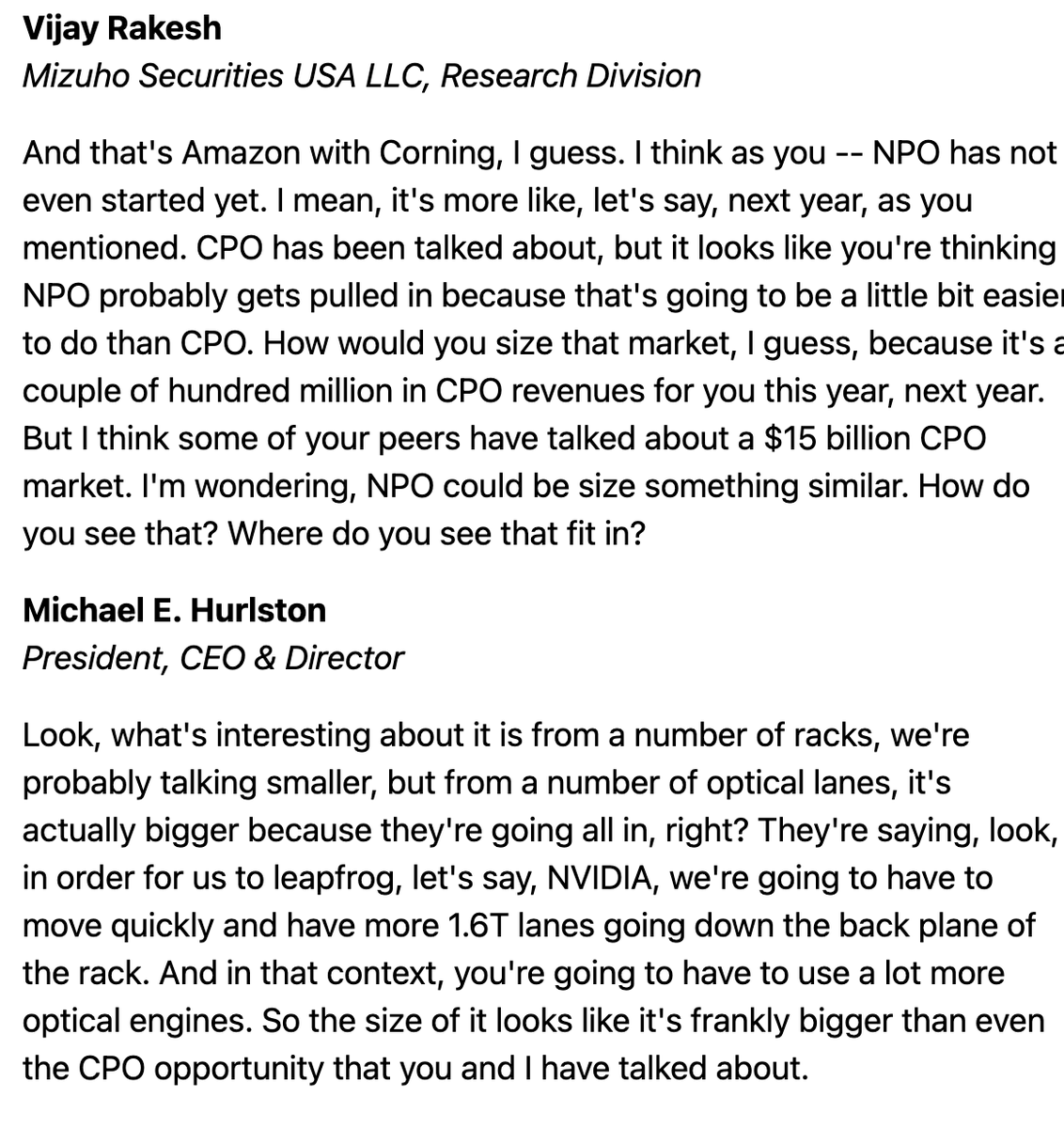
Yeah, that’s right. Lumentum thinks NPO could be an even bigger opportunity than CPO (in the medium term).
This is only possible if NPO uses the same ELS architecture as CPO. As selling commodity lasers into the NPO market would simply never have numbers that can eclipse anything involving UHP CPO lasers (which are ~10x the price) no matter how many optical engines there are.
The second is that Michael Hurlston confirmed scale-out CPO could contribute $50 to $100 million of incremental revenue THIS QUARTER.
That is a $200-$400m run rate in the middle of 2026, which likely implies $400m full year revenue, which is 50-100k switches according to my flawless model.
SemiAnalysis says, “The street currently models 60 to 100k scale-out CPO switches shipped by 2027... We think today’s pace of scale-out production is too low to reach this bogey.”
According to Lumentum’s actual revenue, it seems like today’s pace of scale-out production is not too low to reach this bogey.
Conclusion
Based on the evidence I see in the past few days, the optical story has gotten better, not worse.
Scale-out CPO seem to be on track and pushing Lumentum’s revenue this quarter to the high end of their guidance.
Scale up CPO was never delayed, as it was always shipping with Feynman, not Rubin Ultra, in the first place.
And NPO does not cannibalize CPO. Instead, it cannibalizes the Kyber racks, making it purely incremental content for optics.
If NPO uses ELS, NPO would contribute the exact same revenue to optical players as CPO, which, based on Lumentum’s comments about the NPO market, seems by far the most likely scenario.
I thought the whole thing about Rubin Ultra was that rack-to-rack (not scale out, but scale up in a multi-rack scenario) was going to be CPO. I remember a detailed breakdown from GTR (now defunct) on Substack. IMO, CPO was a Rubin Ultra story in scale up because those mid-plane PCBs were supposed to work well. Now, failing that, the only choice is to go all optical. NPO is the best bet instead of CPO because at least the complexity of advanced packaging is saved.
Good post!
why CPO ELS needs much higher power and can charge 10x higher?