

Today, I talk about the company that is my biggest position, and it is actually one that I haven’t discussed at all on my Substack.
The last of my “big 5” (LITE, AIXA, INTC, BE) I haven’t started to super-intensely cover. But it was one of the first ever chip companies that I discovered and invested in!
It’s also up 10% today and 200%+ YTD and I’ve only ever added. I am proud of this one.
By accessing this content, you acknowledge and agree to our terms and conditions. This research is not financial advice.

The thesis here is 90% memory go brrr so it’s kind of not an idiosyncratic thing at all. SK hynix is only my favorite memory maker by a margin, but own Samsung and Micron, and really you should have the same result. Honestly, I don’t think it matters, because if once you’ve picked your memory maker and it starts going up, the cost of switching to another memory maker and paying taxes is probably going to be greater than whatever marginal benefit the other one has. This is basically to say that my largest position isn’t exactly a company, but a memory.
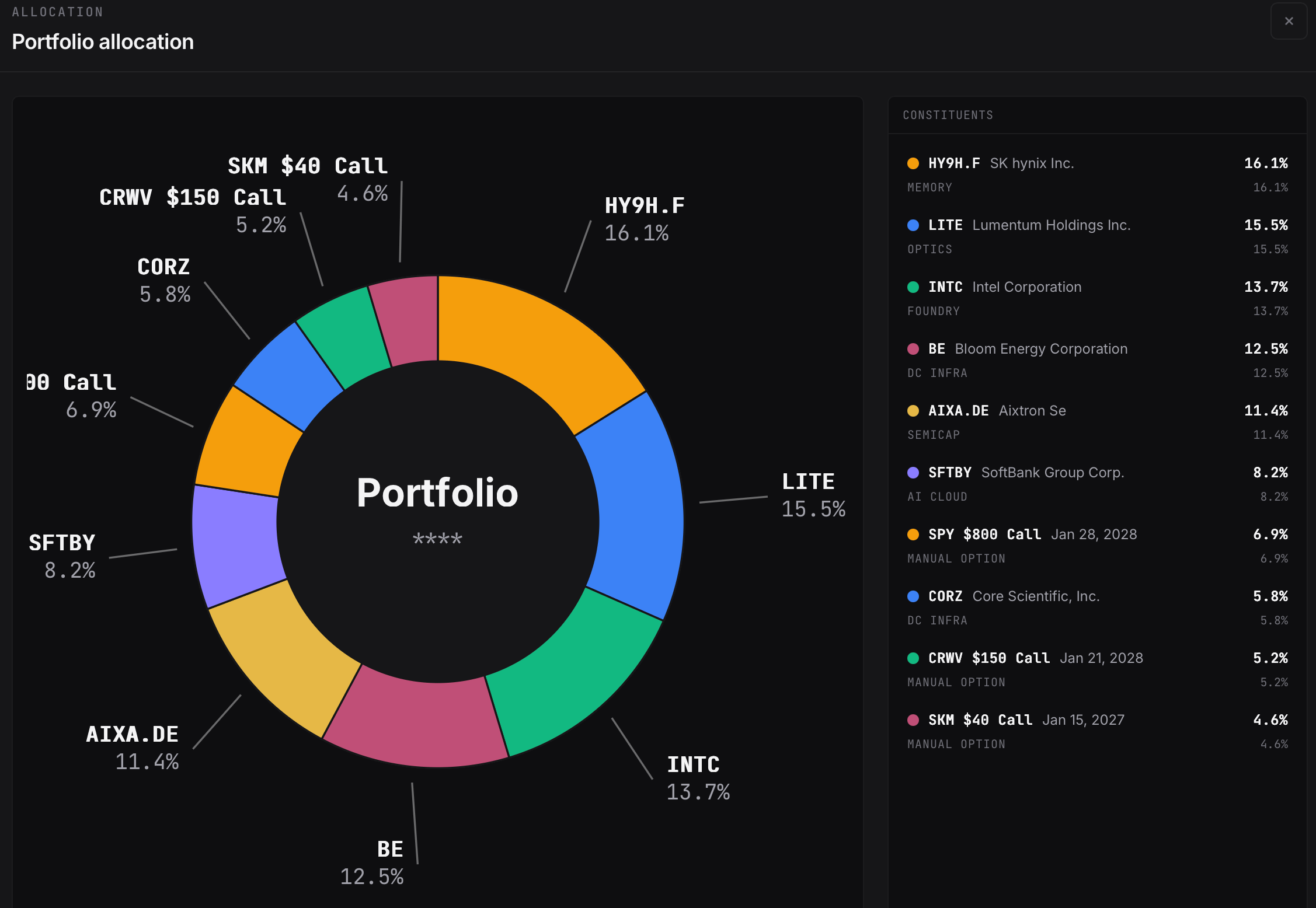
Although, if you look at my portfolio, memory isn’t my largest thematic exposure. Lumentum and Aixtron both contribute to optics, and that would then make up nearly 30% of my portfolio, so my favorite theme is still optics. But memory go brrr.
Contents
Supply vs. Demand
Book vs. Earnings
DRAM vs. NAND
Samsung vs. Micron vs. SK hynix
Supply vs. Demand
The point I’m about to make requires you to notice a visual quirk in any memory supply-demand graph from the sell-side or wherever.
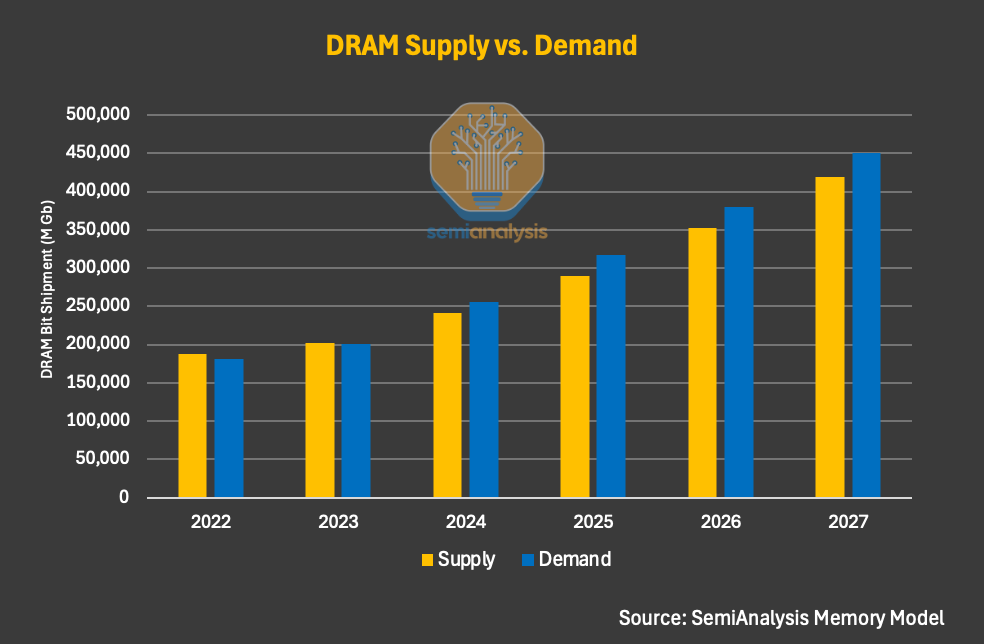
Notice anything? The gap is small!
We are in perhaps the greatest memory shortage of all time ever in the universe, and DRAM is only about 5% behind demand, while NAND supply is about 4% behind demand. Those are not large absolute numbers.
If you’ve been in the weeds of memory, maybe take a step back and think about some other subsectors of AI infra, like optics, where Lumentum regularly says that they are 30% behind demand for their EML lasers and even more for scale across components.
However, very unintuitively, the words I just typed above are the most bullish sentences that you have ever read about memory.
The supply-demand gap is small. Yet, ASPs look like this.
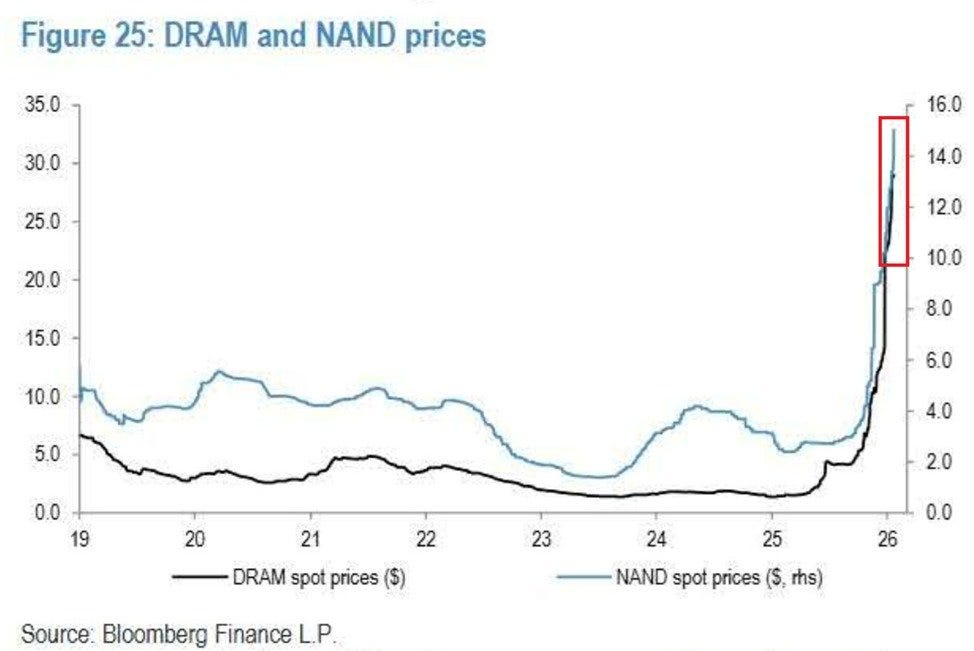
Even Lumentum, being 30% behind demand, is barely able to raise prices. This is because of two reasons.
First, this is the power of a commodity market: the difference between monopolistic and perfect competition, between price makers and price takers.
When we’re not in the world of custom-designed stuff, moats, differentiation, and long-term contracts (a.k.a. perfect competition), all that is needed for earnings to go vertical is for demand to slightly inch above supply.
Second, both supply and demand in the short to medium term are extremely inelastic. Inelastic curves mean that a small change in the quantity results in a big change in the price.
What this means is that memory can be a very levered bet on AI. All you need to do is have a variant view that demand isn’t 5% above supply, but is instead 10%, 15%, or even 20%. Then the equilibrium price that you arrive at for bits is way higher. That’s not a tall ask.
Book vs. Earnings
Ever since I bot my first memory stonk, I have struggled with the valuation question.
Is it P/B or P/E?
Yeah, memory has always been cyclical in the past, and P/B has always been the right way to value such cyclical commodity businesses. It obviously should be P/B, right?
But valuing memory on P/B would make you look like an idiot, because not only are they trading at such low P/E that they can earn back their entire market cap in just a few years, but also those earnings keep getting revised up as memory prices keep increasing!
The answer is that the idea of P/B being too conservative and P/E being too aggressive is not the correct way to frame the problem. Fundamentally, nothing says that valuing a company by its assets is more conservative than valuing it by their earnings!

They are different tools for different purposes, but at the end of the day, there’s only one intrinsic value for a company: the present value of all future cash flows. Both ratios are just a way to approximate it.
P/E is just a shorthand way to do a DCF. P/B assumes that the cash flow generating assets have a value that itself can be estimated, essentially making the corporation only a wrapper around those assets. P/E is much more popular because, in reality, for most companies, the operations of the company cannot be explained by one asset base that’s just easily valued. There is IP, proprietary processes, talent, and a whole bunch of other shenanigans that happen within a company, which allows it to generate value beyond what its assets can do by themselves (ROIC > WACC). For most businesses, they are not commodities and thus are not cyclical, so earnings aren’t very volatile.
Memory, on the other hand, is the complete opposite. There’s not much you can add to a memory fab to differentiate it from other memory fabs. At the end of the day, a bit is a bit. Memory is a commodity. A Micron fab is pretty much the same as a Samsung fab. Because of that, there isn’t much proprietary stuff that earnings capture over the book value, so P/B becomes a far less bad way to approximate intrinsic value. On the other hand, earnings is now complete and utter garbage because commodities have a cycle and a market price, and therefore estimating the intrinsic value of all future cash flows using the cash flows for only one year is a terrible idea. That one year could be very unrepresentative of a through-cycle earnings number.
So yes I’m completely arguing that memory should be valued on price-to-book.
But then why is a memory company my biggest position? Well I believe the book number is far too low (the “real book” or the actual intrinsic value of the fabs if they were properly priced and traded on a market would be much higher). The worse the supply-demand imbalance, the higher the value of the fab. This will simply play out through the price of memory continuing to increase.
However, I actually don’t think the market agrees with me. I think because the earnings of memory companies are so massive and the P/E is still so low, if the earnings keep going up, the stock has to go up with it, because you cannot compress the P/E to like 2x as the laws of cash gushing onto the balance sheet prevent the company from being valued that low. Which makes memory companies quite safe. As long as the demand, supply, and balance keep worsening, the earnings will keep going up and the stock will keep going up.
DRAM vs. NAND
DRAM wins supply and NAND wins demand.

DRAM wins supply because it is much more EUV intensive, and EUV machines are more likely to be a semi-cap constraint than etch-and-deposition. It has a much tighter oligopoly with three players (basically just the big three memory makers) versus NAND, which also has SanDisk, Kioxia, and YMTC. It also has a China problem in that YMTC is as competitive or even ahead in some aspects in terms of NAND, while CXMT is way behind in DRAM, especially HBM. HBM cannibalizes DRAM like crazy, which NAND doesn’t have.
NAND, on the other hand, wins demand and therefore is much more degen and can have more upside over DRAM.
Think about AI data as a stock and flow model. The KV cache of all inference happening at any time is the flow, while the amount of data created by AIs in inference is the stock. NAND therefore captures the stock, while DRAM captures the flow. This is a vast oversimplification, but you can imagine that investing in the stock is much more attractive than investing in the flow.
NAND KV cache offload. This is a bet on long context overflowing our current ability to store it in DRAM. NAND therefore acts like a call option on all of the data demanded but not able to be fulfilled in the KV cache. Obviously, this would be beneficial if you are trying to play the possibility of bit demand vastly outstripping supply.
AI workloads cause SSDs to be much more write-heavy than before, so the more intense AI demand is the faster SSDs get worn out from all of the writes and the more of a consumable that SSDs become.
But the point that I’m trying to make here is that I think it’s much more prudent to bet on both than to have a bias towards one side. The reason is because the beta is far more important than the alpha.
Are you really sure that DRAM is going to vastly outperform NAND, or NAND is really going to vastly outperform DRAM if one wins in supply and one wins in demand? You would have to know how much better DRAM supply is or how much better NAND demand is. The magnitudes are almost impossible to estimate and know in advance.
What we are more certain about is that bits will win, and betting on both ensures that you don’t miss that critical thesis.
Samsung vs. Micron vs. SK hynix
This is the simplest section because the answer is that IT DOESN’T MATTER.
A fab is a fab. A bit is a bit. HBM has some value add, but at the end its biggest input is DRAM, and the value add that each player puts on top of the HBM for performance won’t ever get close to the value of the memory fabs themselves.
(Think about it this way: If a memory maker didn’t have HBM lines at all, they could just sell their DRAM to a hypothetical firm that only turned DRAM into HBM through backend packaging lines. The DRAM maker will still be much more valuable than this hypothetical HBM OSAT even though making HBM has a lot more differentiation. Of course, this would change in a down cycle, but if you think memory is gonna be in a down cycle, I don’t want to talk to you. Actually, I do want to talk to you because there are literally no memory bears right now, and that concerns me just a little bit. You probably have some really interesting insights. If you are a memory bear, please DM me.)
So why did I pick SK Hynix? Well, at the time, Samsung was too capital and inefficient, as it also had a big phone business and a bunch of other junk. Micron has a much smaller NAND business than SK Hynix (12% vs 20% market share and also no Kioxia stake), despite being almost the exact same market cap, so it is much more DRAM oriented, and I prefer balance.
Winner of the giveaway is @Mohamed Husain
Ticker DRAM has all three.