

Opinions are my own and do not represent past, present, and/or future employers. All content is based on public information and independent research. This newsletter is not financial advice, and readers should always do their own research before investing in any security. I am invested in the semiconductor industry. As of the date of this publication, I currently hold a long position in Aixtron SE (AIXA). Feel free to reach out at jasonschips@gmail.com.

hey guys.
Aixtron has had a good run since my first two posts. When I released my first post about Aixtron, they were €14. When I released my second post, they were €17. Today they are €21.
This is due to a few reasons.
First, half of the sellside has upgraded Aixtron. JPMorgan rated them hold and had them on negative catalyst watch before recently upgrading them to buy. BofA rated them underperform, then double-upgraded them to buy, then named them SMID top pick.
Second, there was a major rally in semicap to start out the year. Today, there is a shortage in leading edge semiconductor manufacturing that is only getting worse. As sell-side banks began to create 2026 foundry capex forecasts, they realized their prior estimates were way too low. This meant semicap revenues needed massive revisions higher. Semiconductors in general are becoming a consensus long. New year, new positioning is real.
We’ve already established Aixtron as a heavily moated company with a leading market share on every one of their end markets. Crucially, their market share is higher in GaN and Optoelectronics (90%!!!), giving them a near monopoly in the two end markets facing completely unrelated yet equally compelling inflection points.
GaN is inflecting because of the inevitable 800V HVDC data center architecture transition.
The Aixtron Series | Part 1: Power Electronics

Hello and welcome to my Substack! Updating this about 45 days since it was published as there are many new readers to whom I want to introduce my writing and publishing style.
Optoelectronics is inflecting because of the inevitable boom of optics in networking and the increasing epitaxial intensity faced by fabs.
The Aixtron Series | Part 2: The Optoelectronics Supercycle

Hope everyone enjoyed their Christmas!!! Thank you to anyone who subscribed or pledged. It means the world to me that you found my research helpful and wanted to support.
Today we break down their financials. Revenue and capex build, income statement, balance sheet, and cash flow statement projections. And then value them with a DCF. Models do not predict the future but they teach us how to think about companies.
Modeling Philosophy
One thing you should probably know about me is that I invest like a VC. In thinking about the bull vs bear cases, I want my bull case to be so compelling I’d invest even if the bear case meant my position goes to 0. This means a) I don’t do bear cases and b) I set a very high bar for the bull case, even a 100% return isn’t enough. That’s why my price targets may appear to be fully unhinged (today is no exception).
Why do I use this approach?
Risk is what you DON’T see. Therefore, the “risk case” is almost never risky enough. Do you think anyone’s January 2020 “bear case” model for airlines included COVID? The unknown unknowns end investment careers. I’d rather have delusional bullishness than delusional margin of safety.
The best defense is a good offense. If there are 10 stocks in a portfolio, just 2 of them being multibaggers can eliminate so. many. losers. And focusing on picking multibaggers means that probabilistically some of them will be. The best downside protection is upside from your other names. Such is the beauty of diversification.
It’s funny because I used to be 100% in the value investor camp but now have very strong opinions most of them won’t agree with. With that out of the way, on to the Aixtron model.
Aftermarket Revenue
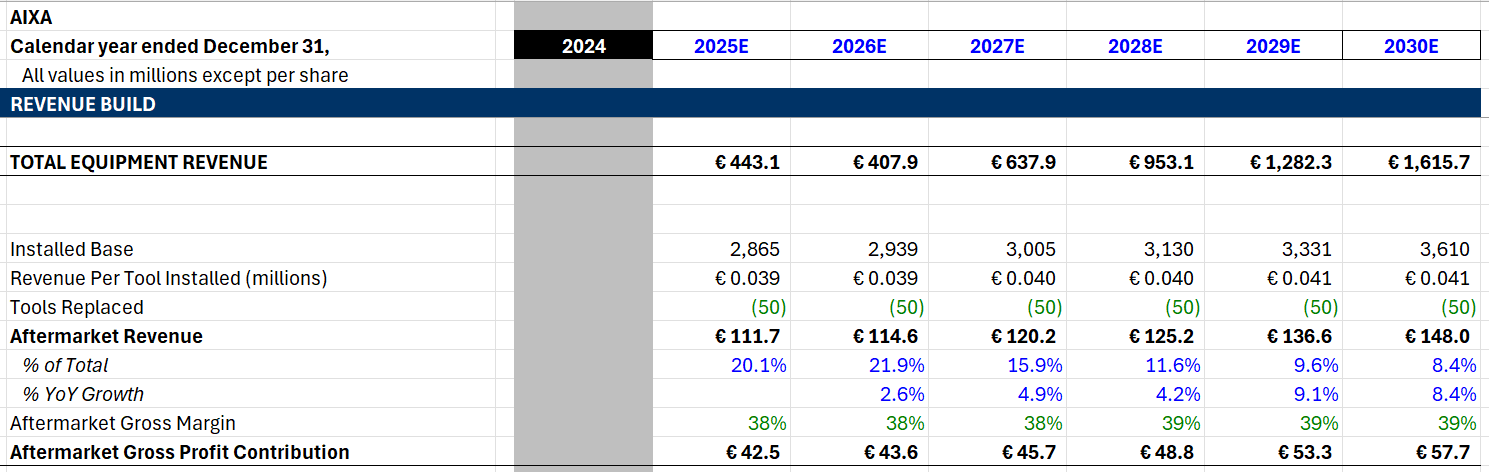
We finished part 2 finalizing the equipment revenue from all 4 of Aixtron’s end markets—GaN, SiC, Optoelectronics, and LED. However, equipment sales only make up ~80% of their total revenue. The entire Aixtron installed base requires regular maintenance and replacement, driving their aftermarket sales.
Aftermarket sales are modeled on a revenue-per-tool-installed basis. This means that as their installed base grows and more equipment is added than is retired, their aftermarket revenue grows too, albeit slower than the corporate average. Based on a starting installed base of 2865 tools and a retirement rate of 50 tools per year, we project revenue CAGR of low teens to €148mm in 2030.
The Capex Miracle
Semicaps are extremely capital light. This blew my mind when I first learned about it.
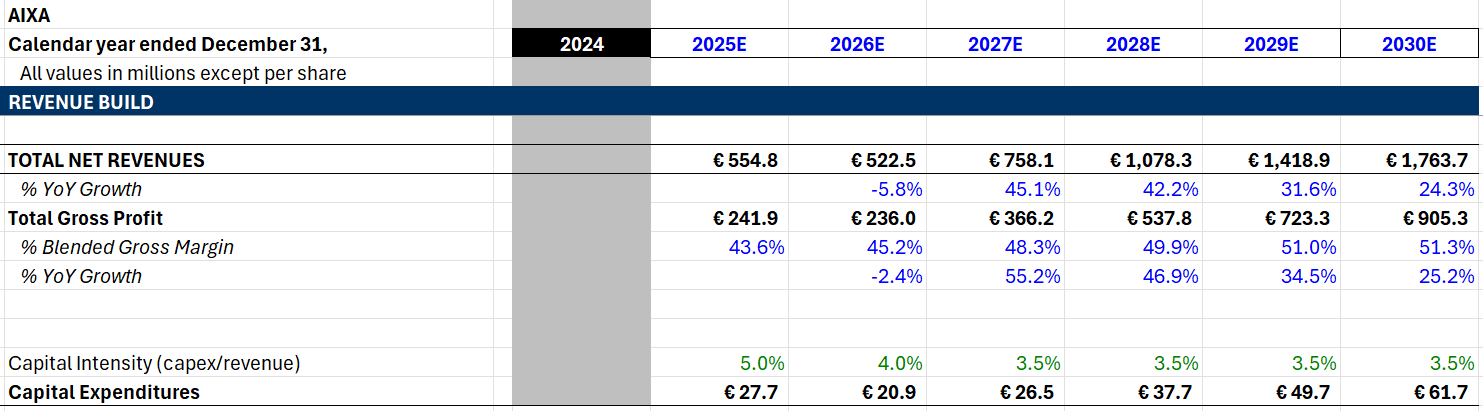
Fabs that have to build cleanroom facilities, buy all their equipment, and run the whole operation. In contrast, semicaps just own the IP and source their components from a network of 3rd party suppliers, only acting as a final assembler. This means their capital intensity is as low as fabless companies, reaching low single digits of revenue.
This is huge. Combined with their signature highly niched-down monopolies, the business quality of semicaps is so underrated.
What do they actually spend capex on? Mostly R&D labs to test their
For example, they spent 16% of revenue in 2024 on the Aixtron Innovation Center in Herzogenrath. Outside of these labs, maintenance capex is usually 3-4%.
Thus, we project capital intensity of 5% in 2025 dropping to 3.5% in 2030.
Income Statement
As we move down the model, things only get more fun. Now, I want to introduce you to my favorite concept in investing: operating leverage.
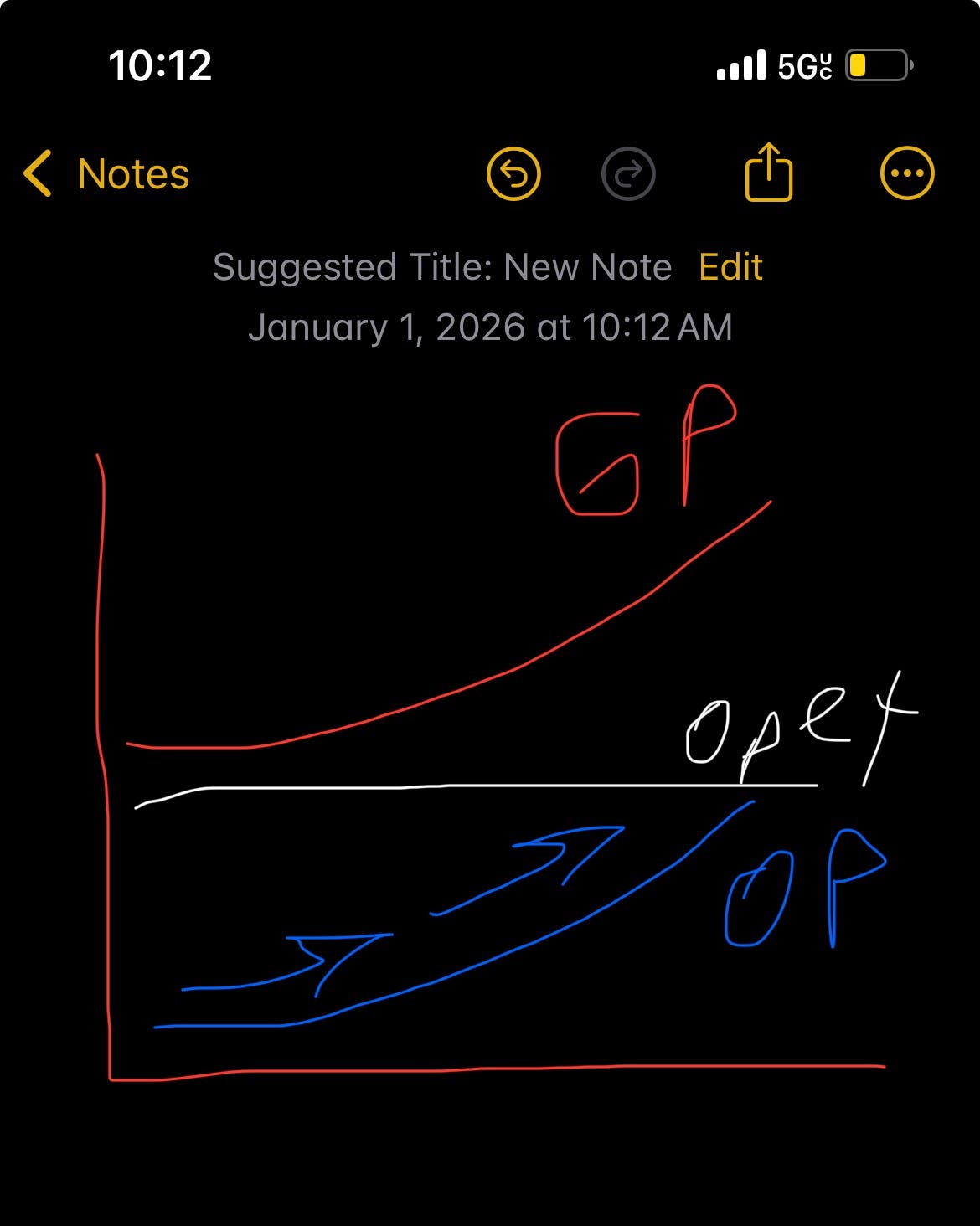
It’s honestly stupidly simple but even more stupidly underrated. A business with profit from units sold (gross profit) growing faster than fixed costs (operating expenses) have their overall operating profit (gross profit - operating expense) accelerate dramatically.
Behold my notes app drawing:
Why is this concept underrated? Because it provides an investor with torque if they are correct about their views.
Let’s say you make a correct prediction on a company with 60% net income margins and hypothetically no operating expenses, so earnings moves lockstep with revenue. You think there will be a 20% acceleration in revenue. The market disagrees. During the next earnings call, you are right. Earnings increase by 20% as a result, and the intrinsic value, discounted PV of cash flows, increases by 20%. Hooray.
What if instead of 60%, margins were only 10% and the other 50% are operating expenses instead? Now the 20% revenue acceleration provides a 15% bump to margin (gross margin 75% * 20% revenue increase) and earnings skyrocket 150%.
Even better, with continued revenue growth, margins keep expanding and earnings keep growing at gangbuster speeds.
The discounted PV of cash flows has now increased by an order of magnitude.
As a fundamental equities investor, this is your secret weapon. Your hard work, analysis, and thesis now produces multibagger results, not the meager 20% return in the first example.
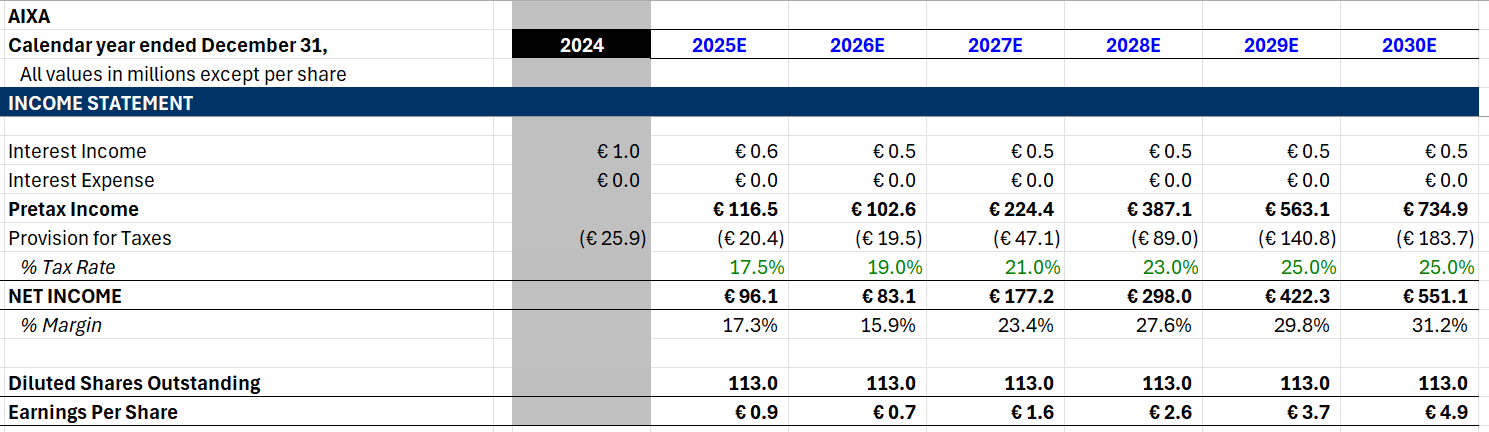
This is exactly what we see in Aixtron’s bull case. With 30-40% revenue growth, operating margins expand from less than 20% in 2026 to over 40% by 2030, adding a 2x multiplier to EPS vs vanilla topline growth.
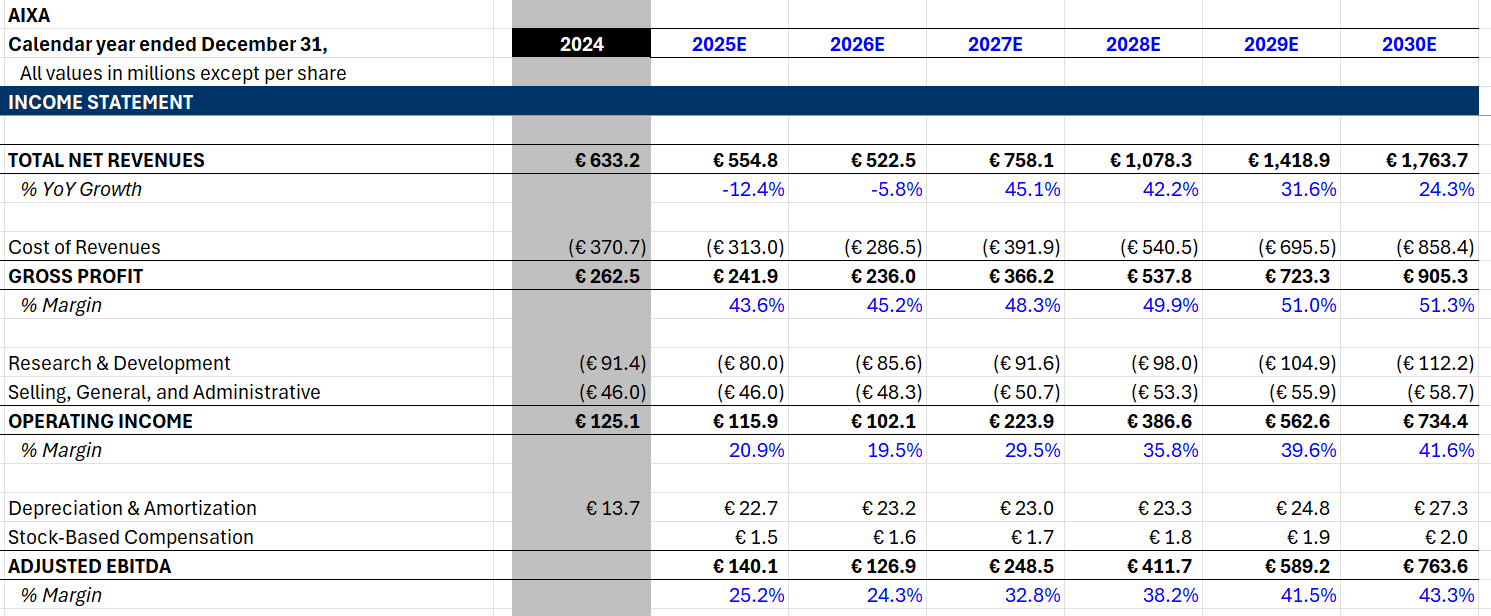
In terms of shares outstanding, they have nothing to hide. There are 113 million shares no matter if it is basic or diluted and there are no complex corporate structure dilution shenanigans. This is a hugely underrated positive for intrinsic valuation, especially if you’re using US-based comparables.
As a result, I arrive at €1.6 EPS for 2027. This means they trade at 13x 2-year forward P/E.
Balance Sheet and Cash Flow Statement
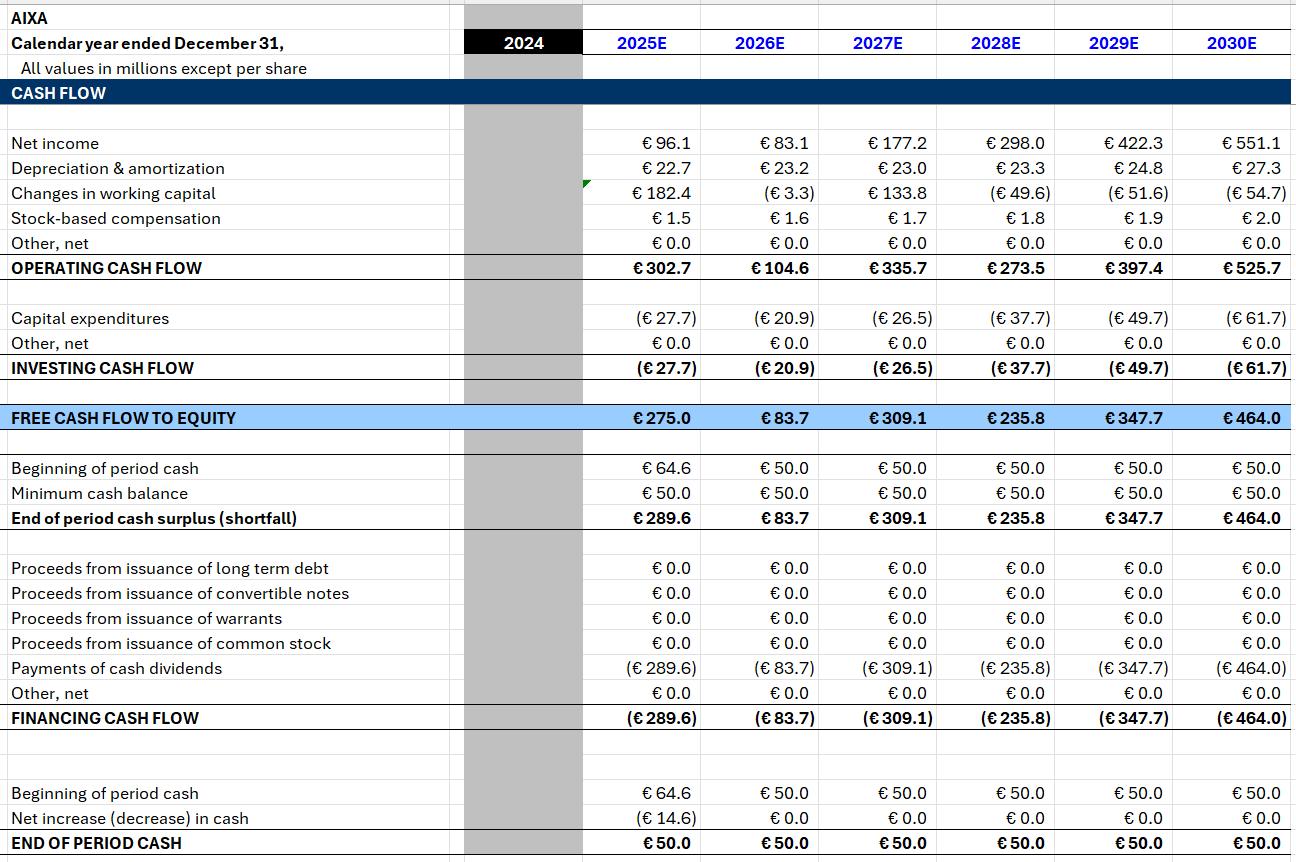
The balance sheet and the cash flow statement are boring and universally hated so I will make it quick to save you the pain.
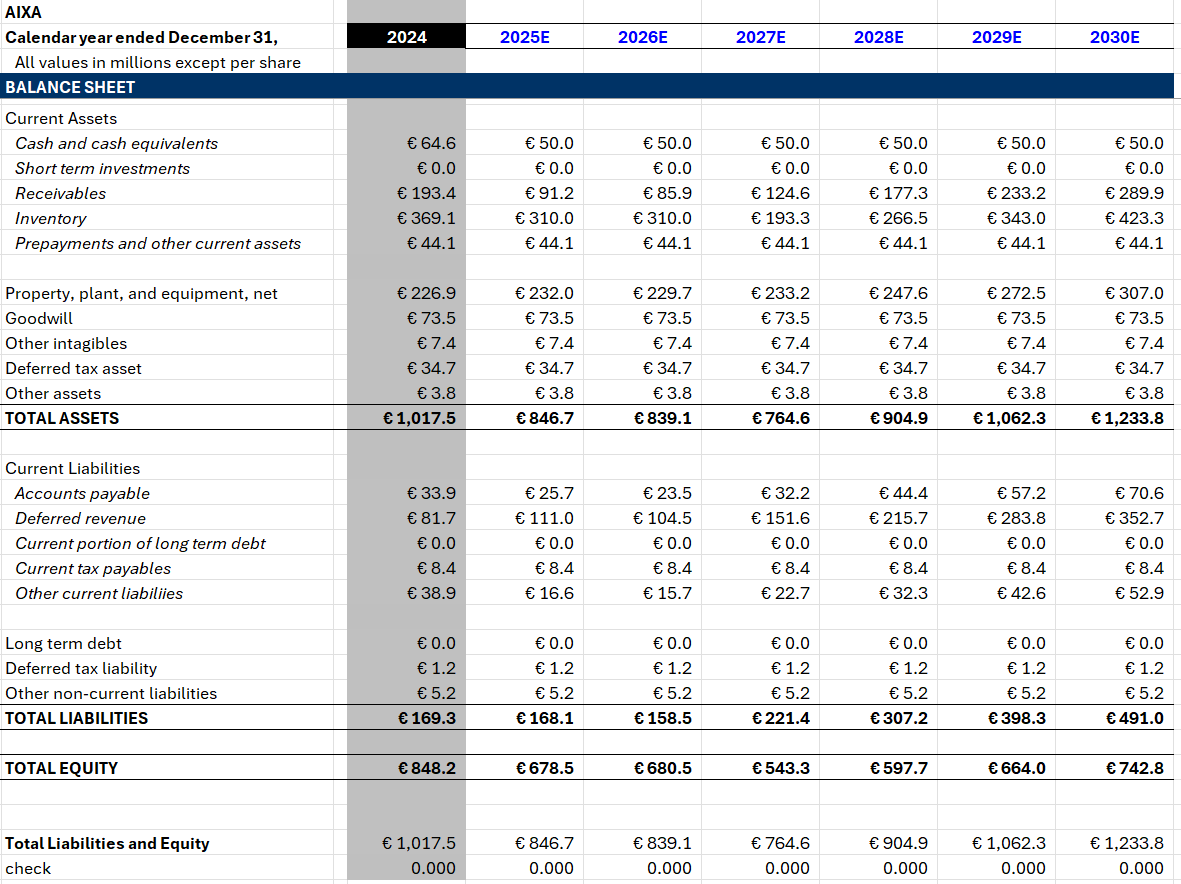
For Aixtron, the most important story told by the balance sheet are the working capital dynamics. We model all working capital line items with the standard “days outstanding” procedure. This essentially measures how many days of revenue or COGS the working capital item covers. For inventory, it’s how many days of sales you can fulfill and for payables, it’s how many days of COGS you haven’t paid yet, etc.
We use
DSO = 60
DIO = 180
DPO = 30
The only metric that is different from ordinary companies is the high days of inventory Aixtron must hold. This is pretty intuitive when you think about how their business works. To sell very large and expensive machines, they must hold them as inventory for a long time for testing and also hold lots of complex and custom components spare as they can’t ship a machine with a loose screw. Thus inventory becomes a large cash sink. As Aixtron’s revenues grow, more free cash gets trapped in inventory, depressing FCF.
For the near term however, management has guided that inventory levels will be depleted, providing a free cash flow tailwind. This is why I modeled inventory down and then flat for 2025 and 2026.
WACC
On Refinitiv their beta is around 0.6. However, I actually don’t trust this number.
Now, this part is important. There is ONE opportunity cost of capital for a business at any time, called The Opportunity Cost of Capital (TOCC). This is the theoretical rate of return that compensates investors for the riskiness of the business operations. It’s deterministic. If a business’s operations have X risk at time T, TOCC = Y. WACC is only an estimate of TOCC.
Betas are derived from historical volatility and correlation to an index but are used to proxy the business’s inherent risk. Those two things are not the same. See the mismatch?
Why is 0.6 too low? That number was derived from Aixtron’s historical profile as a supplier of SiC to the EV market, which for some reason lowered its correlation to the index. Today, SiC makes up a much smaller part of their business, especially compared to AI.
Therefore, I use a beta of 1 because I don’t see Aixtron’s business characteristics as being inherently more or less risky than the operations of the average business in the stock market. This won’t get me a job as an investment banker but it makes sense for this valuation.
Discounted Cash Flow
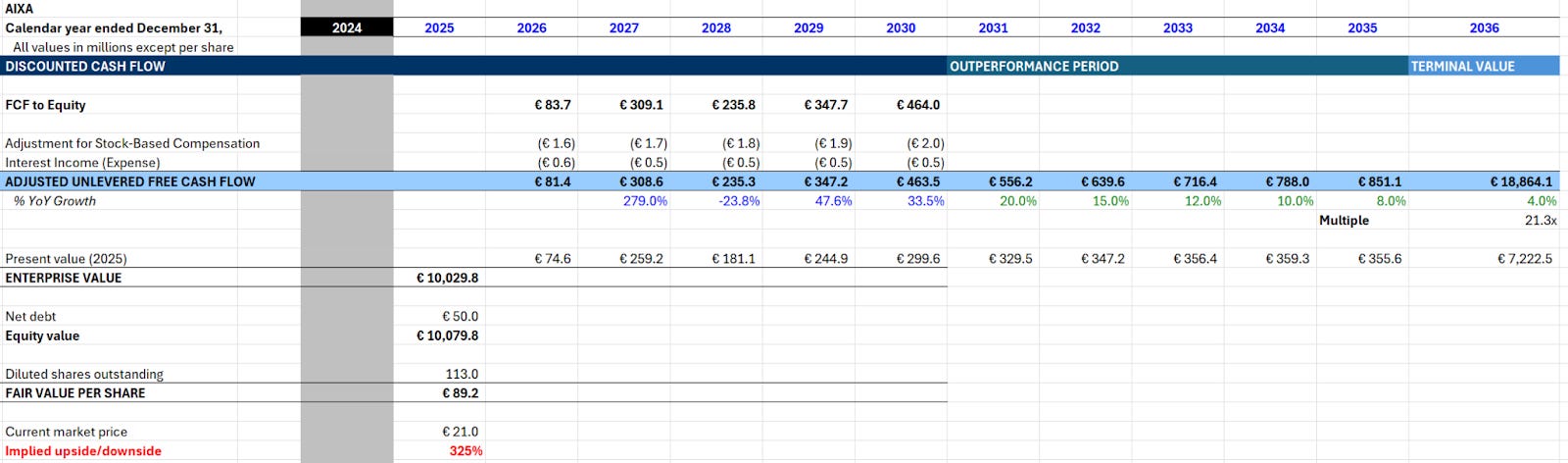
I adjust FCF by subtracting SBC because DILUTION IS AN ECONOMIC COST!
Because our final year FCF is still growing at 30%+, I use an outperformance period to allow the growth to taper off instead of having it drop directly to the terminal rate. Then, I assume a 4% terminal growth rate because 2% inflation and 2% GDP growth.
I also don’t believe in exit multiples because they are just a function of the terminal growth rate assumption. Sue me, finance professors.
It is unhinged price target time!
In my bull case, Aixtron’s intrinsic value per share is a staggering €89.20. That is over 4x today’s price.
Now to be clear, even if my assumptions play out, I do not think Aixtron will reach anywhere close to that price over the next year or two. The DCF measures intrinsic value of cash flows over a very long time horizon, not market price. The way the intrinsic value gets distributed to investors would instead be through continuous compounding and earnings beats adding up to an above market return for an entire decade.
Couldn't agree more. Your analysis of the growing shortage in leading-edge semiconductor manufacturing and its impact on capex forecasts is highly astute. Very well articulated.
It is a german company which provides tools for material inspection and quality control of produced goods (chips, etc.). There are two business segments, but that is now not important. The thing is, that they want to doubble their revenue till 2028 (from 250 milion EUR to 500 milion), the EV is somewhere about 600 to 650 milion by a minimal leverage ( net debt to EBITDA 0,5). I could be 3 to 5 bagger dependent on execution. You have analyzed Aixtron, so you obviously know something about semiconductors. The company has a little coverage, so you could have here an edge.