
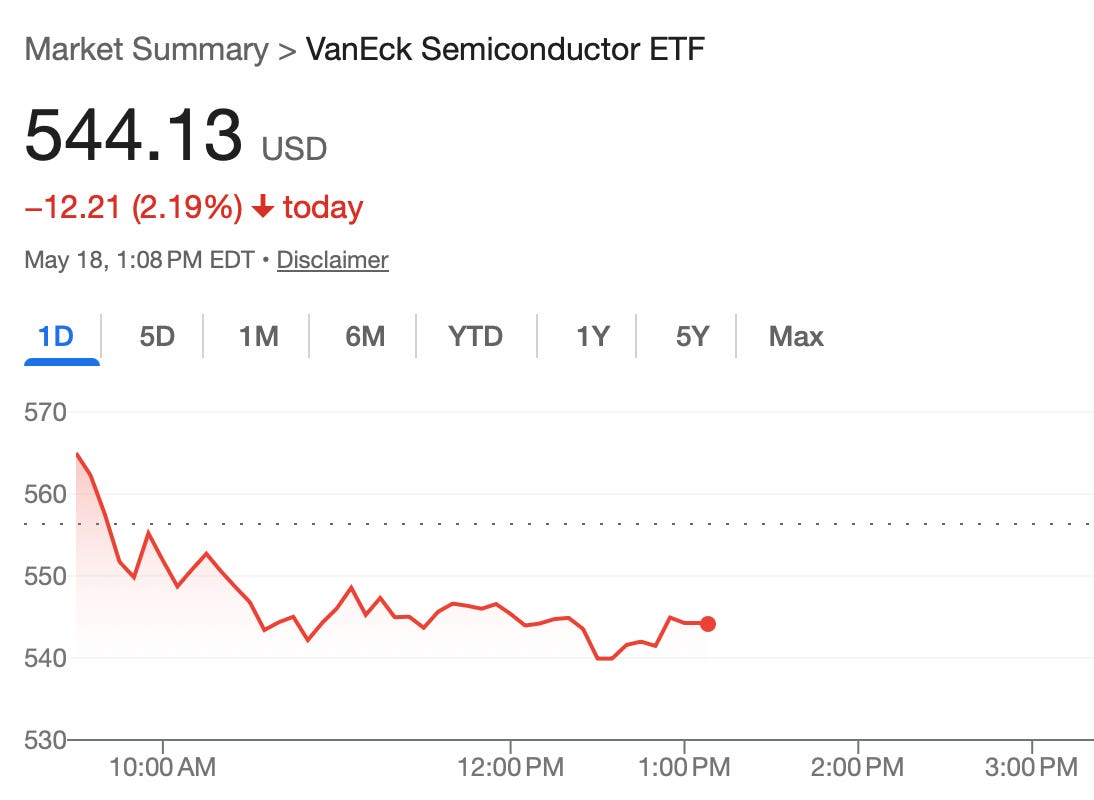
Leopold’s 13F caused a semiconductor sell-off. This Leopold sell-off has to be the most stupid sell-off in the history of all sell-offs.
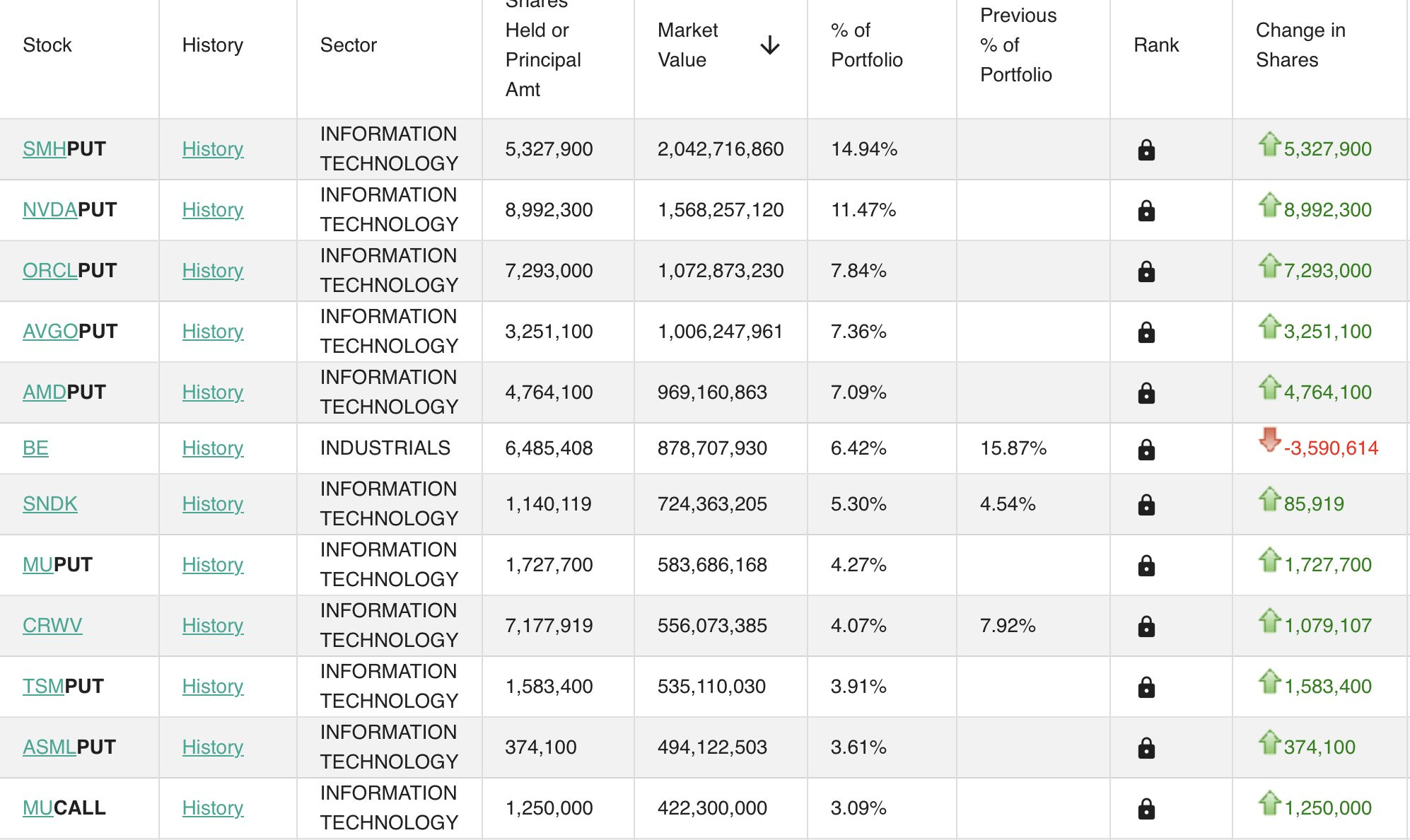
His 13F showed a very scary amount of puts on literally every single large-cap semi company.
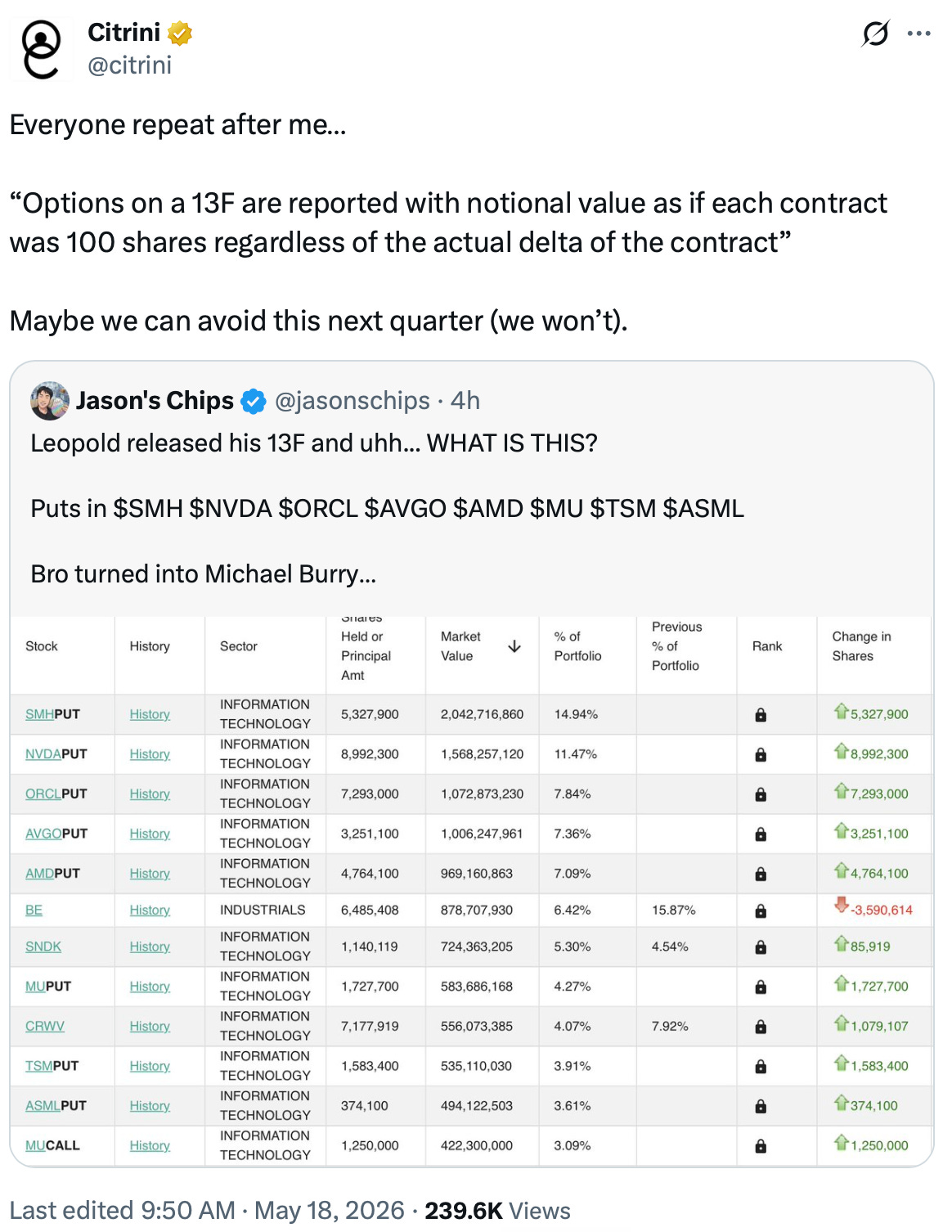
Yes, I am aware I played a part in the FUD. Citrus correctly called it out.
The lesson today is simple. OPTIONS ON 13-Fs ARE MISLEADING!!
How Options Are Reported on 13Fs
The market value row shown above is simple for shares, but not so simple for options.
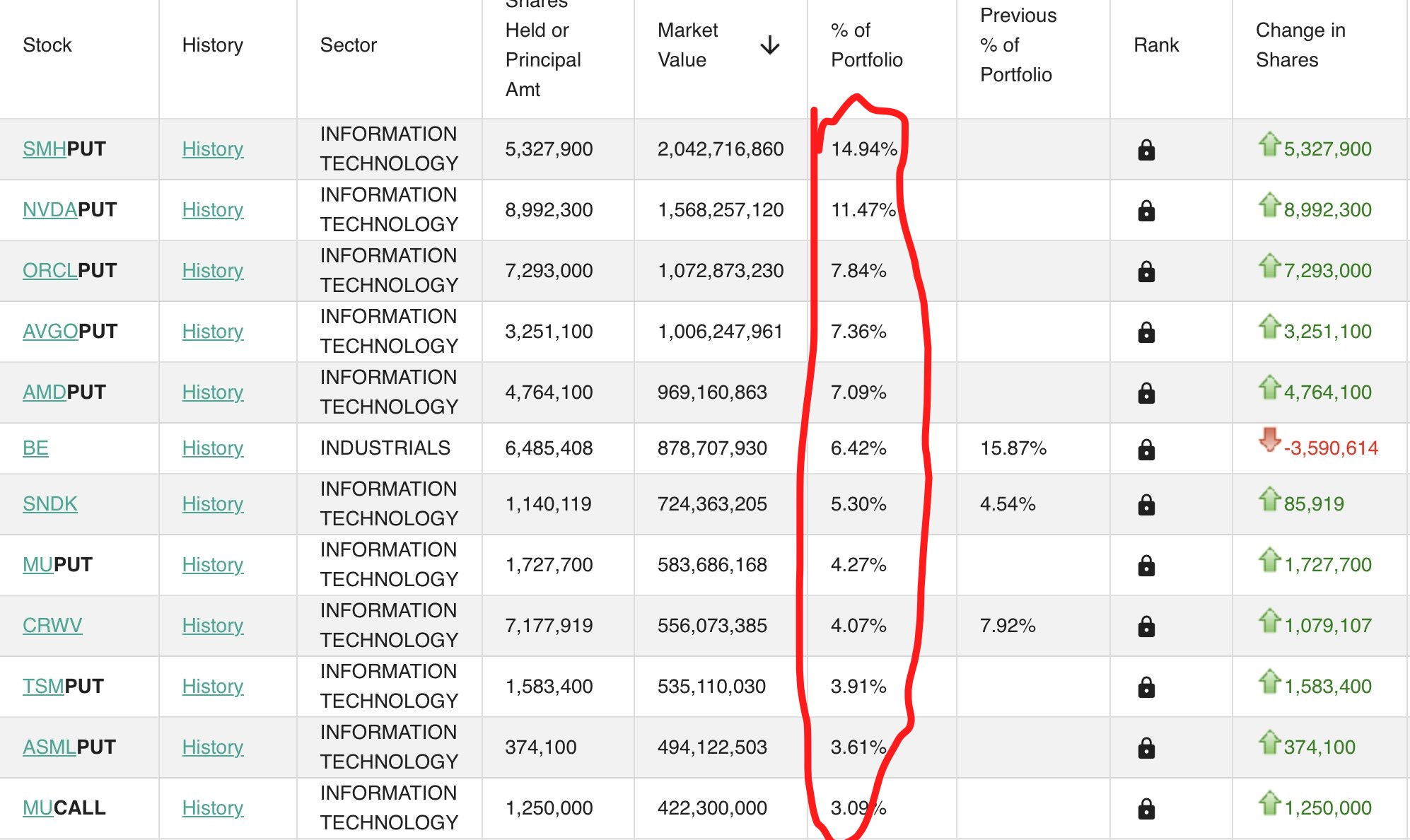
For shares, it literally is just the market value at the end of the quarter.
For options, however, it is not the value of the options. Instead, it is the market value of the shares controlled by the options.
This means that the actual market value of the options is way, way smaller than the market value shown on 13F. Plus, it is completely unknowable because we do not know the expiry date and moneyness (if it is in or out of the money and by how much) of the option. These are important because the closer the expiry, the lower the market value of the option relative to the shares it controls. The more out of the money the option is, the lower the market value of the option relative to the shares it controls.
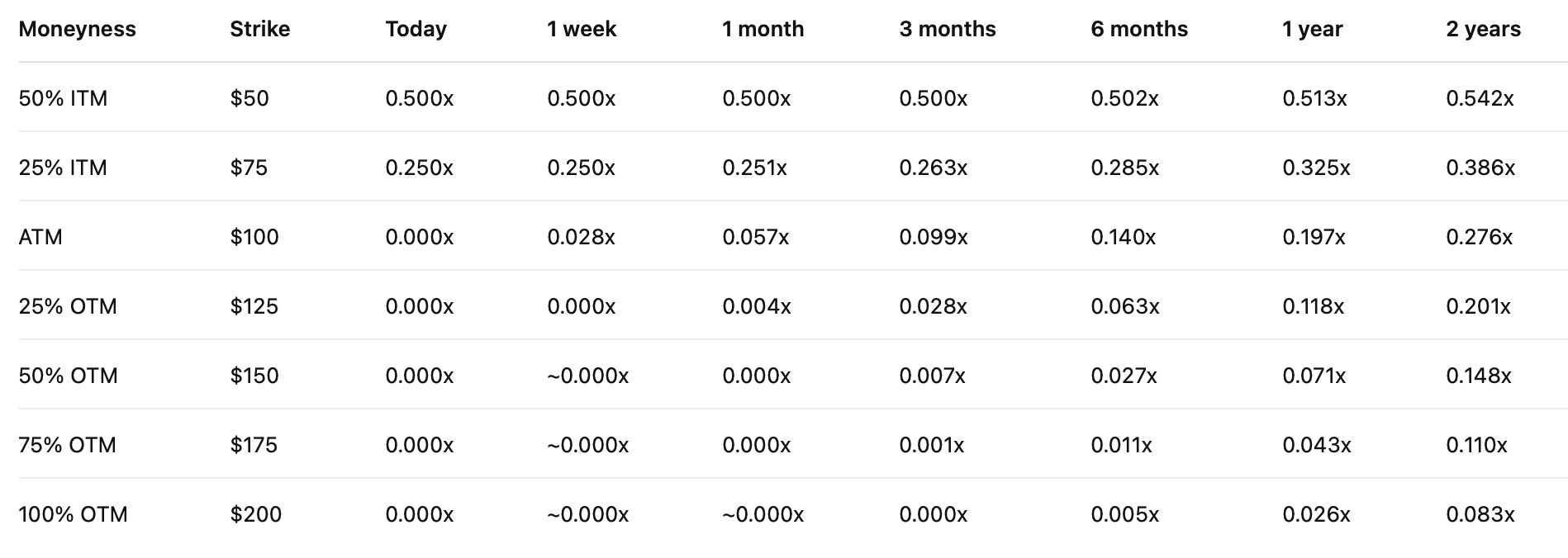
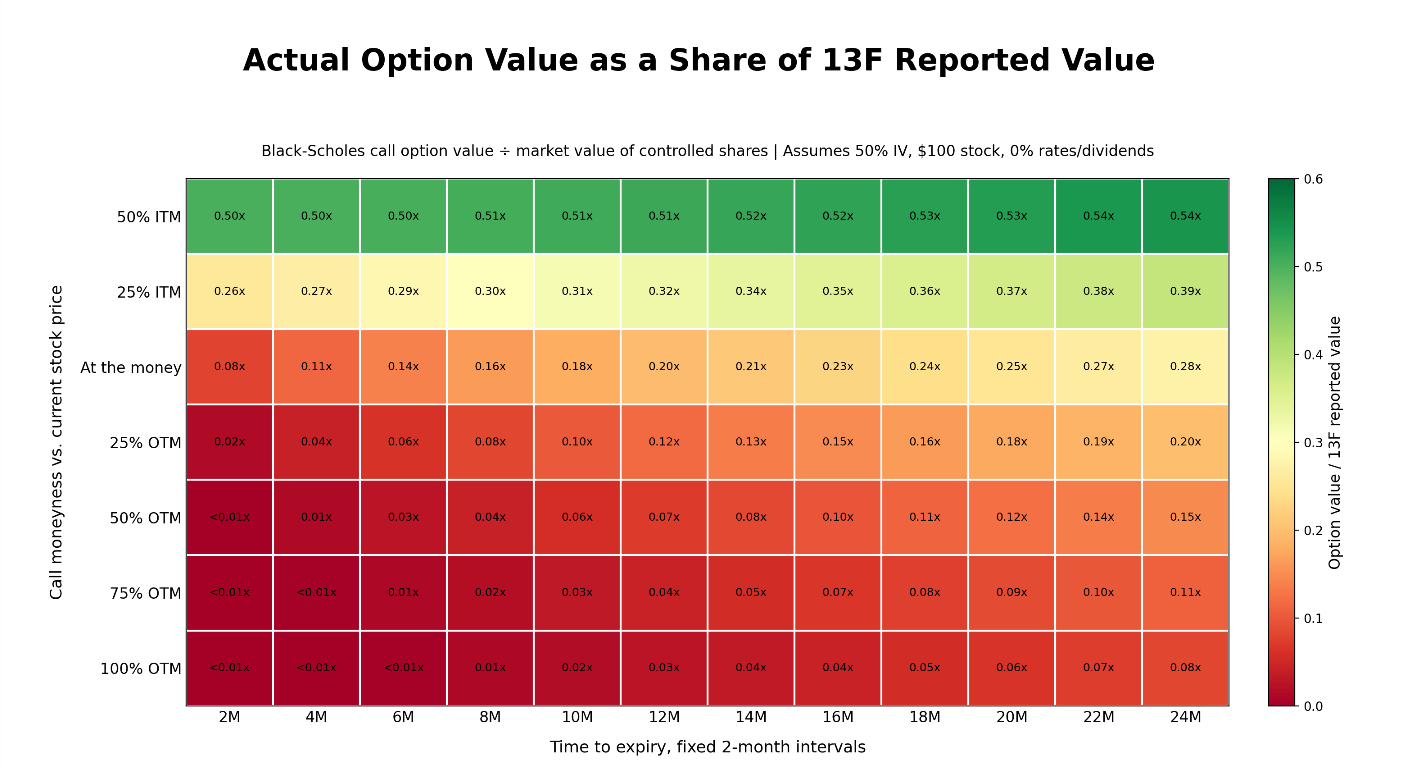
This visual really hits home. There are two main takeaways that we need to have here:
The option value is guaranteed to be very low compared to the reported value on the 13F. In many cases, it is near zero.
The uncertainty is massive. Near-term out-of-the-money options have pretty much zero market value compared to the shares they control (i.e. you can control 100 or 1,000 times your capital in shares) why long-term in-the-money options can reach 1/3 to 1/2 the value of the shares. It is an order of magnitude of uncertainty. The market value therefore is incredibly low signal.
There is a very large chance that these were one- or two-month out OTM puts to hedge Iran, in which case they are like 3% of what the 13F says they are.
Leopold’s Real 13F
So, how should we read 13Fs?
STRIP OUT ALL OF THE OPTIONS. SHARES ONLY. ONLY SHARES.
Here was Leopold’s 13F from last quarter. Meaning what he owned on December 31 2025.
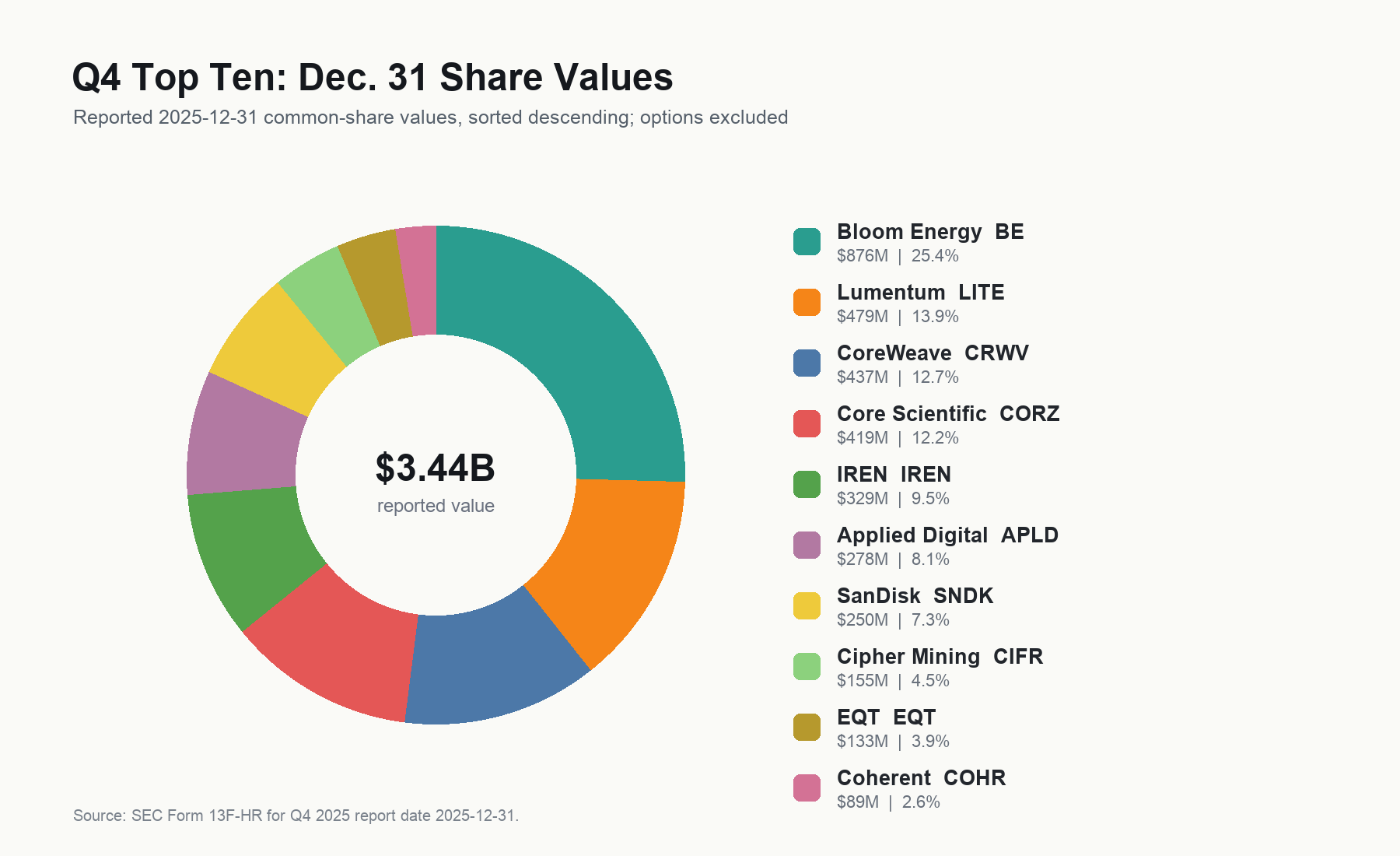
As you can see, this is basically your classic super concentrated thematic equity portfolio. Bloom, Lumentum, and CoreWeave pretty much make up half of the portfolio. The rest make up the other half. This was that big Bloom bet that he took in the beginning of the year. Notice that we’re completely ignoring the Intel calls and the CoreWeave calls. They look optically very large in the December 13F, but again, we have no idea how large they are.
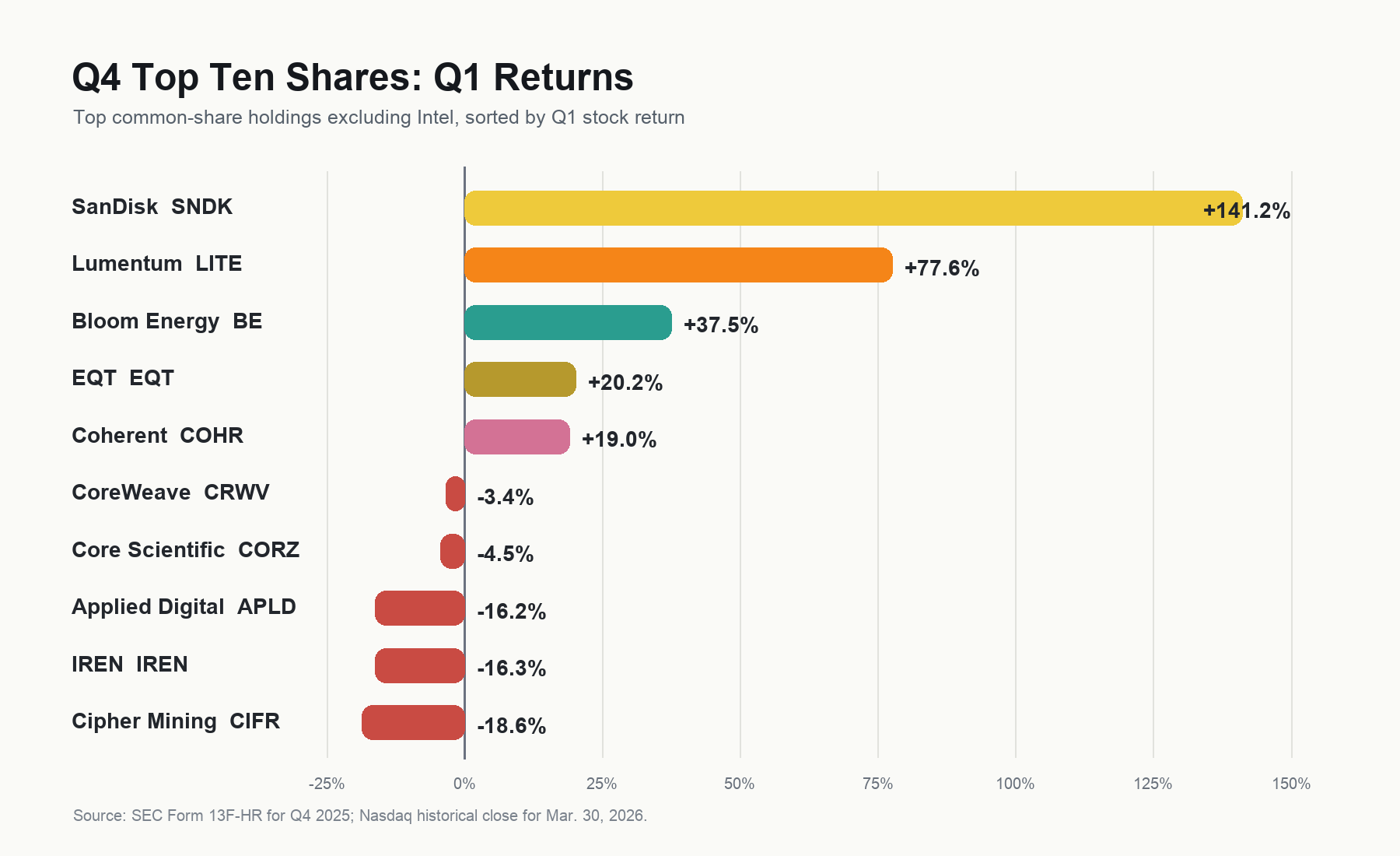
Here is how his holdings performed during Q1. As expected, Sandisk and Lumentum absolutely mog everyone else. The Neoclouds and miners are the laggards. Leopold has a pretty high affinity for the Neoclouds and miners and regularly adds to them, even through some rough performance over time. He gets his god-like status purely from his bets on the vertical chart crew (aka Sandisk, Lumentum, and Bloom). And honestly, that’s enough because I’ve never seen anybody successfully bet on all three. I am a Big Bloom Bull (BBB), but I came in late.
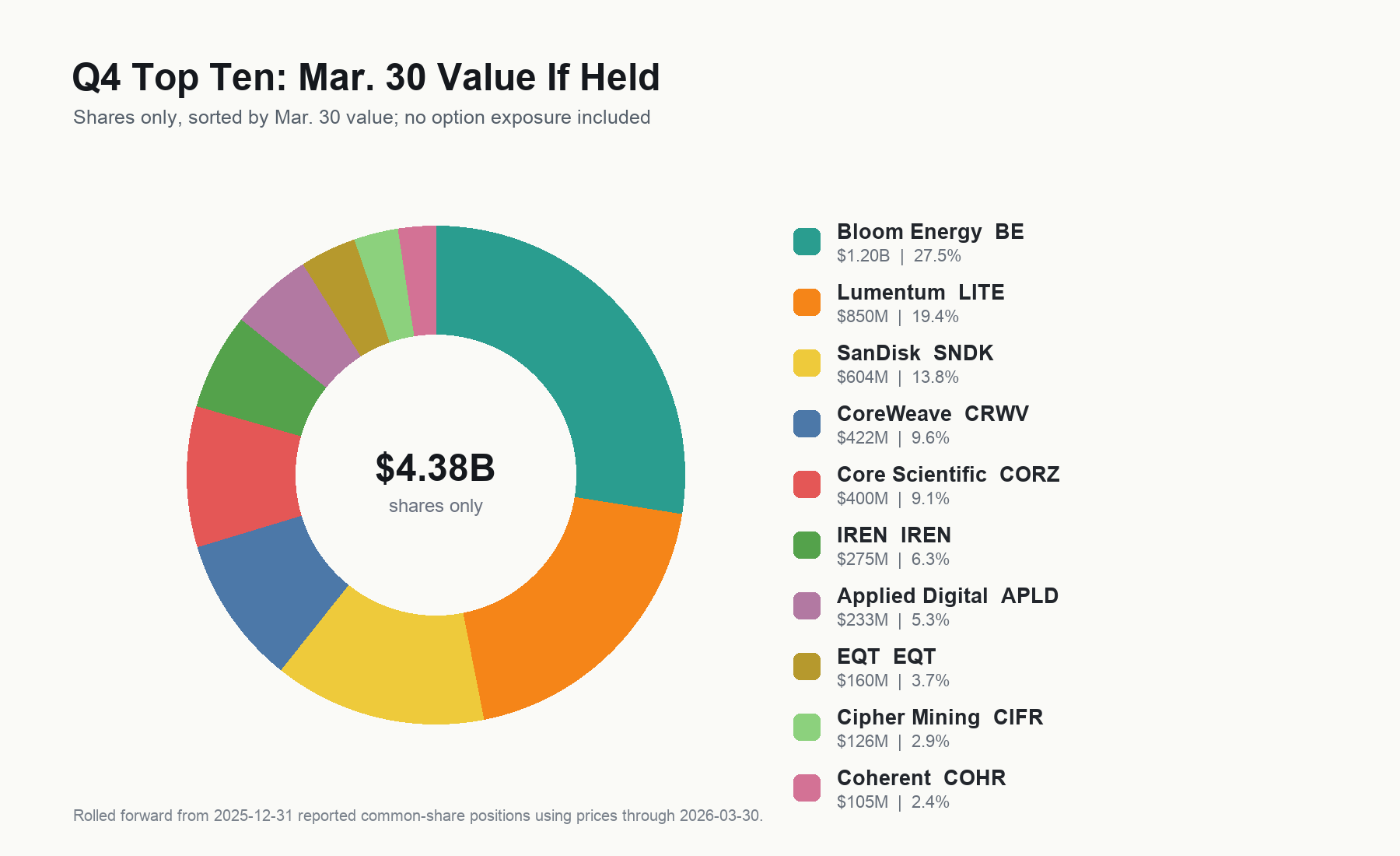
Here is his portfolio if he’d held the exact same equities through the entire quarter. His Q1 return would have been 27.3%. This is interesting because, despite a very large divergence in the performance, it looks relatively similar. At least everything outside of SanDisk. That’s really the only difference. SanDisk now takes up 14% of the portfolio, where before it was 7%. It is doubled in size. But of course, he partook in a common hedge fund activity known as “trading.”
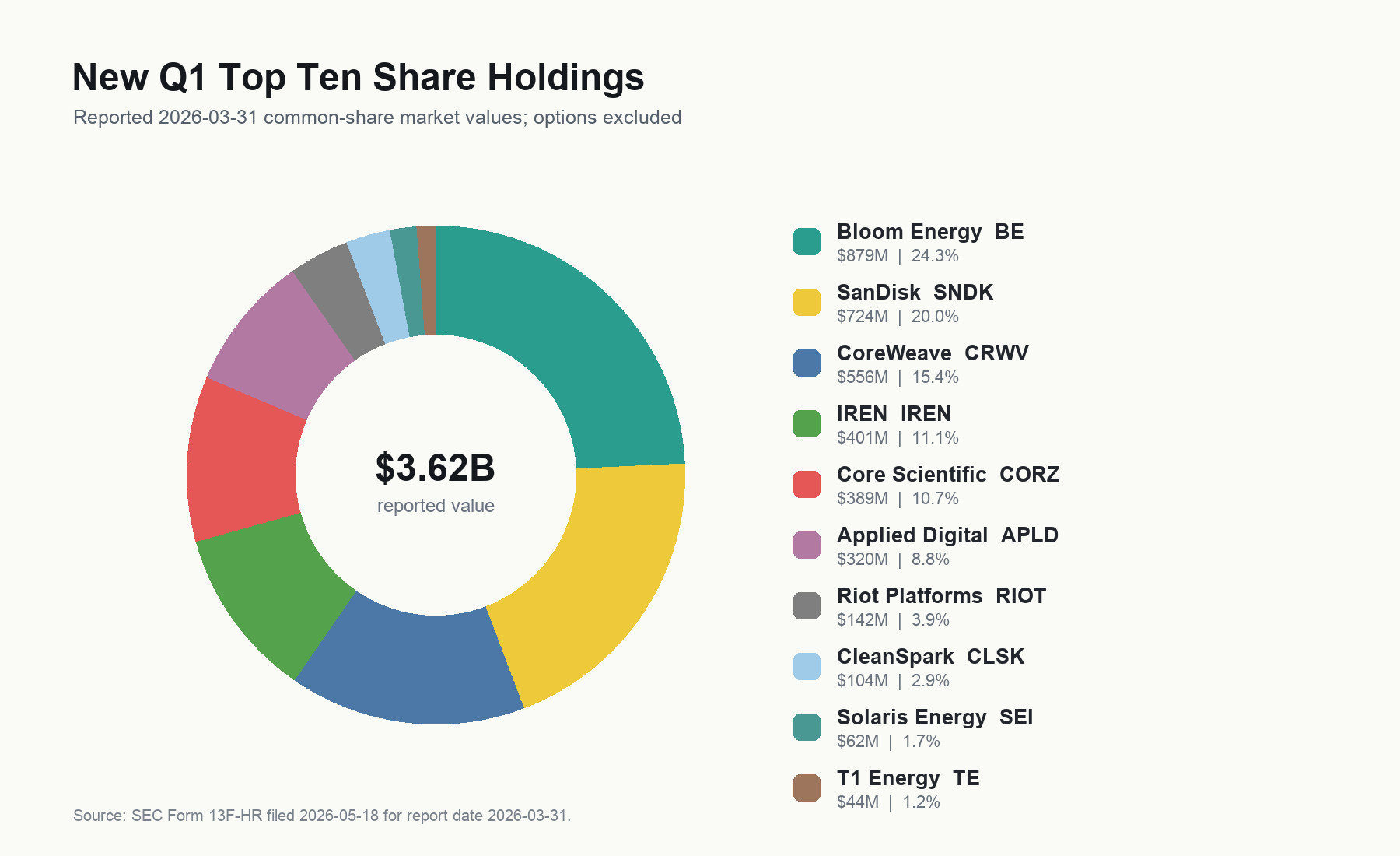
This is his new portfolio. Notice anything different?
First of all, it is only slightly (5%) larger than the Q4 portfolio.
Second of all, both Lumentum and Coherent are gone. Tower Semi, which weren’t in the top 10, are gone as well. Every single optics play was liquidated, and because this isn’t options, this is actual shares, this is real signal.
Third of all, because everything optics is gone, even though he reduced Bloom slightly by around 20%, it still makes up around a quarter of the portfolio (bc shares appreciated). His relative conviction on Bloom hasn’t really changed. The similar thing can be said for Core Scientific: reduced very slightly, but now actually makes up a larger portion of the portfolio.
Continuing on this train of thought, anything kept or slightly added to actually now takes up a larger portion of his portfolio. This includes CoreWeave, IREN, and Applied Digital.
However, the standout here is SanDisk. Not only did it appreciate materially more than the others, but he also added to it through the quarter. It is now his second-largest position, right between CoreWeave and Bloom Energy.
Below the paywall, I will attempt to read the mind of Leopold and tell you what he is thinking. I think I have read the original Situational Awareness essay like five times, and I followed every single 13F since Q2 2025, soooo I think I’m pretty qualified.

Contents
Optics Exit
Bitcoin Miners
NAND
Energy
Optics Exit
I think there’s a simple explanation here that’s generally pretty underrated. Leopold is the cult leader of fast timelines. After all, he wrote Situational Awareness.
On a podcast with Dwarkesh, Dylan Patel said this:
I think obviously Leopold, Leopold jokes that, you know, he’s the only client of mine that tells me our numbers are too low.
Everyone else tells me our numbers are too high almost ad nauseam, you know, whether it’s a hyper scaler saying, hey, that other hyper scaler, their numbers are too high, you know, and we’re like, Nah, that’s it.
And they’re like, no, no, no, no, it’s impossible, blah, blah, blah.
And then you’re like finally have to convince them through all these facts and data when we’re working with hyper scalers or AI labs that in fact know that number isn’t too high.
But eventually and eventually, like sometimes it’s like 6 months later, it takes them to realize or a year later, I think, I think other clients like on the trading side also use our data, right.
And I will say Leopold is pretty much the only person who tells me my numbers are too low always.
If you have by far the most bullish view on AI out of all major investors, and your fund is literally a mandate to express that view, would you be biased towards or against a technology that only reaches mass adoption in 2028?
The logic is that if we know the beats across the infrastructure ecosystem will be gigantic, we will see massive beats in more near-term plays like memory, Neoclouds, and miners, causing those stocks to re-rate, while optics will have to wait until Feynman to see major beats. We might have to work through years of conservative inline guidance before we see any upside.
I am not Leopold, so I don’t know if this view is right. I am just speculating here, but it seems like a solid guess and would be a logical position to take.
Bitcoin Miners
Leopold aped 35% of his portfolio into miners in Q4 and 37% of his portfolio into miners in Q1. CORZ, IREN, APLD, CLSK, RIOT are all pretty much the same type of business.

I think this is a basket bet. These miners don’t really have any differentiation besides execution, and their moat is near infinite switching cost and cornered resources. This means that stock picking is a lot harder, and a basket approach actually can reduce risk.
His favorite is still CORZ, as is mine, due to their forward observer pre-build strategy, which can allow them to get higher contract pricing, as well as their densification of their campuses using Bloom.
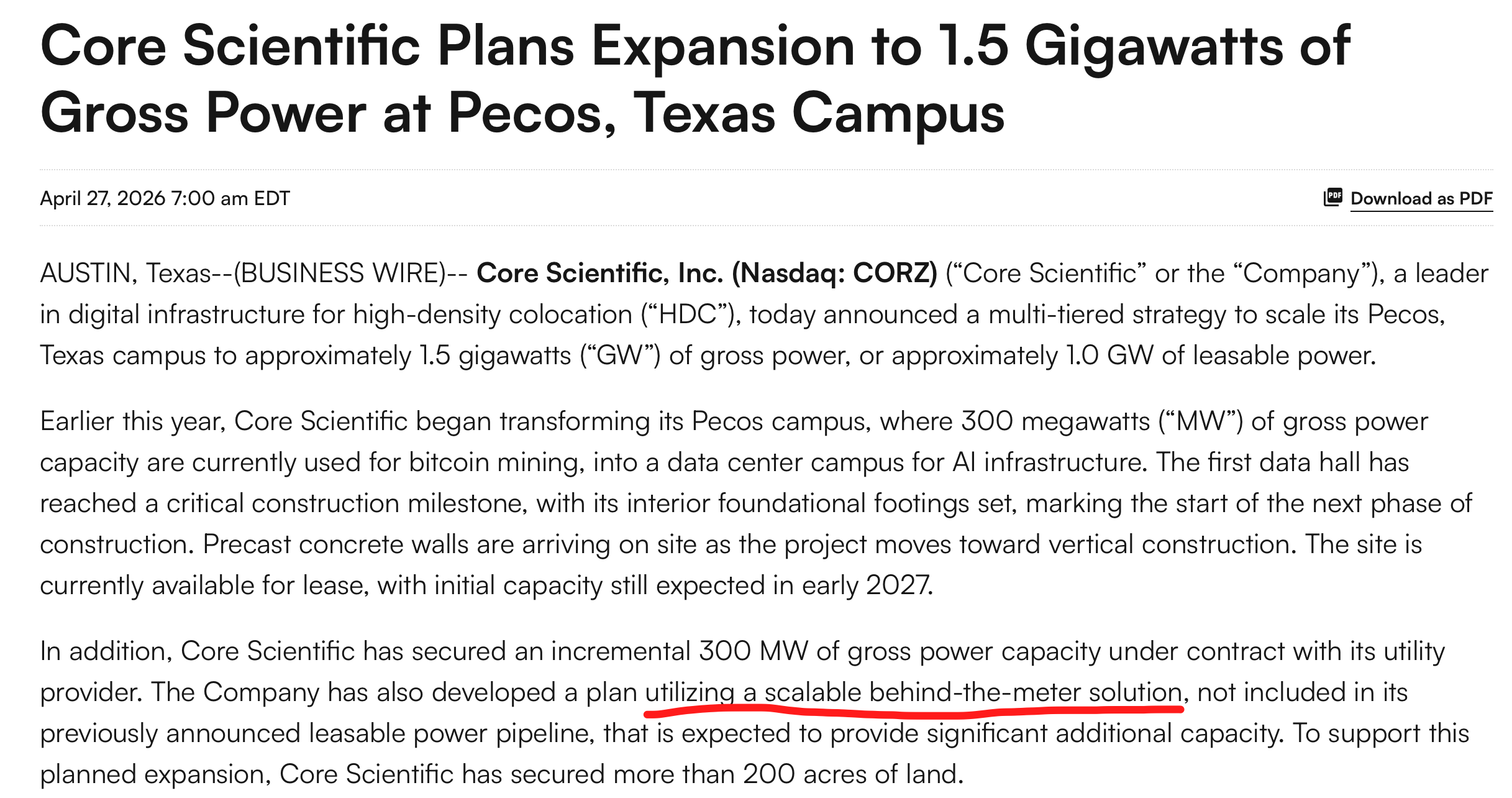
A.K.A better execution.
But why so much of the portfolio? Bitcoin miners are a time to power bet. It fits very well with the fast timeline thesis. Self-build takes way longer. Much of it is the permitting of sites, but the labor and experience is underrated as well. The miners provide both the sites and the experience of building high-density compute clusters from their crypto days.
NAND
NAND is probably the most interesting one. Notice that he bet on SanDisk and not Micron or SK Hynix.
Why NAND and not DRAM? I believe it comes down to supply and demand. DRAM wins the supply side while NAND wins the demand side. I generally don’t have a view that one is absolutely better than the other, but I do think that DRAM is the safer bet while NAND is more degen but has more upside.
Read this article if you want to know why DRAM wins in supply.
For why NAND wins in demand, there are a few simple reasons:
Think about AI data as a stock and flow model. The KV cache of all inference happening at any time is the flow, while the amount of data created by AIs in inference is the stock. NAND therefore captures the stock, while DRAM captures the flow. This is a vast oversimplification, but you can imagine that the stock can grow much faster than the flow.
NAND KV cache offload. This is a bet on long context overflowing our current ability to store it in DRAM. NAND therefore acts like a call option on all of the data demanded but not able to be fulfilled in the KV cache. Obviously, this would be beneficial if you are trying to play the possibility of bit demand vastly outstripping supply.
AI workloads cause SSDs to be much more write-heavy than before, so the more intense AI demand is the faster SSDs get worn out from all of the writes and the more of a consumable that SSDs become.
These factors are all demand-side drivers and kick into high gear in a fast-timelines world. In a slow-timelines world, supply matters much more, which is where DRAM provides more of a safety net. Given Leopold’s world view, NAND fits it much better.
Energy
Leopold’s energy portfolio is mostly Bloom with a tiny bit of mobile gas turbines (Solaris Energy) and solar (T1 Energy). We will focus on Bloom here because it is pretty much a dozen times larger than his two other energy bets combined.

Bloom Energy is, in my opinion, the best AI energy solution in the world. Leopold obviously agrees. However, this is debatable, and you could reasonably take the other side. The capex per megawatt is still noticeably higher today. But there are two unarguable benefits that Bloom provides, which fit perfectly into the fast timelines thesis.
First is time to power. Bloom is the only solution that is available in months rather than years. This is pretty much consensus, even among Bloom bears. They argue that time to power is not enough to drive investment due to the higher upfront cost. But if you are playing fast timelines, fast time to power is a must.
Second is flexible capacity.
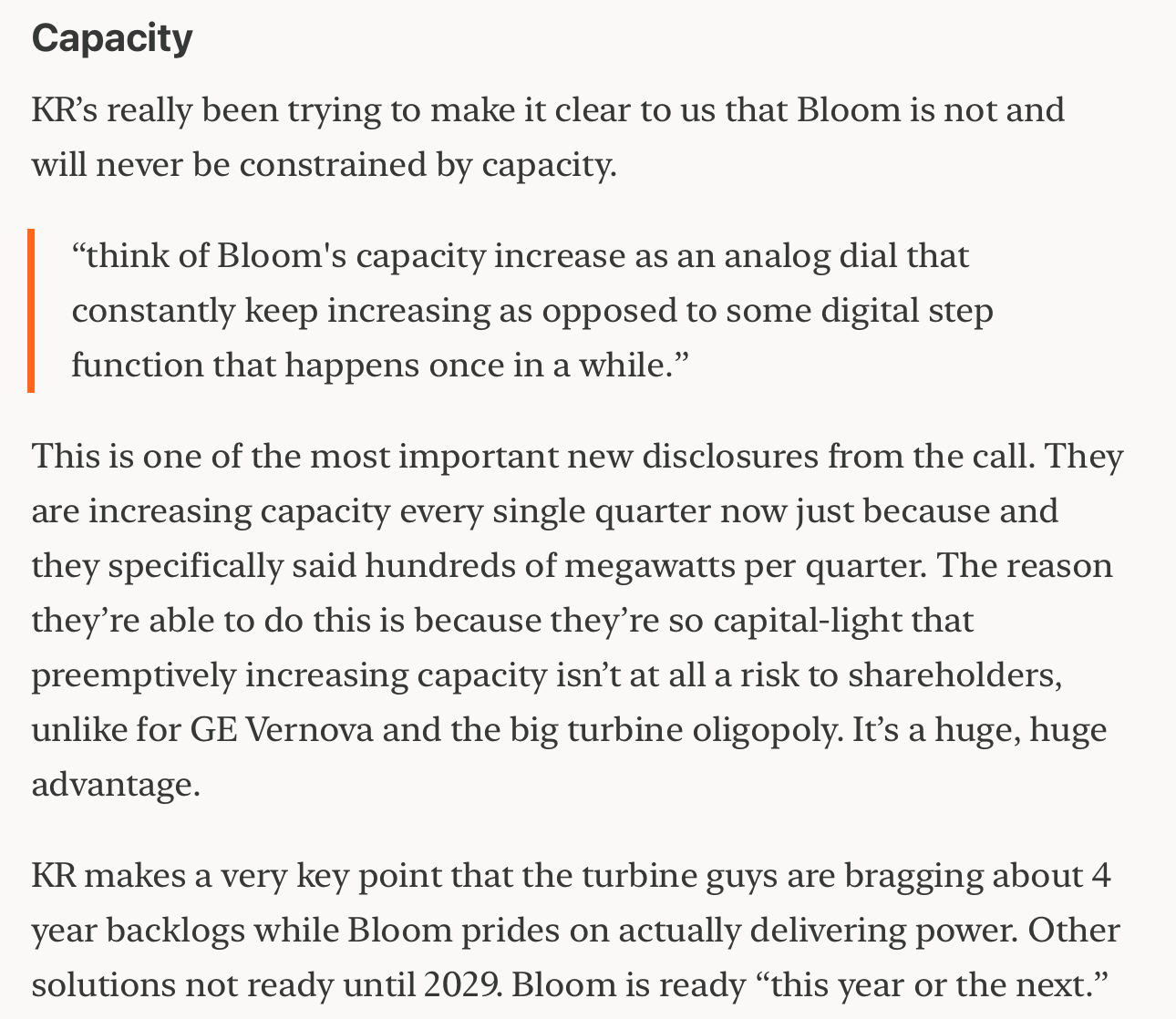
Bloom essentially acts as an overflow valve for gas turbines. This is perfect for fast timelines because the more demand is above expectations, the more orders fall into the overflow bucket. Think of it like a call option that captures only the upside above the current available capacity.
I like your writing style and the way you think. Thanks for doing this.
This is the best SALP take I’ve seen across the whole internet