

Apologies for the low posting frequency this week. I have been inundated lately. I know people have been asking for portfolio reviews, so I am getting this one out first.

In terms of the YTD the reason why my monthly and weekly portfolio reviews have sort of different numbers is only because of the measurement technique since I’ve been adding capital throughout the year.
(imagine you are adding capital every day to an index fund, and the index is going up, your returns on your brokerage, AKA a MoM or MOIC, would be lower than the returns of the index, AKA capital agnostic CAGR.)
Measuring it the other way would be 195%.
I honestly don’t know which is the better measure, as both are gameable, so whatever. I am up anywhere from 150-200% in less than 1/2 a year without leverage which is not bad in terms of stock picking abilities.
There is a lot of change this time. Specifically, there are 4 new positions a bunch of exits and I’ve made one company ~25% of my portfolio. Also featuring CPO discussion, a cool podcast, sell-side research, macroeconomic theory (not microeconomics this time), and the interesting stuff that happens when you try to DCF a co-location provider.
By accessing this content, you acknowledge and agree to our terms and conditions. This research is not financial advice.
Lumentum (LITE)
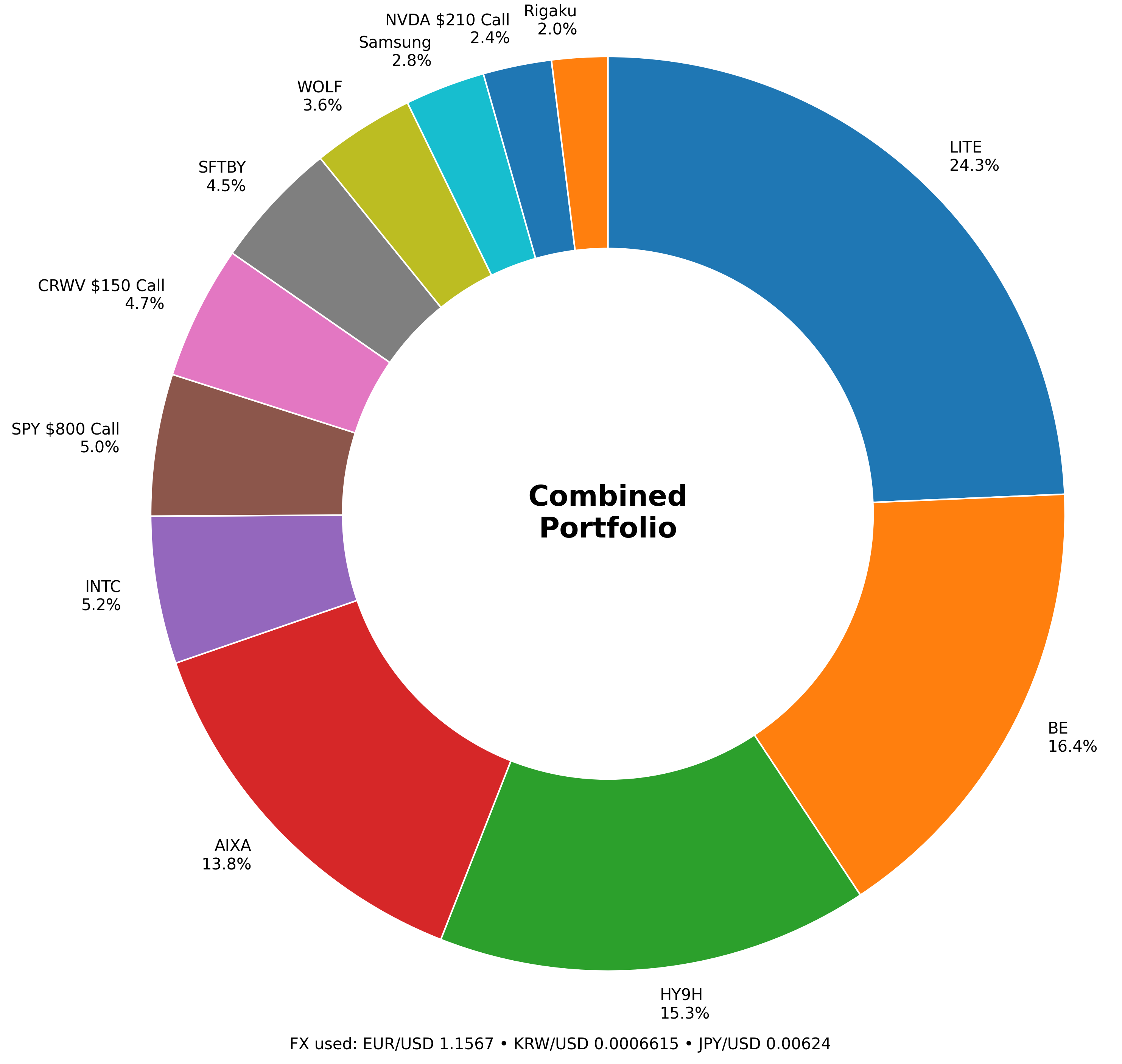
Portfolio Allocation: 24.3%
May Performance: -5.25%
Change: Massively added
Yeah, I have a fat retarded LITE position.

CPO is already doing $200-400 million of revenue run rate at this very instance. This is while we are at the very bottom of the CPO S curve. The very first low-yield shipments of scale-out CPO switches (that people seem to be hating on) will S-curve, creating a ton of laser demand. Then phase one scale-up CPO will S-curve starting 2028. Then phase two scale-up CPO will S-curve starting 2030. So it’s just S curve after S curve after S curve.
We also have NPO and Lumentum CEO saying that it could be a larger opportunity than CPO. Obviously, it wouldn’t be the case long-term, but I think he’s referring to the medium-term, especially 2027. NPO seems to be replacing Kyber Racks in Rubin Ultra, which is exciting. They can sell lasers into this market. To anybody who thinks that NPO cannibalizes CPO and is bad for LITE, you can sell me your shares.
I’m also doing more work on OCS, which now seems to be much more compelling than I originally thought.
Bloom Energy (BE)
Portfolio Allocation: 16.4%
May Performance: +0.58%
Change: Massively added
Bloomentum now makes up 40% of my portfolio.
I don’t cover this company in as much depth as the Optics names, so we’ll probably have some more articles out on this one. The next two will be on their native 800 VDC advantage and their unit economics, respectively.
There’s this great podcast by K.R. Sridhar (Bloom CEO) that I really like.
This dude is based. You need to listen to him talk on earnings calls and podcasts and whatnot. He will hype you up.
They’ve been doing this stuff since before 2000 and have accumulated hundreds of patents over the years, making tiny little tweaks in the process technology of making fuel cells. Each patent solves a small issue which becomes an integral part without which the whole system cannot function. You think pre-volume upstarts like Ceres can replicate all of that?
SK Hynix (HY9H.F)
Portfolio Allocation: 15.3%
May Performance: +74.34%
Change: Trimmed a tiny bit?
Not my biggest position anymore.
Memory is still the single biggest binding constraint in AI. Intel (and maybe Samsung) might just solve leading edge logic. InP/CPO won’t be a problem until much later. Everything else only affects a certain architecture (like M9 CCL for Kyber) so in any case, the industry can probably route around it.
Memory is literally a tax on everything and everyone. I think it’s foolish not to have a memory allocation in an AI infrastructure portfolio, and honestly it is more of a hedge.
SK Hynix is also a backdoor Kioxia play. Did you know they own 33% of Kioxia? That is now 9% of their entire market cap because Kioxia has 7x’ed year to date.

Aixtron (AIXA.DE)
Portfolio Allocation: 13.8%
May Performance: +23.97%
My whole portfolio is literally just four companies.
I pretty much haven’t touched a single share of this company since I bought it in October of last year. LMAO. And I will not ever touch it.
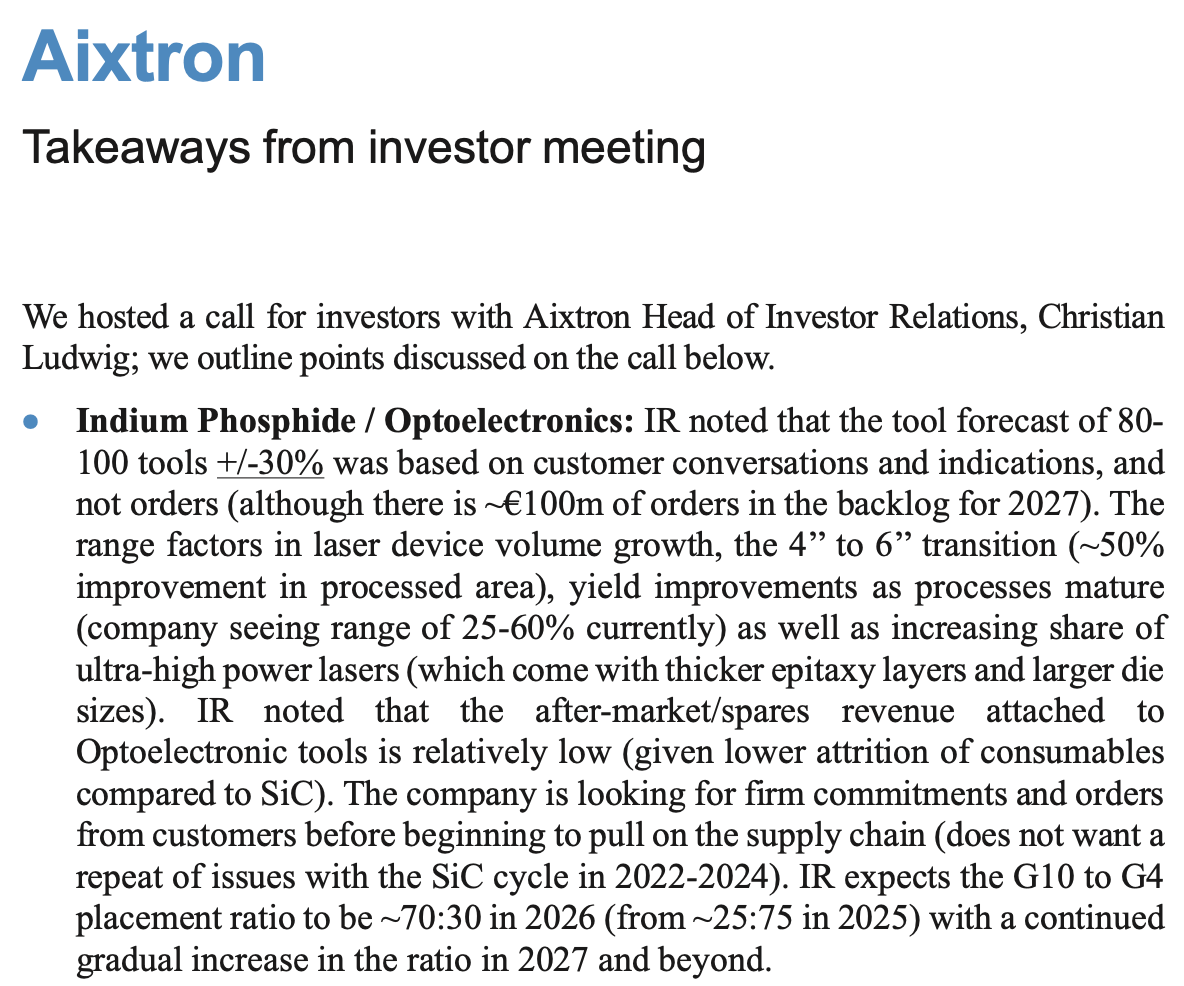
I will be working on finding out what is the purpose of those 80-100 tools, and when that capacity is coming online.
This is important because if they are for CPO (or coming online in 2028 or later which means they are for CPO) then Aixtron’s revenue will inflect as CPO adoption S-curves into 2030.
If they are not for CPO…
Well, remember that the die sizes for CPO are way larger, which requires more MOCVD machine time?
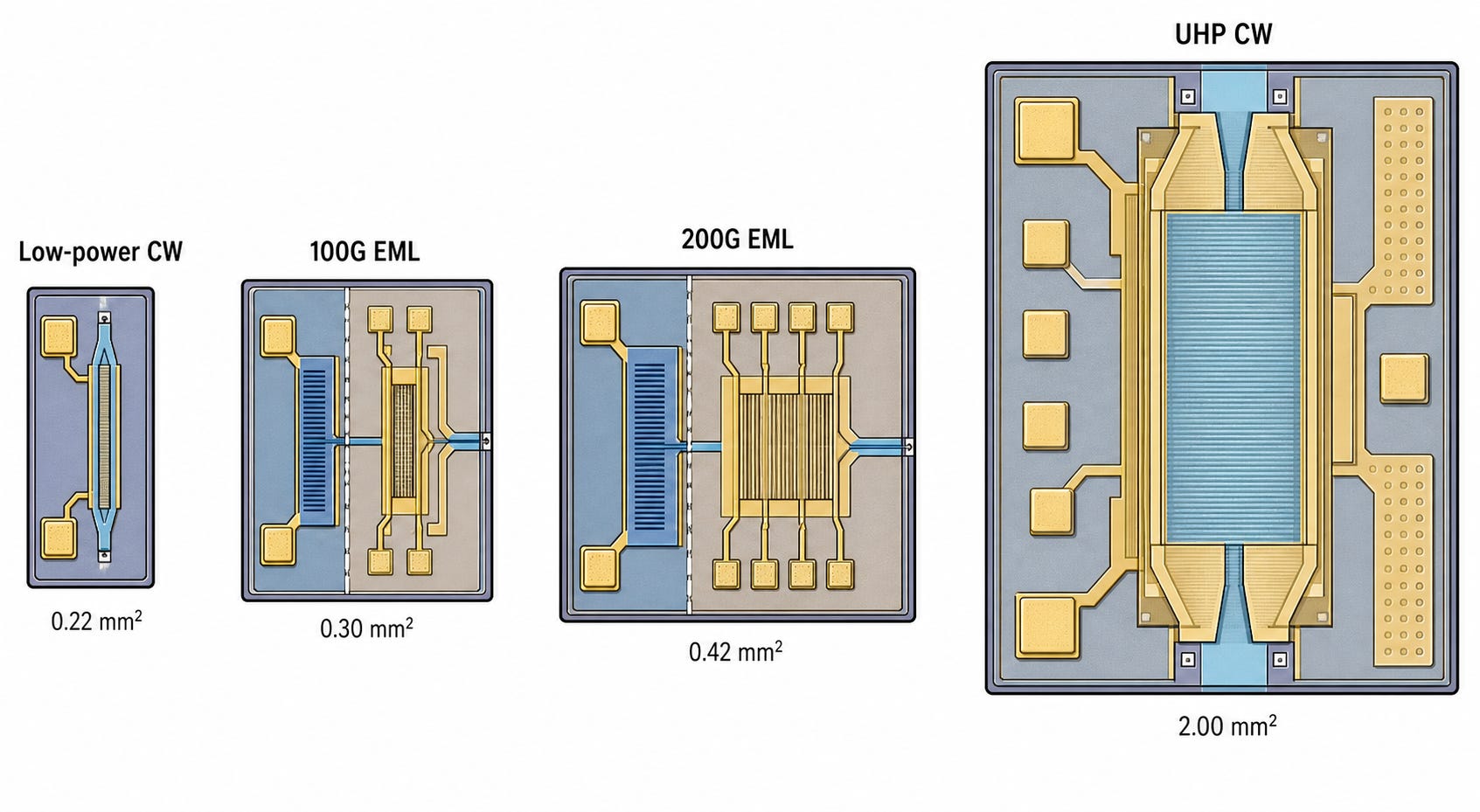
Then those tools are currently for EML/CW, and we would actually need an order of magnitude more tools when CPO and Aixtron become the single biggest binding constraint in all of photonics!
Also, Coherent-Lite could be interesting. Very big surface area.
Also, power semi (GaN and SiC) could be interesting.
Intel (INTC)
Portfolio Allocation: 5.2%
May Performance: +21.38%
I trimmed this one. Nothing really changed except for the valuation. I still think it can go to over $1T, possibly even 2 or 3 trillion, but 1 trillion is less than a double from here.
Unlike with Soitec, I am never gonna sell this thing. We’ll just let this run no matter how expensive it gets.
Degen SPY Calls
Portfolio Allocation: 5.0%
May Performance: +5.26%
Change: Trimmed
I am a little afraid of the macroeconomic theory of higher productivity increasing equilibrium real interest rate (r*) and want to get into robotics, so low key this position will not last.
Basically, here’s the intuition. If AI/Semis/Robotics becomes the industry producing the highest, most unimaginable productivity gains in the economy, it becomes a capital black hole, sucking out investment from other industries. All of a sudden, owning Walmart and Costco at 50x PE or Coca-Cola at 25x starts to make no sense.
But more importantly, nobody would want to put their savings into treasuries and other passive instruments and make a 5% yield when the AI economy is going bananas. Therefore, yields rise, the risk-free rate rises, and macro valuations should compress.
There’s also another lens, which is more academic, which is that demand and supply for savings and investment gets impacted as the demand (investment) has a positive shock (companies building data centers) and the supply (savings) has a negative shock (people taking out their savings to either spend or invest in AI companies).
CoreWeave (CRWV)
Portfolio Allocation: 4.7%
May Performance: -1.85%
I’ll have another article out about CoreWeave shortly. Still think it is a shitco that may eventually un-shit itself.
Think about it this way: currently, CoreWeave signs deals at $9 million per megawatt, while SpaceX just signed $50m/MW with Anthropic and Google. CoreWeave’s margins are absolute dogshit, so they trade at very low multiples. What’s the core difference between CoreWeave’s data centers and Elon’s? What happens to CoreWeave’s dogshit financials and multiples if the revenue per megawatt closes the gap with SpaceX even slightly?
There can be a few mechanisms for this. Here’s one as a teaser: every year, Nvidia passes more value to its customers in performance gains than it is able to capture through higher ASP, and that is structural, because otherwise Nvidia would literally hike its prices by 100x every year. However, the economic value of this performance doesn’t just disappear. If you are the first entity in the chain to have access to this free producer surplus, why wouldn’t you capture it?
SoftBank Group (SFTBY)
Portfolio Allocation: 4.5%
May Performance: +39.12%

Wolfspeed (WOLF) *NEW
Portfolio Allocation: 3.6%

Wolf speed is a book value + long-term technology S-curve dumbbell hybrid and funny shitco memeco play.
The book value is that they have sunk $6 to $7 billion into SiC capacity pre-bankruptcy and now trade at less than half of that.
The long-term technology S-curve is solid-state transformers, which are necessary for the final stage of native 800 VDC, sort of like the scale-up CPO of the power world, which will inflect in 29/30.
Samsung Electronics (005930.KS) *NEW
Portfolio Allocation: 2.8%
Moar memory exposure.
With a bonus of a heavily discounted logic fab, which is implied to be worth 200 billion but probably should be worth way more. This probably doesn’t matter, because even if the value of the logic fab goes ballistic, most of the enterprise value is still memory. It’s really still a memory play. Oh well.
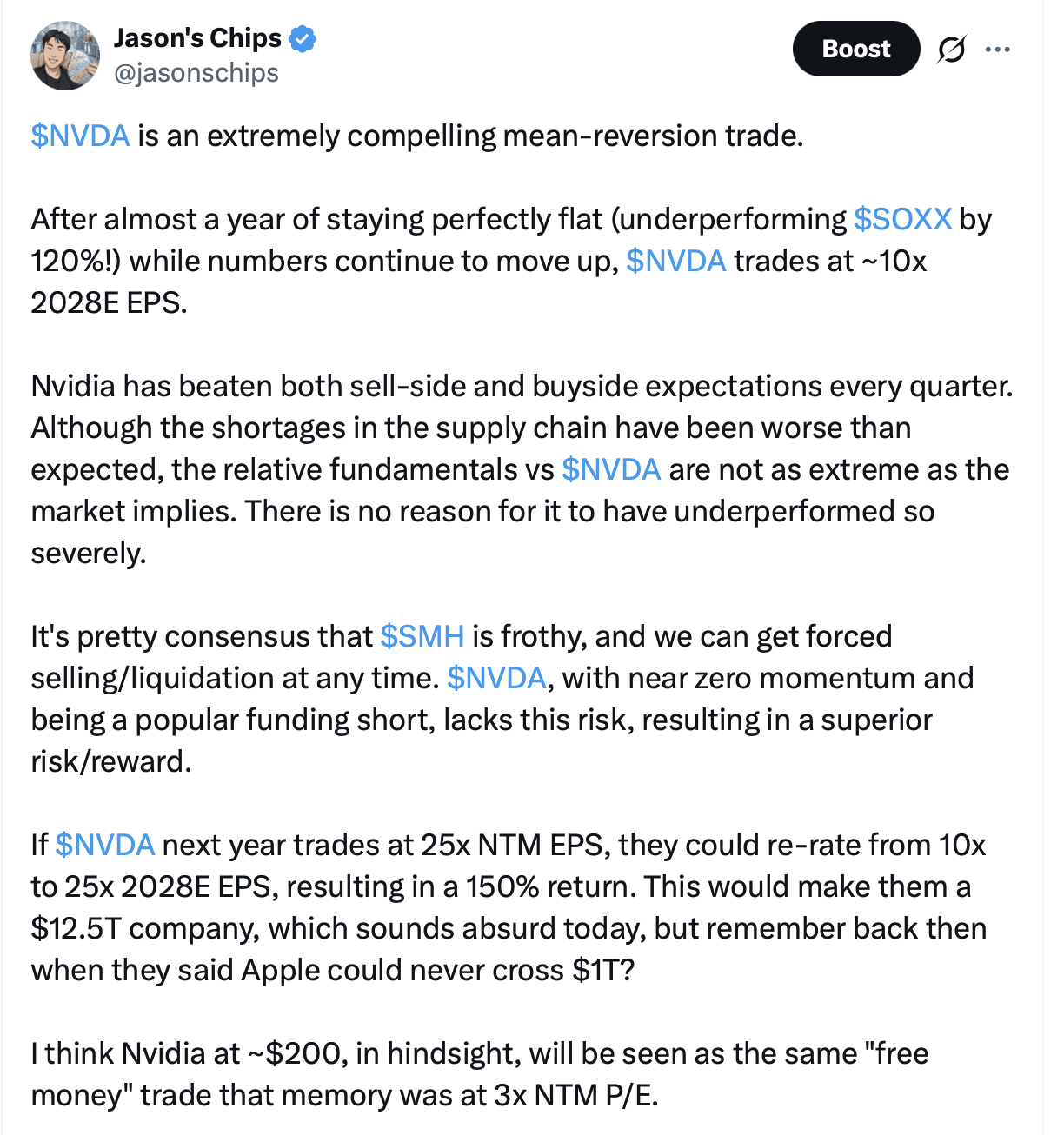
Degen Nvidia Calls *NEW
Portfolio Allocation: 2.4%
Rigaku Holdings (268A.T) *NEW
Portfolio Allocation: 2.0%
Opposite of a shitco.
These guys are a Japanese company that makes X-ray inspection equipment. Onto and Camtek competitor (but it’s better because Onto and Camtek use optical/infrared not X-ray).
Basic thesis is that x-ray machines are great for 3D chip structures and are needed in GAA/CFET, hybrid bonding, GaN/SiC and more. Consensus doesn’t have this thing growing fast at all. I haven’t done too much work into it yet, but it seems like a very safe bet.
More intuitively, you can think about it like: the installed base of X-ray equipment we need for advanced silicon with weird 3D structures is probably a lot higher than what is being implied in Rigaku’s earnings which are projected to grow at low double digits.
Core Scientific (CORZ) *EXIT
I exited to finance my LITE.
I spent more time modeling this one and just concluded it is too hard to have a view on the valuation of these things, because pretty simply, colo providers have to spend double-digit millions per megawatt to make single-digit millions per megawatt per year in revenue. Almost all of it must be equity financed.
So essentially, if you buy the stock today, you really don’t own any assets. It’s just a wrapper on a financing vehicle. Therefore…
Small tweaks in assumptions in CapEx costs, or contractual revenue, or growth rates, or interest rates can move the DCF NPV from negative to like $100b+.
I am still positively biased towards these companies because of their inherent time to power and permitting advantages, but again, it is too hard for me to have a view on the valuation/financials.
But usually whenever I sell something it’s a massive buy signal so this is your chance to buy these guys before a massive deal is announced!
SK Telecom (SKM) *EXIT
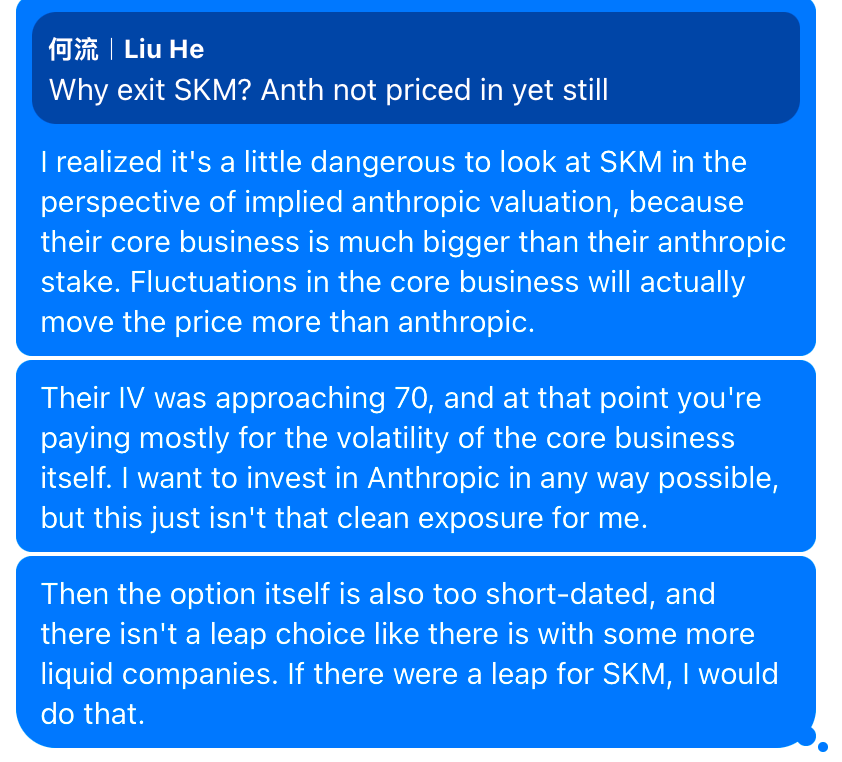
Just buy them at IPO honestly. The signal-to-noise ratio here is terrible, and the hedge is just nowhere near good enough lmao.
Winner of giveaway is @Andrew
When is the expiration date of your nvda call?