

Opinions are my own and do not represent past, present, and/or future employers. All content is based on public information and independent research. This newsletter is not financial advice, and readers should always do their own research before investing in any security. I am invested in the semiconductor industry. As of the date of this publication, I may hold long or short positions in the securities discussed in this article.

At the end of March, the price of my paid subscriptions will increase by 2x. Readers who subscribe in advance will be grandfathered in at the lower price.
In February, I returned 16.17%, delivering real alpha this time as the market was relatively flat. SMH returned +0.72%, QQQ returned -2.34%.
I added 3 positions and exited one, for 13 positions total. Today I yap about February happenings, provide updates and thoughts on my positions and whether I added or trimmed this month, and discuss the strengths of my key themes.
Outline
Macro View and Positioning
Key Themes
Portfolio Allocation
Positions
Macro View and Positioning
Feb 2026 was the month of SaaSpocalypse and AI-disrupting-everything-fear-selling. Good thing we hide away in the AI infra supply chain and don’t feel any of it.
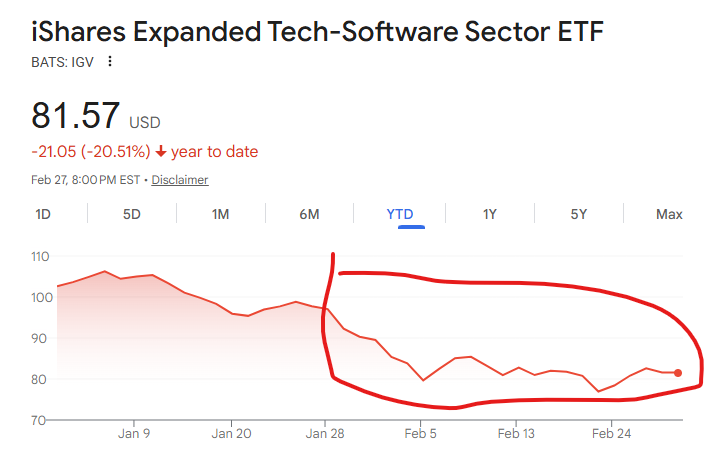
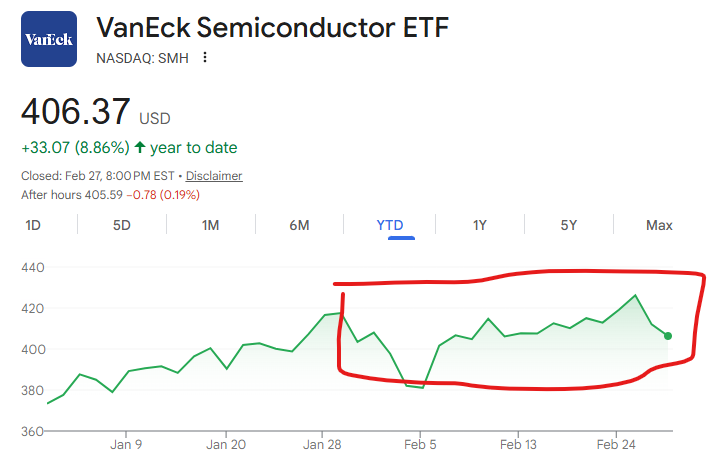
You would think if we believe AI will replace trillions of dollars of software this means people have completely flipped on the AI bubble narrative and now think AI is worth the capex. But that’s not really the case. SMH is relatively flat.
What’s really been going on is people’s belief in AI as a net-negative for the economy and financial assets. That is the key theme of this month. There’s this niche author called Citrini who wrote a really undiscovered article about it and I think he summarized it well.

What do I think? Well, it depends. If you know anything about economics you may be familiar with the idea of Keynsian economics vs the Real Business Cycle (RBC).
Basically it goes something like the Keynsians are demand-driven and if demand drops, like people don’t have the money to buy stuff or don’t want to buy stuff then businesses won’t invest in the means of production to produce it, resulting in a vicious cycle. The RBC guys are supply-driven and say that if a fundamental input is made cheaper, productivity rises which makes everyone richer, resulting in a virtuous cycle.
Generally the Keynsians are right in the short term but the RBC folks are right in the long term. This is probably true for AI. Because the obvious effects, such as job loss, are immediate, while the hidden effects, like the removal of economically wasteful friction costs, take time.
If you get fired, you feel it immediately. But the cost improvements don’t fully ripple through the supply chain until years later.
I generally lean towards the RBC camp. That’s because we’re guaranteed to reach the higher productivity end state eventually. Whether we get there too abruptly and cause the Keynesian disruption or move slow enough for people to adapt is a matter of chance.
Key Themes
I still structure my portfolio for approximately 3:2:2 exposure to optics:memory:logic (leading edge). Compared to January, I’d say my conviction in optics has increased relative to the other two, and so has my allocation to it.
Optics
February was a pretty crazy month for optics names. We started with the massive Nvidia CPO pull-forwards, causing a 2x rally in LITE, and ended with the absurd guide from AAOI. I think the fundamentals here are only accelerating.
Optics is special because it’s a share gainer. Within a larger compute supercycle. Sometimes it’s really that simple. Crazy.
Memory
My stance here does not change.
Memory Moore’s Law running out — bit growth has to come from capacity expansion.
Agents are much more context intensive than chatbots.
The big 3 have PTSD (Post Traumatic Supply Disorder) from COVID and won’t expand.
HBM yields less bits per wafer than DRAM and thus will continue to cannibalize supply.
Logic
We are seeing a lot more interest around fast decode for agentic inference using SRAM with the interest around Nvidia-Groq and OpenAI-Cerebras. SRAM is memory that is super expensive but super fast.
Agents unlock many new model use cases that don’t fit under the same “query chatbot, get answer in 15 sec” archetype, resulting in need for new hardware to optimize for them. This is where SRAM comes in. One example is using subagents to handle small tasks, which don’t need massive context windows.
Especially since the DRAM-to-SRAM cost ratio has increased significantly.
The thing that is bullish for logic foundry and thus logic semicap is that SRAM is made using standard CMOS transistors in a logic process, not in a separate DRAM process. So it’s made by TSMC/Intel not Samsung/Hynix. Think about this intuitively: You can buy Crucial memory (RIP) externally but your CPU comes with cache.
Portfolio Allocation
Brief take on AAOI included.
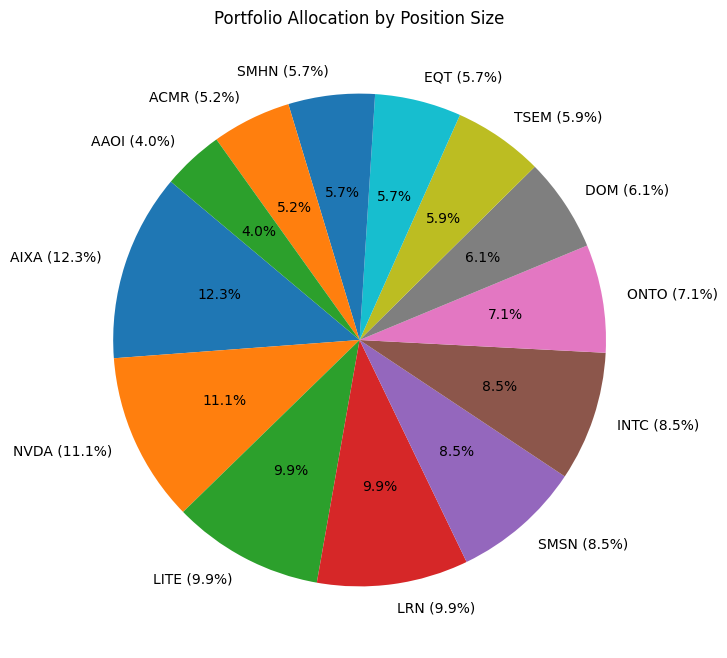
I take back what I said about portfolio weighting. I am new to AAOI and know nothing about it so it gets a small allocation. Discipline and risk control. But if I like it I size up.
Aixtron (AIXA)
Portfolio Allocation: 12.3%
February Performance: +42.56%
Change: None
Thesis: I have extensive coverage on this name.


Earnings confirm everything I have dispensed on optoelectronics. GaN still in the waiting room and can be a second catalyst in 2027.
LITE CPO pull forwards are a positive. AAOI blowout is also very good for this name. Demand is endless and never ending. Lots of revisions coming.
Nvidia (NVDA)
Portfolio Allocation: 11.1%
February performance: -7.29%
Change: Added slightly.
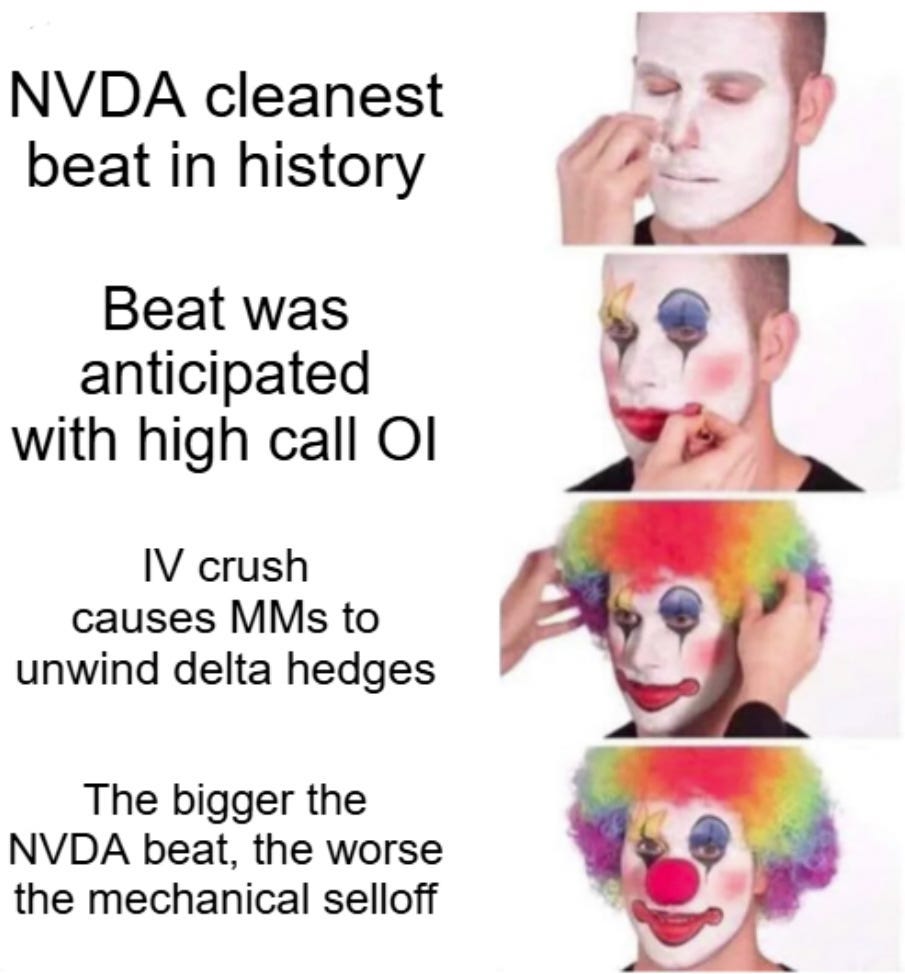
Thesis: Nvidia earnings lately have been a “damned if you do, damned if you don’t” type situation. They guided $78b vs $72b expected, and I don’t think they could have done better in a perfect world.

But for whatever reason, mechanical selling ensues. Don’t matter, I buy dip.
I have a fun theory to explain the post earnings crashes.
Lumentum (LITE)
Portfolio Allocation: 9.9%
February Performance: +78.88%
Change: Trimmed slightly.
Thesis: I have extensive coverage on this name.


Trimmed because this thing was gonna eat up my whole optics allocation. With the run up some other CPO-exposed names have gotten relatively better risk/reward vs LITE so allocated a little to those. Still a top pick. Fundamentals getting stronger.
Stride (LRN)
Portfolio Allocation: 9.9%
February Performance: -0.26%
Change: Added slightly.
Thesis: Not a semis company. See prior port review for intro.
I have a framework for identifying downstream (non-infra) AI beneficiaries. It goes something like your product/TAM depends on software so you feel the full benefits of agentic coding but your moat is regulatory or network effects so you don’t get any of the disruption risk.
Stride is an operator of virtual schools. 80% market share. Regulatory very hard. You do the math.
Samsung (SMSN)
Portfolio Allocation: 8.5%
February Performance: +34.89%
Change: None.
Thesis: Samsung has outperformed the other 2 memory guys for reasons related to good HBM4 performance. Now it is kind of expensive. I want to shift my allocation because memory is memory but taxes are a thing. Oh well, guess Sammy and I will be stuck together for a while.
INTC (INTC)
Portfolio Allocation: 8.5%
February Performance: -1.85%
Change: Added slightly.
Thesis: The United States of Fabs will not fail. CPU shortage. Taiwan hedge. Leading edge shortage and SRAM.
Onto Innovation (ONTO)
Portfolio Allocation: 7.1%
February Performance: +6.85%
Change: Trimmed slightly.
Thesis: Have coverage here.

Global Dominion Access (DOM)
Portfolio Allocation: 6.1%
February Performance: -8.62%
Change: None.
Thesis: Random spanish small cap construction/project management company that works on sustainability, grid, and datacenter projects. No moat but trades at ~3x EBITDA, ~5x FCF. A bet on the infra boom expanding outside of the US.
Tower Semiconductor (TSEM)
Portfolio Allocation: 5.9%
February Performance: -7.34%
Change: New position.
Thesis: LITE rallied but TSEM flat on the year. Relative risk/reward improved significantly so decided to hop back in. SiPho 1.6T transceiver will ramp hard bc epic EML shortage and SiPho obviously important for CPO.
EQT Corp. (EQT)
Portfolio Allocation: 5.7%
February Performance: +6.39%
Change: Moderate cut.
Thesis: Natural gas E&P. Vertically integrated, so owns the midstream + upstream. This matters because 1) they can deliver their gas reliably and sign LTAs anywhere across the northeast unlike competitors, and 2) they have the lowest cost of production.
Honestly just trimmed to delever a bit. I like the fact that it is an AI bet but also uncorrelated to semis.
Suss MicroTec (SMHN)
Portfolio Allocation: 5.7%
February Performance: +11.10%
Change: New position.
Thesis: Absurdly cheap hidden foreign small cap semicap with exposure to advanced packaging through bonders and leading edge logic through photomask cleaning. 90% share in photomask cleaning for EUV.
A reader pointed out this stock to me back in December but only decided to allocate to it recently.
ACM Research (ACMR)
Portfolio Allocation: 5.2%
February Performance: -4.09%
Change: Moderate cut.
Thesis: The China thesis stays but slight cut here because last earnings call showed there is intense competition and a bit of commoditization in semi-critical cleaning tools bc cheap chinese startups. China localization thesis still applies, just slightly less juicy with lower GMs.
Applied Optoelectronics (AAOI)
Portfolio Allocation: 4.0%
February Performance: +93.14% (irrelevant as I entered at end of month)
Change: New position.
Thesis: Ohhhh boy. This is a crazy one that deserves a whole writeup of its own but will try to give the elevator pitch here.
AAOI had long history of bad execution and overpromising by management. Always traded at a discount to LITE/COHR and lived in fear of hyperscaler contract cancellation. Only recently started to become more competent.
This resulted in AAOI being the optical company with most dormant capacity relative to its market cap. Once massive demand overflow happened that LITE/COHR couldn’t fill, or there was some push to source less transceivers from China, or both, AAOI got all the orders. And the guide that management gave was simply unbelievable.
If what management says is possible unfolds, AAOI has $4.5b in revenue run rate by mid-2027 on an $8b fully-diluted-including-bullshit-warrants market cap (even after that whole rally!). A bull case for Coherent puts them at $15b, while the street forecasts just $9b, which at a $50b fully-diluted-including-bullshit-warrants market cap is just over 3x and 5x revenue respectively. AAOI is still under 2x.
AAOI also forecasts reaching 40% GMs. So safe to say there is absolutely bonkers operating leverage.
And AI cycle bonkers demand makes hypescaler cancellations very unlikely.
Feels like transceivers are starting to play out like the early part of the memory supercycle, so throwing my chips in here.
Coherent (COHR)
Portfolio Allocation: 0.0%
February Performance: +22.03%
Change: Exited.
Thesis: Swapped for AAOI as they seem to be more of the beneficiaries of massive overflow transceiver demand than COHR.
Great job and thanks for sharing!