

Another quarter, another NVIDIA earnings. Recently NVIDIA Day has been a lot less hyped and people are generally getting less and less excited about this event over time. Haven’t really heard the usual buzz on X today. Based on this visual, can you guess why?
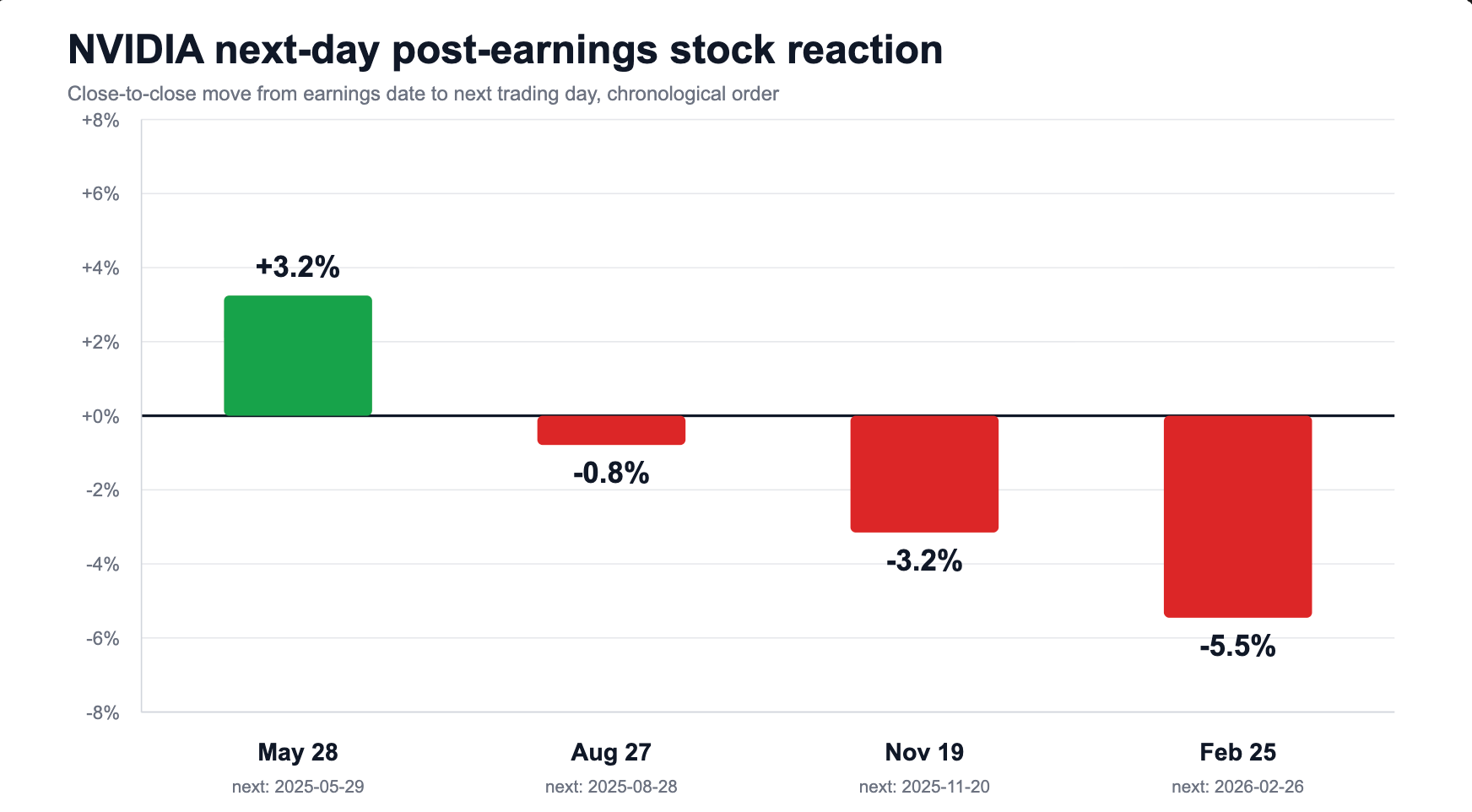
This is despite an increasing magnitude of their beats over time, and probably is frustrating Jensen right now.
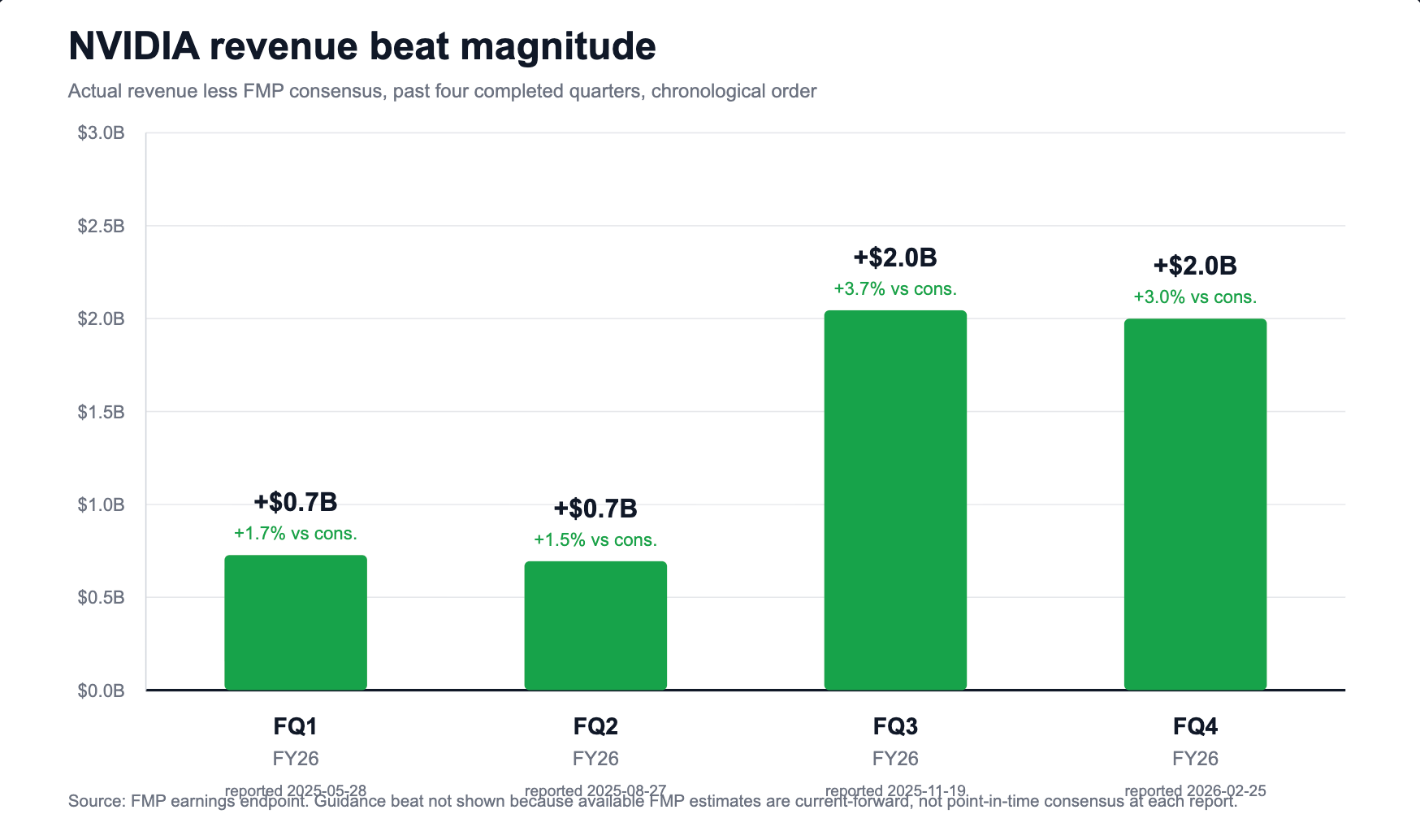
We will see if today breaks the pattern!

Here’s today’s Buy Side Consensus and Street Consensus courtesy of Jukan on X.


Same pattern as always: they guide for $78 billion, which means that they will probably beat by $2-3 billion due to historical conservatism, Sell Side models just above their guide because of Sell Side conservatism, and the stock probably dumps and takes down the whole AI infra ecosystem along with it unless they meaningfully exceed even buy-side consensus.
In terms of their rev guide, buy-side expects $90 billion. That’s a lot.
Gross margin expectation is 75% as always, and I bet it’s going to come out at 75% as always.
The Print
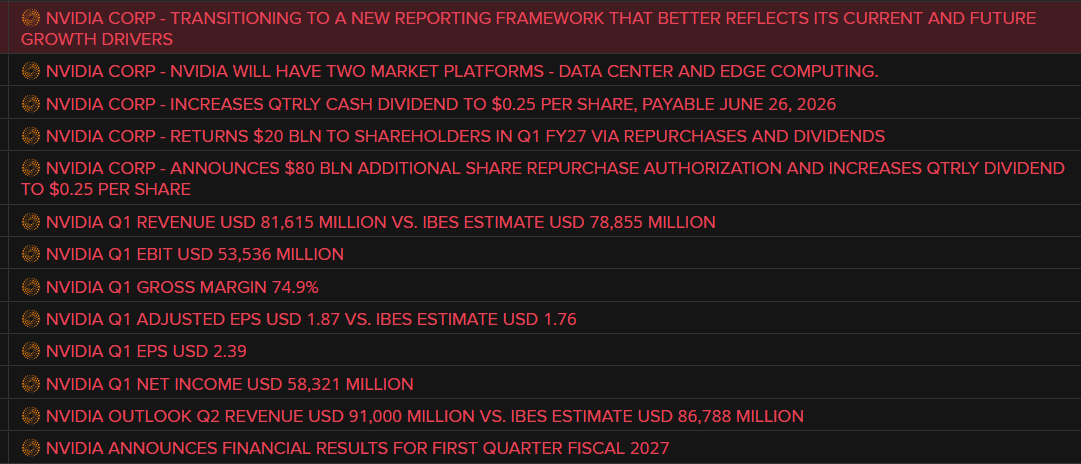
My initial reaction was WOW. $1 billion above buy-side on the guide and almost $1 billion above buy-side on the current quarter revenue. But then I realized it was only a $1 billion beat. Which means… nothing really happened.
The price action is really funny. We went down 3%, then flat, then up 2%, and now we’re flat again.
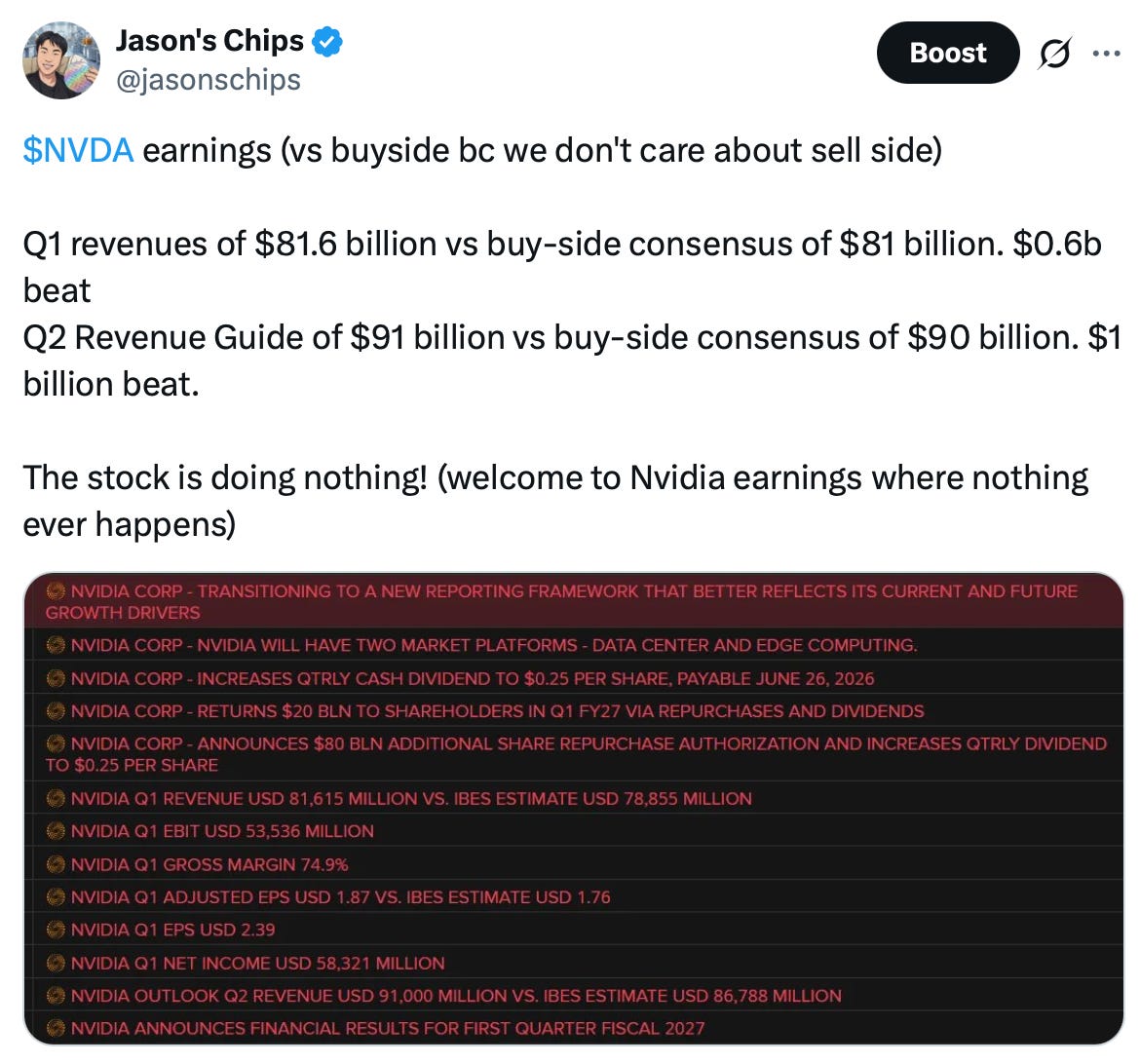
Two other pieces of information that were reported in the print (and we don’t have to wait until the call for closing parentheses) are:
Nvidia said that they have not generated any revenue under their H200 program and do not know if any imports will be allowed into China (by China) at all.
They said that Rubin is not delayed to counter all the Twitter rumors lol.
IMO, the real signal can only come from the call today. There’s a reason that nothing really interesting happens with the numbers ever, because Nvidia’s numbers are mostly a lagging indicator of AI hardware procurement. They’re also easy to estimate because Nvidia is so big. The market would rather look forward.
There have been tons of rumors on Rubin being delayed by a quarter or two. There are a few speculations on why this is.
Competition especially, AMD has pressured Nvidia to start upping the specs of Rubin. For example:
Power from 1800 W to 2300 W
Memory bandwidth from 13 Tb/s to 22 Tb/s
Increasing the HBM4 requirements to over 11 Gbps per pin
The increased HBM4 requirements meant that the Big Three, the Big Memory Three, had to redesign their samples and resubmit.
There was also a claim that Nvidia had unresolved SerDes chip interface problems and was “dialing down specs” as a response.
And also heat-spreader redesign?
Anyways, Nvidia is probably going to get a lot of pressure from the sell-side analysts to explain what’s going on here, so we should learn a lot today.
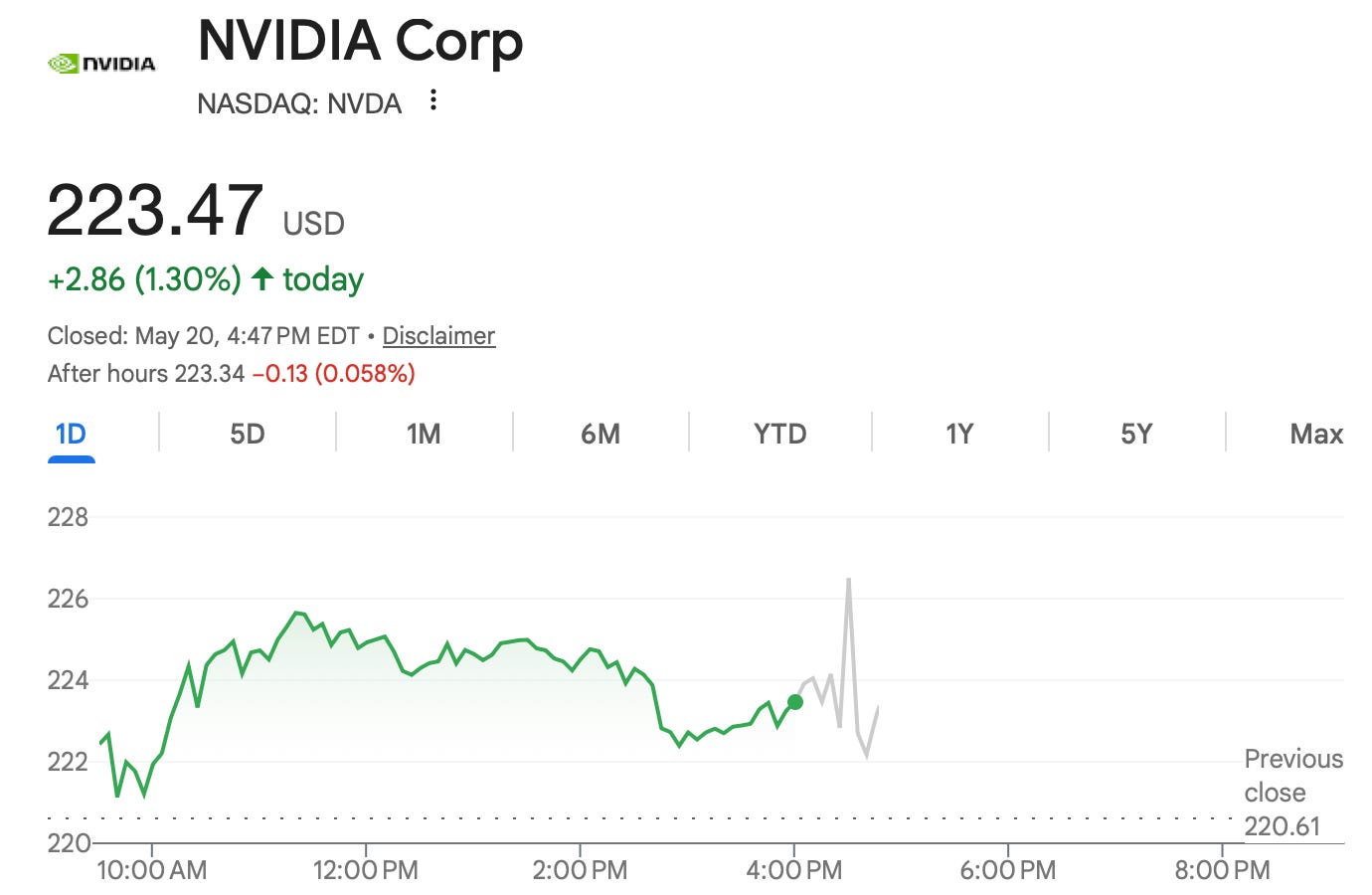
I have never seen a post-earnings chart as perfectly flat as this one today. It’s so perfect and so flat, it’s funny. Probably won’t be the case after the call, though!
The Call
Contents
New Reporting
Compute vs. Networking
Neoclouds
Growth Rate vs Hyperscaler Capex
Frontier Labs share
CPUs
Other
Supply Commitments
Capital Returns
Groq LPX
VR Ramp
New Reporting
Nvidia changed how they now report revenues. Before they reported revenues in very standard categories that included data center compute, networking, gaming, auto, and other. Now they have this strange new taxonomy.
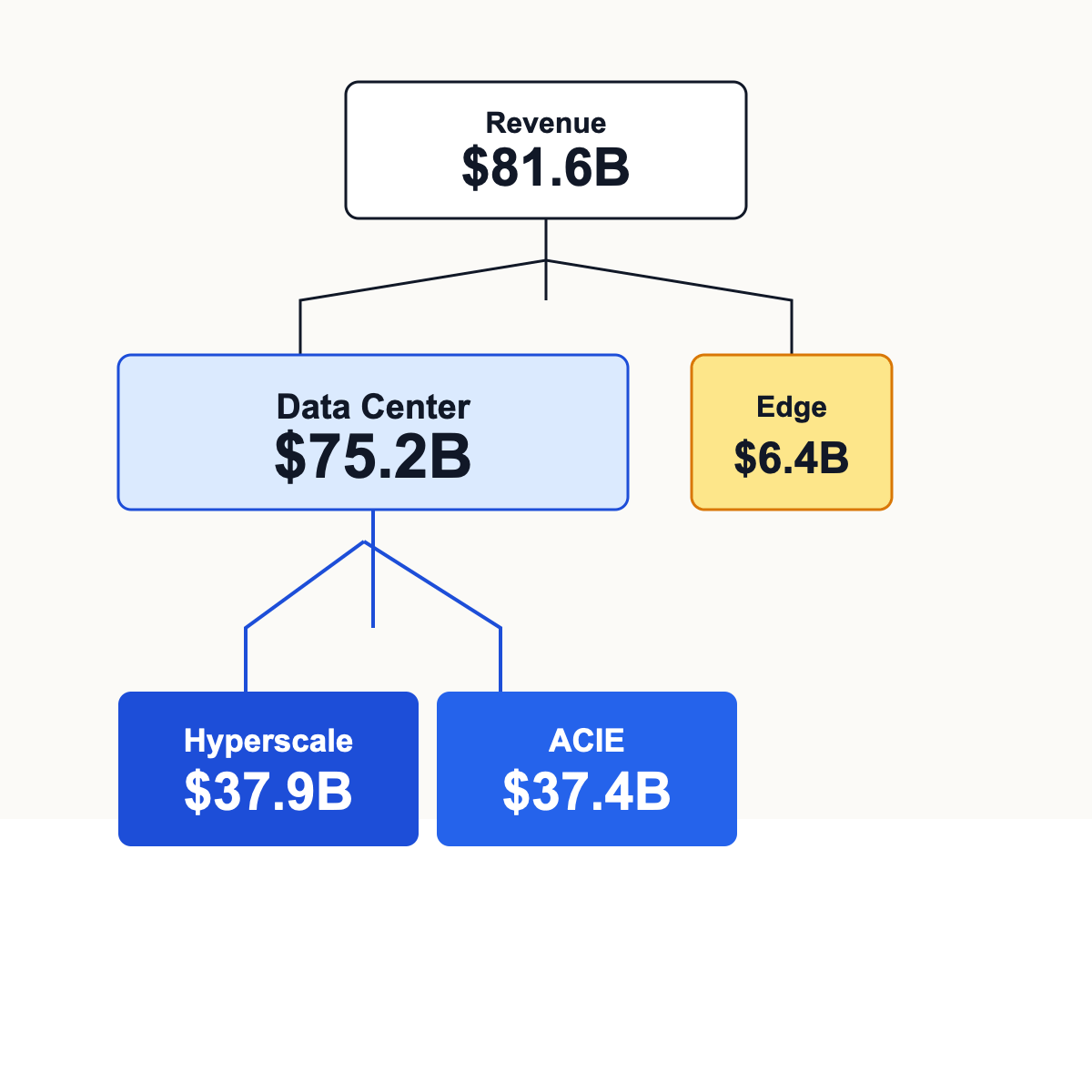
Data center and Edge are the higher-level categories, and then within data center, hyperscale and ACIE are the lower-level categories.
Hyperscale is Hyperscaler. ACIE is basically Neoclouds, Enterprises, and everyone else. Funny enough, they’re 50/50 even though by intuition, you’d think it’s mostly hyperscale.
Jensen provided a pretty good answer for why they segmented this way. The essence of it is that Hyperscale is serving the big players that can pick and choose different Nvidia “AI Factory” parts, and Neoclouds and ACIE want a turnkey solution.
Jensen also made the point that hyperscale grows first, and then the long tail grows second.
“And so for many of the other applications, industrial applications, enterprise applications, until the AI is very capable and thus really productive work and does it safely and it could do it in a way that can actually generate impact and income It does not really get used. And so you expect the second category to develop slower than hyperscale. And you could see that in the numbers. However, long term, if you look at look at industrial and enterprise, clearly, that is where future economics is going to be. Because it represents some you know, $50 trillion to $80 trillion of the world's economy. And so and it is gonna be larger than that because of AI.”
But that non-hyperscale will become a larger business over time.
Compute vs Networking
If my interpretation of this is correct, they might not be splitting their revenues into compute and networking anymore. But this quarter, they still split out compute and networking on the call.
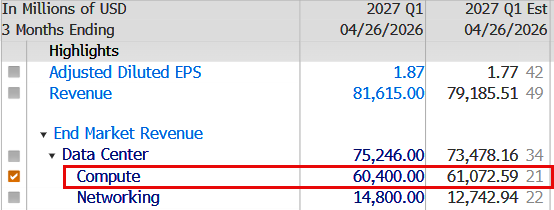
Crazily enough, they actually missed in compute and then beat massively in networking. I think this is a very underrated piece of signal for networking gaining more market power and significance in the rack. The networking train is not going to stop, and overall this is quite bullish for photonics.
Neoclouds
On Neocloud specifically, Jensen also made a comment that taught me something new about the business model, which is that he emphasized that it is the most rentable and the easiest to finance. H/t to Austin Lyons.


Not only is it that the Neocloud ecosystem was created by Nvidia and only buys from Nvidia. The Neocloud ecosystem also requires cheap financing, and cheap financing only comes to the most reliable, most common solution. NVIDIA being dominant also means that NVIDIA is the easiest to finance. It’s a self-reinforcing compounding loop.
Growth Rate vs Hyperscaler Capex
Nvidia is generally seen as having revenue that literally grows in line with hyperscaler capex because, after all, they have majority share in AI compute. How could they possibly outgrow them?
Jensen had a very interesting answer to this, and actually it makes quite a lot of sense. He says that they are growing faster than hyperscaler capex for two reasons:
First is that they basically have 100% share in Neoclouds and enterprises since they need turnkey solutions, and that means they practically only buy from Nvidia. And since they will inflect in growth later than hyperscalers, the overall growth rate for Nvidia will shift to these segments in which they have 100% share over time. Not a huge driver, but definitely still relevant.
They are also gaining share in hyperscale itself because they are gaining share in Anthropic.
Frontier Labs Share
Today Jensen bragged a lot about gaining back share at Anthropic.
“So the amount of capacity that we are gonna bring online for Anthropic this year and next year is going to be quite significant. Very significant. And so we are growing and our coverage of anthropic has been largely zero until this until just recently. And so we are gaining share tremendously fast in inference.”
Which ties into a broader comment about broadly actually gaining share in inference rather than losing share to custom silicon as everyone predicted.
“Well, we are growing share in inference. And we are growing share in inference very, very quickly. And the reason for that is this year, the number of frontier model companies grew. And so there is Cursor and Perplexity and there is some new model companies, TML and Reflection and list goes on.”
Their share used to be literally 0. Anthropic ran everything off of TPUs and Traniums, but now Nvidia is in, and based on what they’ve said, they are in big.
In fact, when a sell-side analyst asked them about potential upside over their 1 trillion forecast from GTC and sort of hinted at maybe CPUs being the largest driver of that, Jensen actually said that it is growing share in the Frontier Labs (a.k.a. Anthropic) being the largest driver.
CPUs
Jensen said that they have visibility to $20B in total CPU revenue this year. Later in the Q&A, he specified that this is pure play Vera CPU racks. If you assume that the total server CPU market is $40B, Nvidia has 50% of the server CPU market which is pretty crazy.
I heard, funny enough, both an analyst on the sell-side in the Q&A and people on Twitter say that this whole CPU thing is bearish for Nvidia GPUs, but I honestly think that is a dumb take. CPUs are completely an incremental market. It’s because agents need to interact with the world. It does not cannibalize GPU workloads, because it is not that the more an agent needs to interact with the world (CPU work), the less it needs to think itself (GPU work). In reality, they are complements and not substitutes.
Other
Supply Commitment
Their supply commitment is now up to $119 billion, up from $90-ish billion last quarter. Continuing their mission of supply-chain-maxxing and mogging AMD and Broadcom
Capital Returns
They’re returning 50% of free cash flow to shareholders, which resulted in increasing their dividend from one cent to 25 cents per share per quarter and an $80 billion share repurchase authorization.
This one I feel like gets more press than necessary. Whether it’s a dividend or share purchase doesn’t really matter. I honestly don’t think it matters too much for the stock, since it’s basically consensus that everyone knows that Nvidia really doesn’t have anywhere to put all their cash. Either they invested in random companies and become an AI index fund, or they just return it to shareholders.
Groq LPX
Jensen made a comment that fast inference can be 20% of the market. However, today he kind of walked it back.
He had this very interesting quote.
“The LPX is designed for low latency and high token rate. Its throughput is low, Size capacity is low. And it is context processing, its ability to absorb a lot of context, for example, for software coding. For agentic workloads, its ability to absorb a great deal of context is lower. And so and so the challenge the challenge is simply and I have explained before, that the use case for LPX is not broad. it is, you know, intended for somebody who has a fairly large portfolio of different types of token services, And for the high token rate, maybe these services are quite premium. And the number of customers is not significant.”
This was a lot of qualifiers for their very own product.
“And I think I think whether it is 20% or 10% just depends on where we are in the development of AI. I think today, it is a lot less than 20%. Someday, these premium tokens could be 20%. And I am know, we are we are ready to work with work with service providers to enable this capability.”
A lot less than 20%.

This aligns with my existing views on Cerebras. Basically, it could be a huge market some time in the future, but until we find exactly what use case turns it into a huge market, I don’t think the space will inflect.
VR Ramp
Finally, they had a very brief comment on the Vera Rubin rack, and yes, they confirmed that it will still start shipping in Q3 and ramp in Q4. When asked to compare it to Blackwell, they said it is hard to say and declined to comment on which one they think would ramp faster.
When Nvidia says vera is best computing. What makes computing in Vera Rubin, the chips? From whom?
GPU has role CPU someway?
Not clearly for me, I am ok when amd is CPU+GPU. But I am frustrating when Nvidia says they are compute also and good for agentic ai with cores.