

Opinions are my own and do not represent past, present, and/or future employers. All content is based on public information and independent research. This newsletter is not financial advice, and readers should always do their own research before investing in any security. I am invested in the semiconductor industry. As of the date of this publication, I may hold long or short positions in the securities discussed in this article.
Outline
Pre-Earnings Vibe Check
The Print
Price Action
The Call
No Hair On The Print
Absolute Dominance Over The Supply Chain
Very Positive Useful Life Commentary
Jensen Reasons In a Way That is Very Different from the Finance People
There is No Way to Prove the Skeptics Wrong
Pre-Earnings Vibe Check
(This section was written prior to the earnings call to communicate the prevailing narratives and provide a contrast to post-earnings sentiment)
This preview will be very brief since I covered most of what’s happened this past quarter in State of Nvidia.

I’ve already covered the idiosyncrasies of this company. What I do want to get into briefly, however, is the macro picture. I think they are in such a strong competitive position any further improvements in Nvidia vs competitors won’t matter. The real valuation mover is Nvidia vs AI Bubble. It’s like finishing the PvP of a game while being stuck on PvE.
Nvidia trades at 15x 2027E EPS not because of the TPU, but because the market is afraid of a downcycle starting in 2028. Every other technology wave resulted in an overbuild, why is this different? Any way Nvidia can address this deep-seated concern will do a lot more than beating guide by $3b yet again.
What will calm these concerns and finally unshackle the stock? Long term growth visibility. How can they provide this? I don’t know. It’s not like the smaller supply chain players with their LTAs, Nvidia is literally the whole market. They are burdened with answering the AI bubble question.
The most compelling argument about a near-term overbuild is the fact that everything is in a shortage. Hyperscalers would spend more, but they simply can’t because there is not enough memory, power, and foundry capacity.
Other than that, I think you have the more traditional questions.
Amendments to the $500b “Jensen Math” backlog through YE2026 they had in October.
Rumors of SK hynix HBM4 issues delaying Rubin by a few quarters (vs mid-2026). True or false? Rubin Ultra shipping mid-2027?
Commentary on if the everything-constraint is affecting growth.
Networking growing faster than compute as a leading indicator of demand.
Is gross margin holding up during the blackwell ramp?
What ever in the world is going on with China.
Anything product related is probably saved for GTC.
Earnings Estimates
Current quarter guidance: $65b revenue, 75% gross margin.
Current quarter consensus: $65.8b revenue, 75% gross margin, $1.53 EPS, $60b datacenter revenue.
Next quarter consensus: $71-75b revenue. $71.7b official consensus. Buyside bogey probably $75b or slightly higher.
The Print
I expected nothing less from Jensen than this absolute blowout. But tbh, this is mostly first order stuff that probably gets forgotten by the market within a few trading days. Still, it’s helpful to go over it to set our baseline.
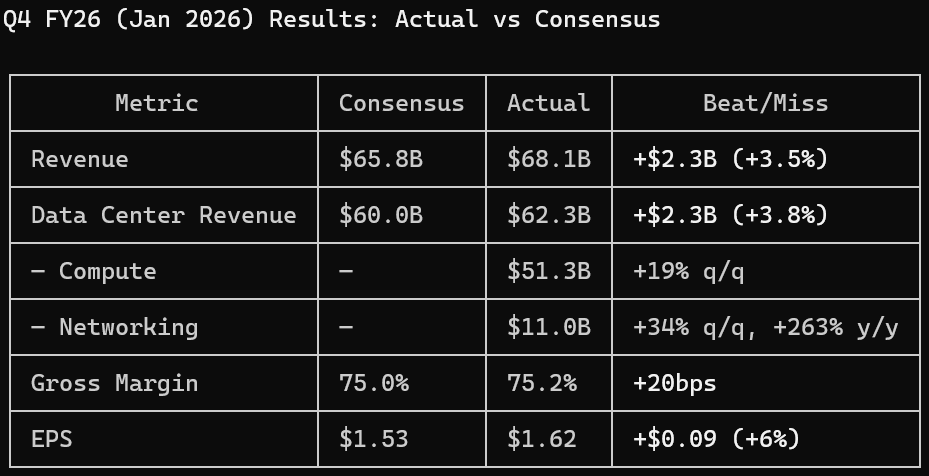
The guide is really the number that matters the most. People know it’s a beat so at this point we be scrutinizing the size of the beat.
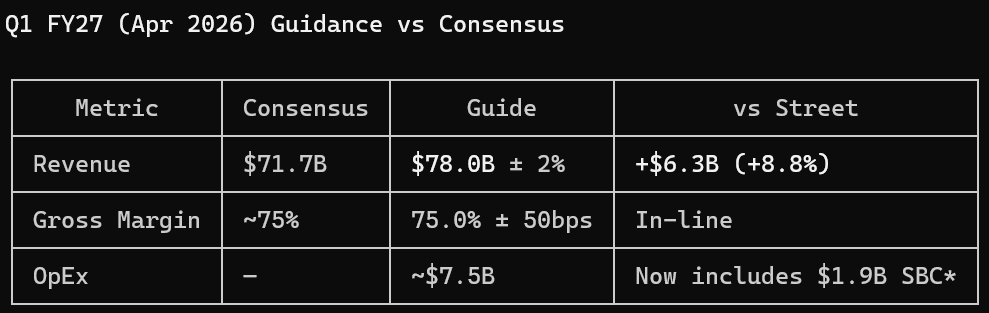
Whisper numbers around $75-76b. $78b is an enormous 8.8% above consensus.
Importantly, this was larger than last quarter’s guidance beat of $65b vs $61.8b, or 5.2%.
Last quarter there was some hair on the 73.7% gross margin, but this time, we got a clean 75%. No hairs whatsoever on this print.
$95.3b in supply commitments for inventory and capacity is interesting. Let’s see what that means. Memory capacity…………? :)
Networking outgrew compute as well, with 34% vs 19% sequential growth, again serving as a leading indicator for further growth.
Price Action
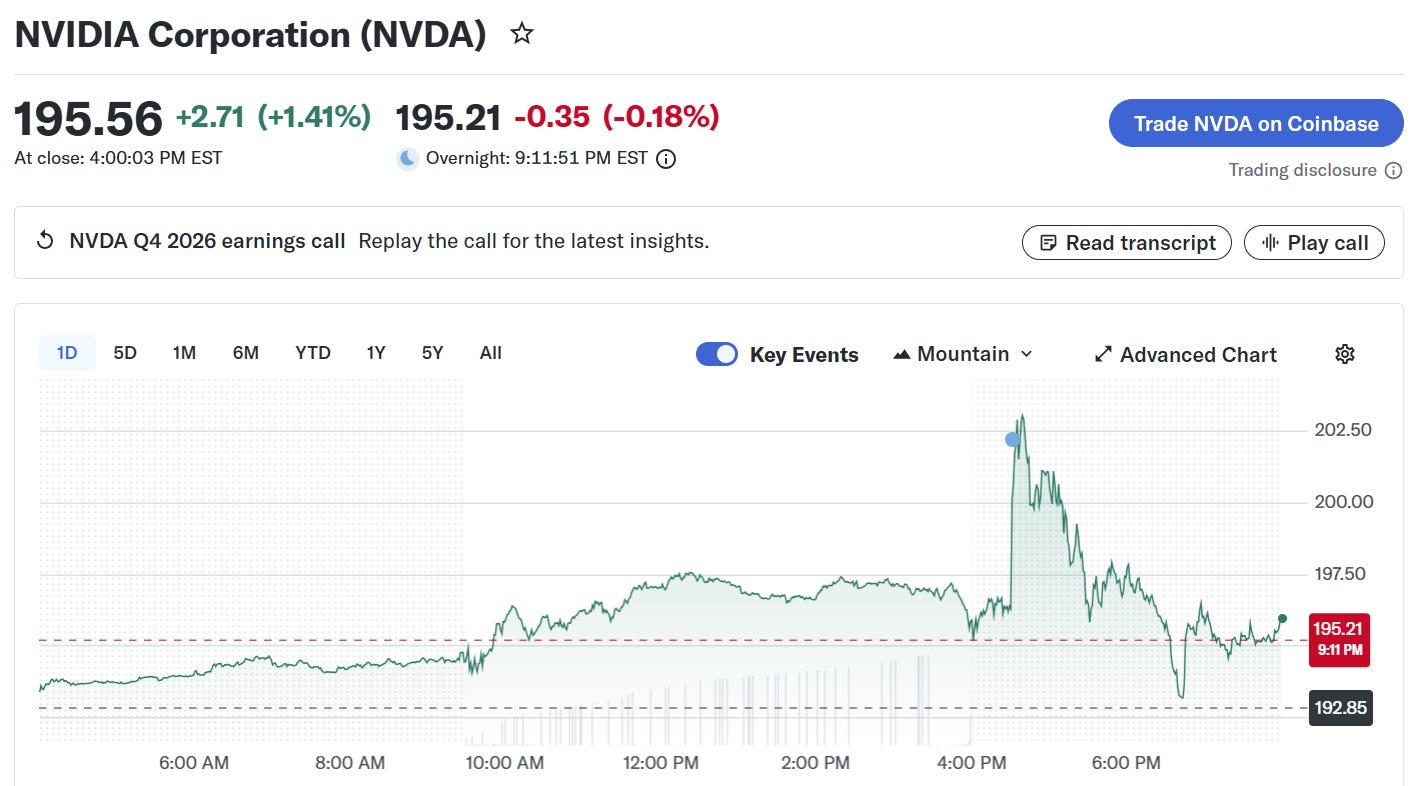
To those new to Nvidia, this makes no sense. We could have asked for nothing more from this quarter. What would actually make the stock go up?
However, we saw the same last quarter. Each earnings becomes a pump-and-dump, because there is a structural reason why Nvidia trades range-bound unlike the other AI infra suppliers that I will dive into behind the paywall.
The Call
No Hair On The Print
There was no hair on the print.
The $500B Blackwell+Rubin revenue opportunity from October is now understated. Colette guided sequential revenue growth throughout CY26 that exceeds it, with visibility extending into CY2027. Rubin samples shipped to customers this week, on track for H2 production, no delays. Networking hit $11B, up 34% q/q, driven by NVLink scale-up switches that come bundled with every GB200 rack, confirming the demand pipeline for compute behind it. Gross margins recovered to 75.2% and guided mid-70s throughout FY27, putting the Blackwell margin overhang to rest. And the $78B Q1 guide assumes zero Data Center compute revenue from China, meaning the beat is entirely organic demand from the rest of the world.
But that’s the bar. I honestly don’t know why, but it’s a characteristic of the market’s relationship with this stock over the years to demand absolute perfection and nothing else. Good thing we got it.
Absolute Dominance Over The Supply Chain
It is in Jensen’s DNA to court the entire supply chain and secure every bit of capacity with an iron grip, leaving nothing for his competitors.

The $95.2B in supply-related purchase commitments outstanding is just a continuation of this trend. Memory and logic capacity are the bottleneck resources today, and usually when a resource is this scarce, there are higher-than-normal benefits to scale.
This is similar to why Apple is in a much better position than Android in the smartphone world at the moment.
Very Positive Useful Life Commentary
I hope we’re done with this GPU useful life nonsense after today’s call.
Everyone has been parroting that even six-year-old Ampere GPUs are sold out in the cloud, with rental pricing actually increasing. This is extraordinary for what should be a fully depreciated, end-of-life product. But why? Queue Jensen:
All GPUs are architected for CUDA, every software optimization Nvidia ships benefits the entire installed base, not just the latest generation. That’s why Hopper and Ampere “feel fresh.” Each generation of GPU moves down the performance ladder, but they actually continue to get better as Nvidia works hard to improve CUDA.
Jensen Reasons In a Way That is Very Different from the Finance People
Through my extensive industry experience, I have made an observation.
The bears on AI are generally finance people, and the bulls are generally tech people. Not universally, but generally. I identify fully with neither group.
It is those same finance people that ask the AI bubble questions and keep Nvidia’s share price depressed despite blockbuster performance.
Jensen’s job is to answer those questions and quell the market’s fears. However, as Head Honcho of the tech crowd, he reasons in a way that is different from the finance crowd and thus I think there is some gap of communication.
Jensen says a few token “Jensenisms”:
Tokens = revenue. Mentioned 5 times on the call.
Transition from standard to accelerated computing.
Old software was pre-recorded. Now, everything is generative in real time.
Finance people don’t want to hear this. They want to hear that there is a specific ceiling. Of course, that ceiling must be higher than current supply realities, but the important part is that the ceiling must exist to give investors an anchor point for comfort.
Think it goes something like this:
“Oh I think the correct amount of compute to be building is $900b. We’re at $650b, we still have room to go. Once you go above $900b, the utilization rate of the datacenters start to fall.”
Without the anchor point, investors go to the next best alternative: History. And history says:
“During each technology revolution, there will always be an overbuild. Thus, we should value Nvidia as if this time is no different.”
But AI doesn’t work like railroads or telecom fiber, where there’s a clear ceiling of satiation. There is endless intelligent work to be done in this world. The more plentiful are the tokens, the more tasks become economical to complete with agents.
Jensen did as good of a job as he could. Tokens = revenue is correct. But it will never be enough.
There is No Way to Prove the Skeptics Wrong
Near-term, we can do it. 6yo A100s are rising in price, not becoming useless as depreciation pundits claim. Anthropic is growing revenue 10x each year. Model capability is not stagnating, but instead accelerating.
But when we talk long-term, we have to accept that no one knows what’s going to happen. Unlike the smaller AI suppliers that have ample room for growth without answering the AI bubble question, Nvidia does not have this luxury. And it is this simple truth that keeps Nvidia’s multiple forever rangebound.
And honestly, it’s not all that bad. We’ll just get our returns when the earnings inevitably moon.