

All of the investing and research and writing and stuff that I have been doing for the past year or so has led me to one conclusion: There are three certainties in life.
To be clear, believing in an Indium Phosphide shortage is different from just being bullish on optics broadly.
Optics is an end market. Indium Phosphide is a material input.
The intensity of the material usage in the end market can either go up or down. In addition, there are also supply dynamics. Demand could go to the moon but there is no shortage if supply goes to Mars.
There are also many layers to the Indium Phosphide supply chain, as I cover in this piece:
Indium Phosphide substrate
MOCVD/Epitaxy machines
Laser device fabrication

Some of which will be in much greater shortage than others.
The key to… bottleneck investing (sigh) is to figure out which layer controls the gating input to the final unit produced. It could be the upstream most layer, downstream most layer, or anything in between. There is a common perception that the more upstream something is, the more of a bottleneck it is, but that relationship is not necessary.
Our agenda today is simple. We start by highlighting why Indium Phosphide demand is going hyper-exponential beyond EMLs and regular commodity CWs powered by two main products:
Ultra-high power CW lasers for CPO
Indium Phosphide PICs
Then, we’ll build supply and demand models for all three layers of the stack: indium phosphide substrates, MOCVD machines, and laser devices.
Finally, we’ll finish with how this translates into the financials for the most important company in each layer.
Contents
Ultra-High-Power CW Lasers for CPO
Indium Phosphide PICs
InP Substrate Demand Build
InP Substrate Supply Build
MOCVD Tools Supply/Demand Model
InP Device Supply/Demand Model
SemiAnalysis Giveaway: The first person to subscribe using the paywall on this post will be selected to receive one free month of SemiAnalysis (sent to your email).
By accessing this content, you acknowledge and agree to our terms and conditions. This research is not financial advice.
Ultra-High-Power CW Lasers for CPO
UHP CPO lasers are a topic that I’ve covered extensively. So much so that you are probably tired of me talking about it. Welcome to my nth laser lecture.
There are two types of lasers:
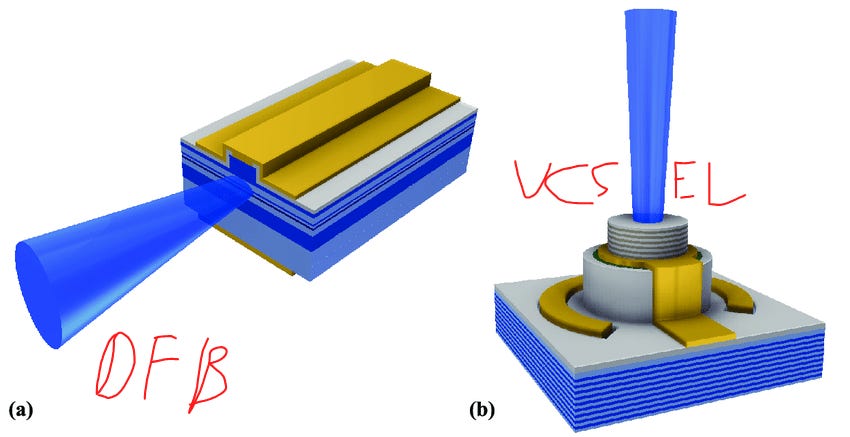
Vertical-Cavity Surface-Emitting Lasers (VCSELs, pronounced vik-sel) emit light from vertically… from a cavity… on the surface. They use GaAs, aren’t great for long reach because they can’t emit O band light, and fail at higher data rates
Distributed Feedback (DFB) lasers emits light horizontally through a bunch of tiny mirrors that bounce it in a feedback loop to get a really concentrated and clean beam. They use indium phosphide! These are the primary CPO lasers.
For CPO, the DFB light source must be remote for the purpose of avoiding heat and maintaining serviceability.
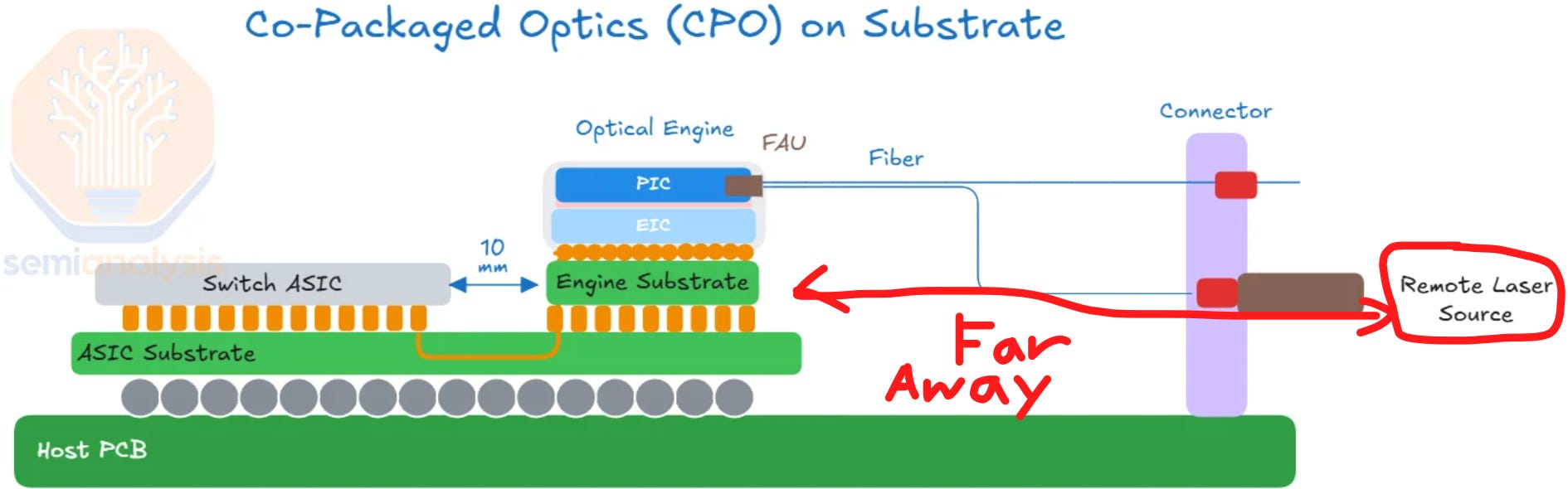
The only way to ensure that the light survives the coupling loss from this journey is to make it high power.
Why not multiple lasers instead? To maintain signal integrity, the light traveling from the laser to the optical engine has to stay in a consistent orientation — consistent polarization. This means every laser requires polarization-maintaining fiber, which is expensive, and the process of attaching it is painstaking and yield-sensitive. We must minimize the number of PM fiber connections per system at all cost, which means using only one laser.
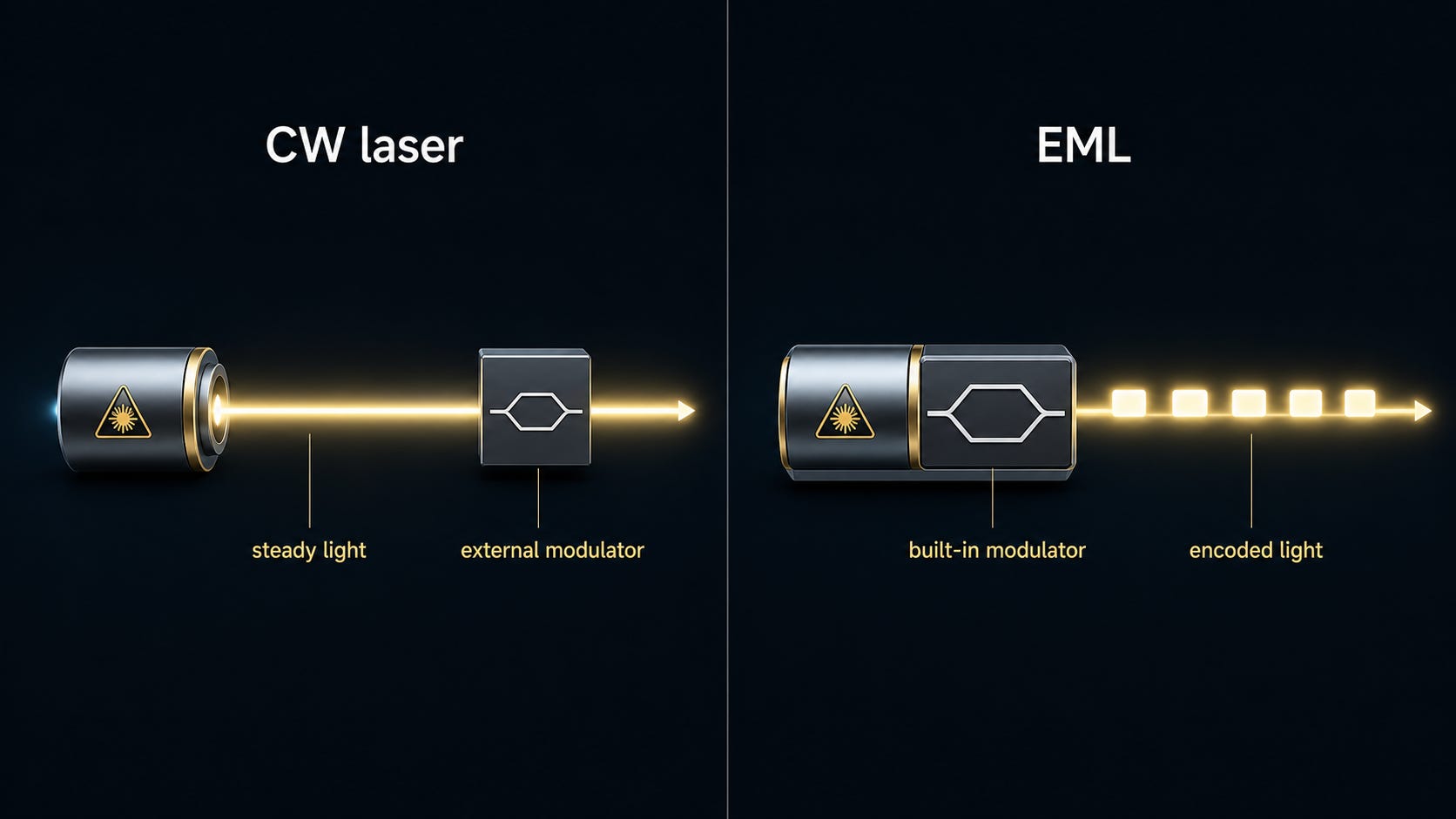
These lasers are also continuous wave (CW). DFBs can either be CW or EML.
CW lasers are lasers that just stay on. It produces a continuous stream of light, like a light bulb or flashlight. A CW laser can provide a steady beam that gets modulated (gets the signal put into it) somewhere else.
EMLs (electro-absorption modulated laser) are lasers plus a built-in light switch. EML stands for electro-absorption modulated laser. The laser creates the light, and an attached modulator rapidly changes that light on/off or high/low to encode data.
Die Sizes
Now comes the fun part: die size estimation. We know that the three main types of lasers used for optical data center optical communication are
Low power CWs (30-70mW, used in Sipho 1.6T transceivers)
EML (used in all sorts of transceivers)
Ultra high power CW (400mW+, for CPO)
So to gauge demand for InP, it’s time to ask: how much Indium Phosphide does each type of laser actually require?
Our base unit will be the 100G EML because it ships in the most volume today. This is the optical equivalent of Toyota Corollas or Big Macs. Or football fields.
EMLs are very low power, even lower power than low power CWs. However, they have a built-in modulator. Therefore, low power CWs are smaller than 100G EMLs.
200G EMLs are obviously larger than 100G EMLs.
Ultra high power CW lasers on the other hand, are MASSIVE. You need a physically larger gain region to generate all of that light. This makes it 5-10x larger than a 100G EML.
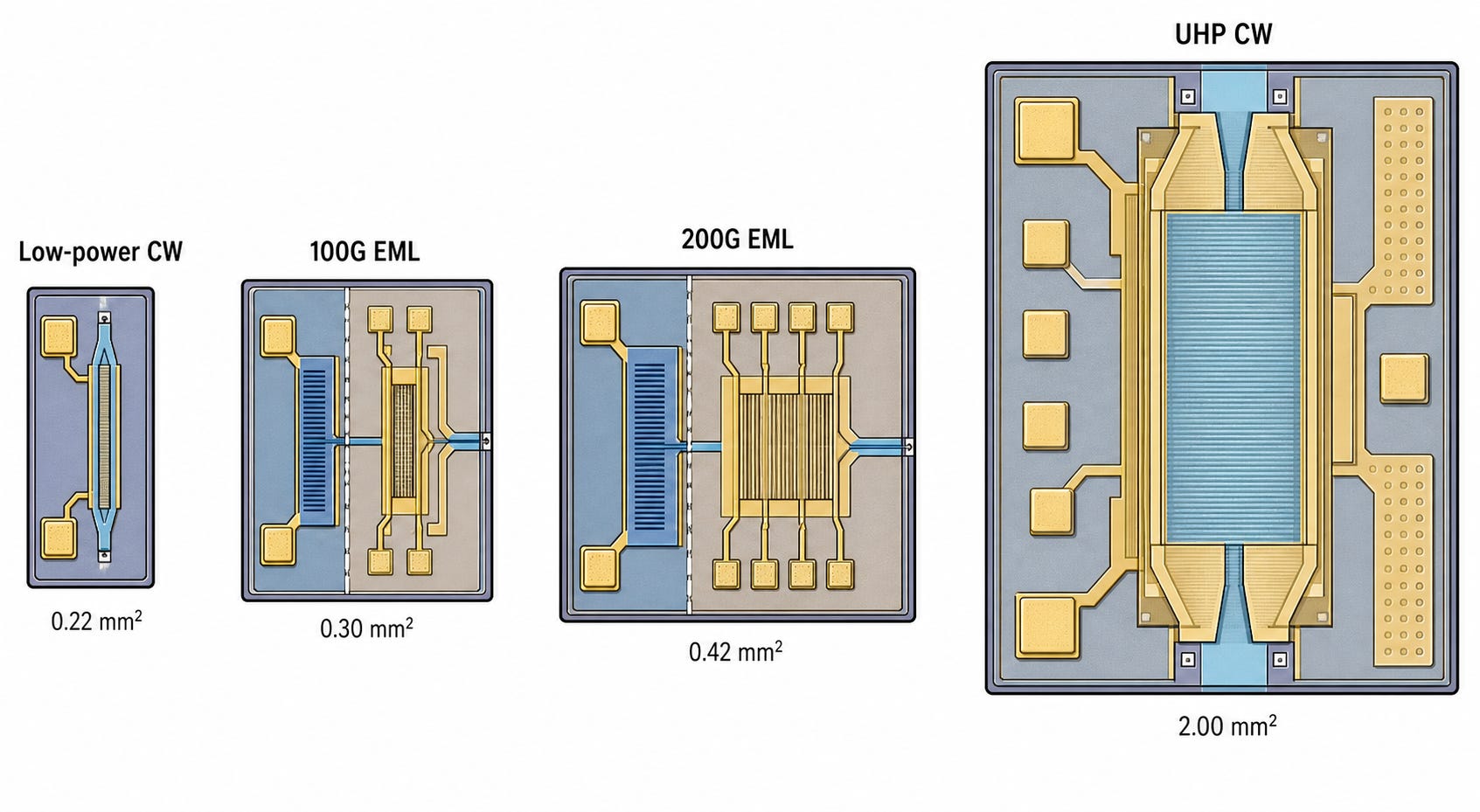
This massive die area consumption is what makes UHP CWs an order of magnitude more InP heavy than existing products on the market. They are the first of our two InP demand drivers.
Indium Phosphide PICs
The second InP demand driver is Indium Phosphide PICs. These are not as widely discussed as ultra-high power CWs, so let’s take a moment to understand what they are and why they are needed.
Optical communication is simply transmitting data through light. There are two ways to encode data in light (known as modulation): IMDD and coherent (no not the company).
IMDD is basically flashing a flashlight on and off. Only encoding signals in brightness.
Coherent modulation is like having one of these:

It encodes signals in brightness, phase, and amplitude.
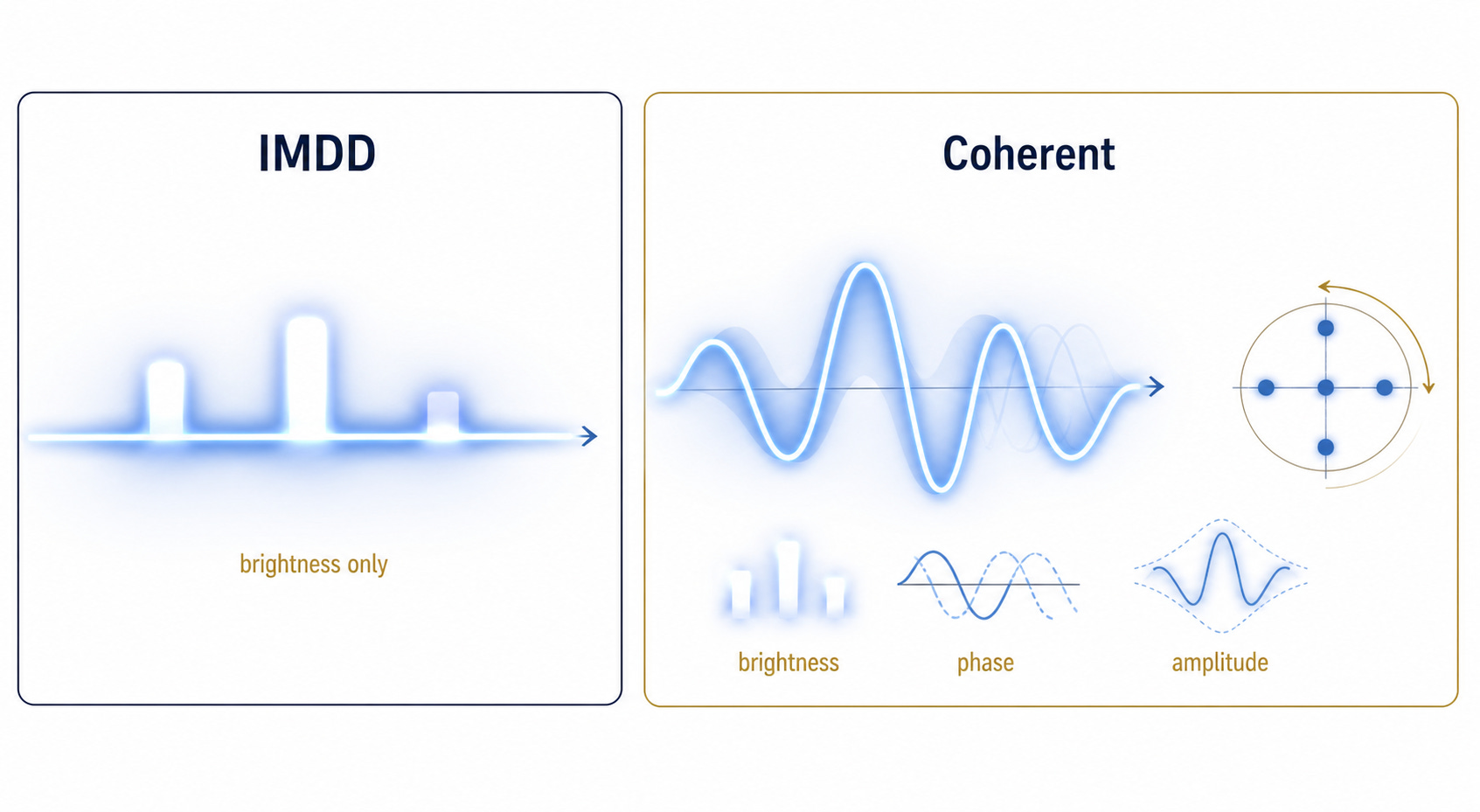
The benefit of coherent modulation is that it makes it much easier for the receiver to detect the signal, therefore allowing the it to survive a greater insertion loss (higher link budget). This is why coherent is used for long-reach telecom and scale across.
On the other hand, it is much more expensive and complicated, as you can imagine.
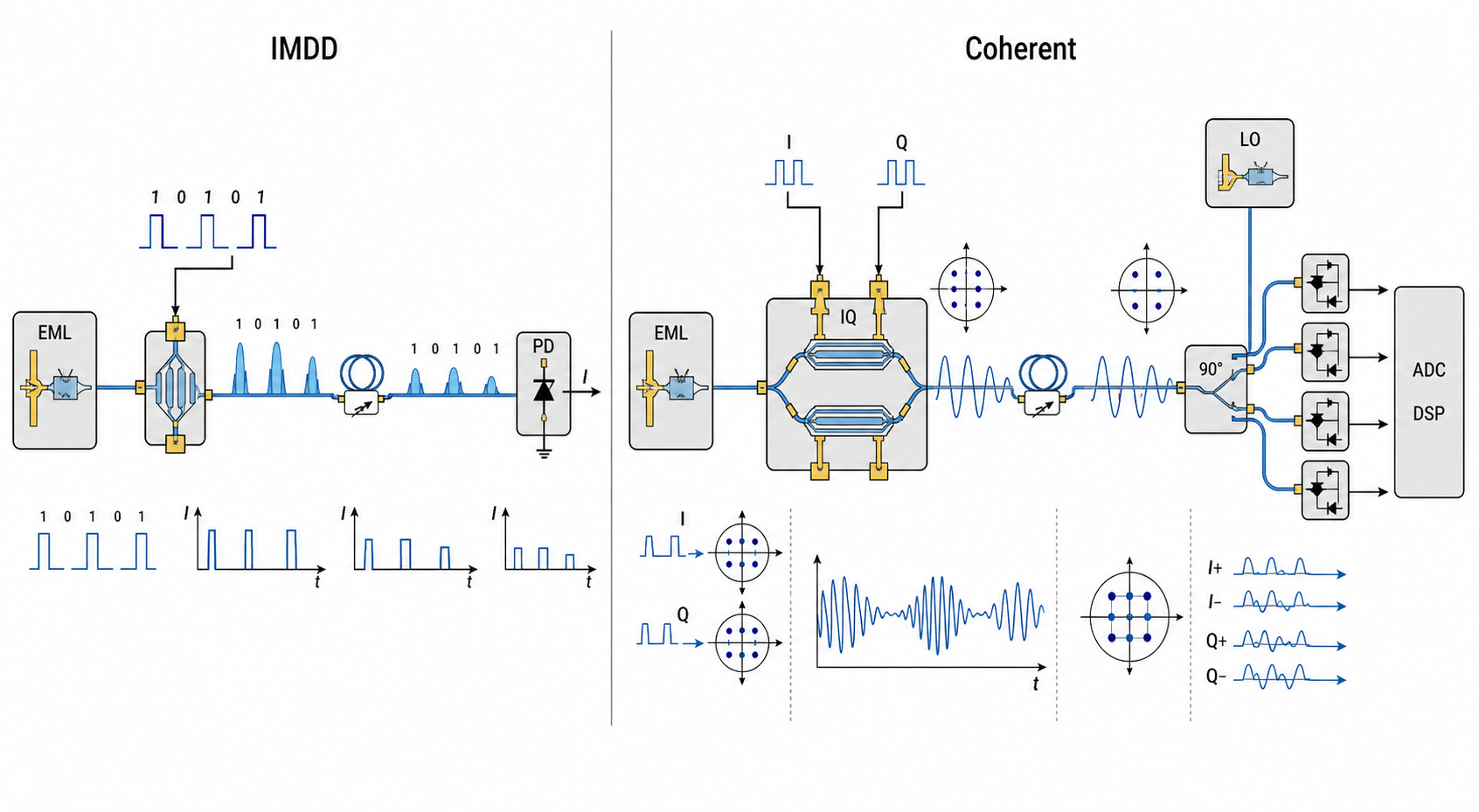
Scale-out in the data center is now running into the limits of IMDD’s link budget. This is because:
The links are too long
Optical circuit switching (OCS) is being adopted. Each time light passes through an OCS, it loses 1.5 to 3 dB of signal.
Therefore, scale-out is moving to adopt a light version of Coherent known as Coherent-Lite (Yes i know it sounds like a Coherent and Lumentum merger. Who named these modulation schemes?).
Coherent light modulation requires a far more complex optical device (InP PIC) than IMDD. It makes a 100g EML look like a 2x4 Lego brick.
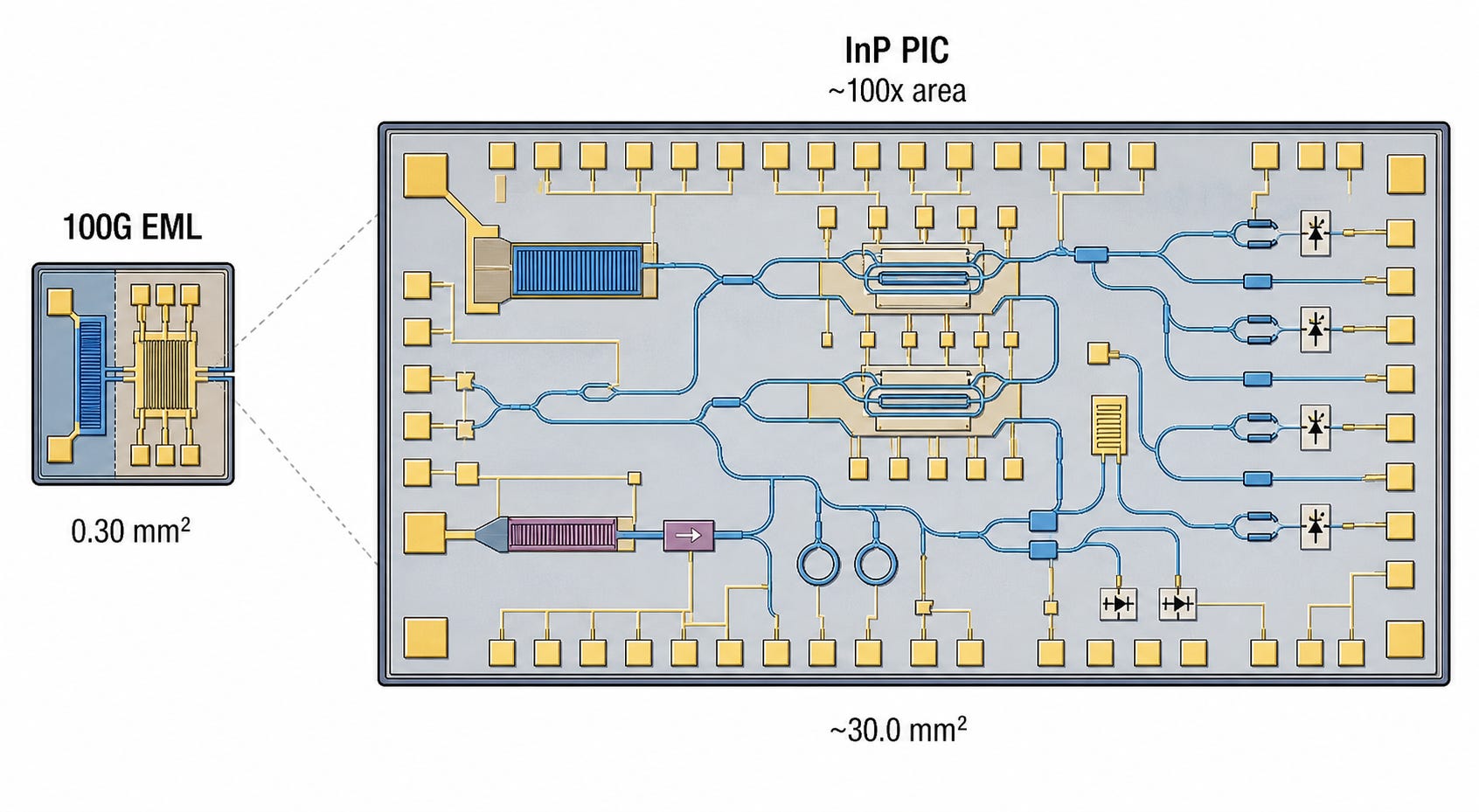
All of this extra stuff is to modulate phase and amplitude.
Note that not all of this is Indium Phosphide. You can have some parts of it be silicon photonics, which makes it a lot cheaper. The standard version, which has the transmit on InP and receive on SiPho, has a substrate consumption intensity of approximately 100x that of 100G EMLs. This is what we’ll be using for our models.
InP Substrate Demand Build
Next, I will share my supply and demand models for:
indium phosphide substrates (AXTI)
MOCVD tools (Aixtron)
indium phosphide devices (Lumentum, Coherent, Nokia, etc.)
We start with an overall demand build for 4-inch indium phosphide wafers that informs every model.
We’ll look at some pretty charts that show the equilibrium balance/imbalance intuitively. The numbers from every use case (demand) and every supplier (supply) shall be color coded. My research is really lit.
The metric unit of measure for indium phosphide demand today will be 4-inch wafers. This can be used to measure everything from substrate demand to epitaxy demand to final device demand. But this chart below is substrate-specific. You’ll see why this is important later.
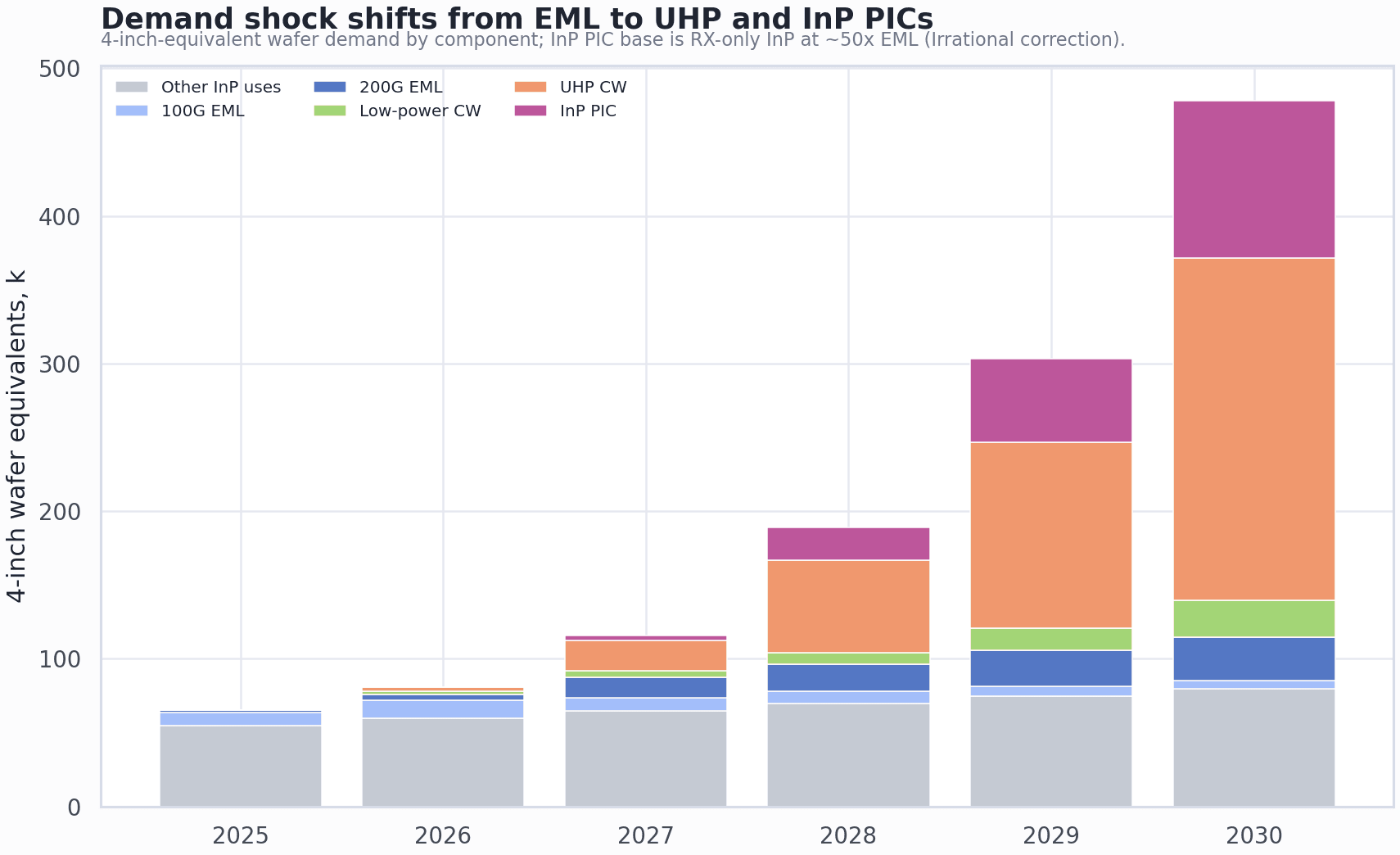
If you didn’t grok the implications of the wafer area intensity numbers from the previous two sections, hopefully this graph shows you just how insane it is. All of the transceiver lasers are minuscule compared to ultra-high power CWs and Indium Phosphide PICs.
From 2026 to 2030, the total demand CAGR is 56%, increasing by nearly 6x, driven entirely by the two new use cases, UHP CW and InP PIC, which together contribute 6x more content than traditional transceivers by 2030.
But also observe that non-AI uses for InP still take up a big chunk of the demand. This means that even with gangbusters growth, AI is starting from a smaller base than many think. This is important for the substrate market, not so much for epitaxy or device fabricators, as they are much more AI-focused and don’t touch the telecom end market as much.
InP Substrate Supply Build
Substrates are our first supply build.
For more context on the three layers of the indium phosphide supply chain that we’ll be analyzing the supply of today, please read this article. It is my most popular article and is required reading.
The results for our first look at supply might actually surprise you and not in the way you expect.
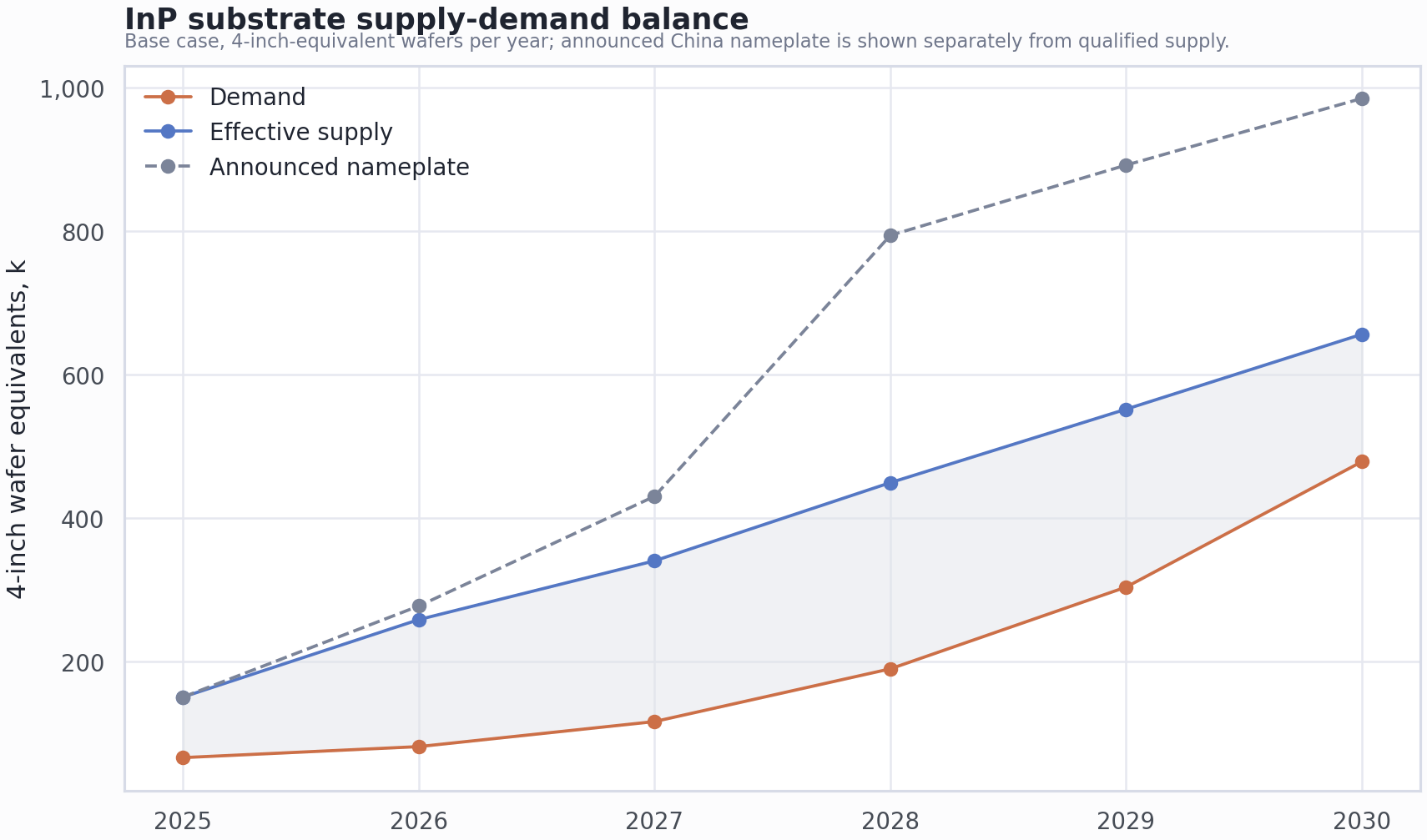
Interesting. Demand actually never fully exceeds supply? And it doesn’t even get close to announced nameplate, which is simply a measure for the aggregate supply ambitions of all substrate vendors, not how much they are actually likely to bring online.
The answer is there is a China problem. Particularly in substrate capacity, as once you are actually competent, it is quick to bring online.
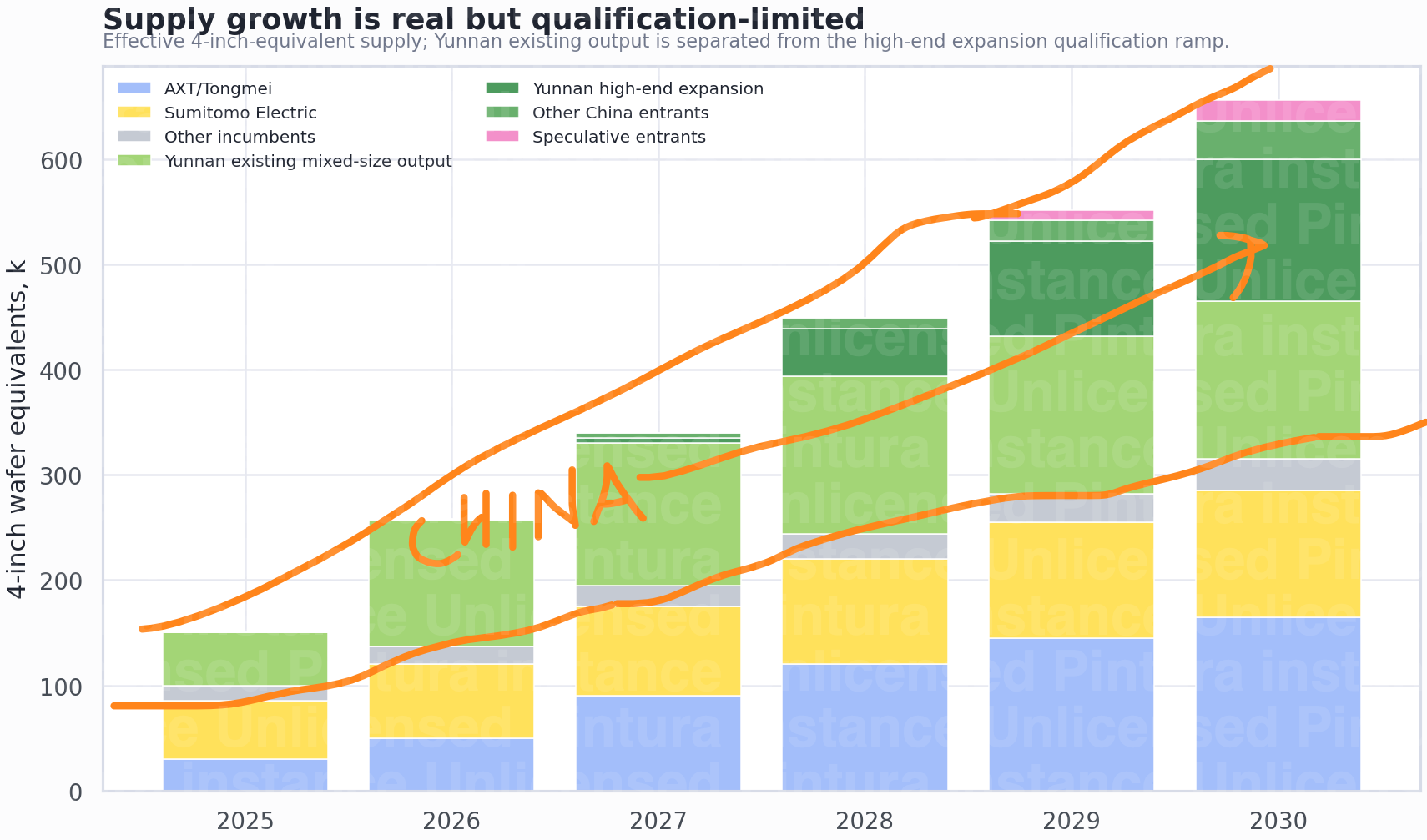
One Chinese firm, Yunnan Germanium, will make up nearly half of all Indium Phosphide production by 2030. However, this is even a conservative estimate of their capacity, as they have publicly committed to 450k of 4-inch equivalent wafer supply, and our 2030 full ramp is only 250-300k, to add a buffer for export controls and qualifications.
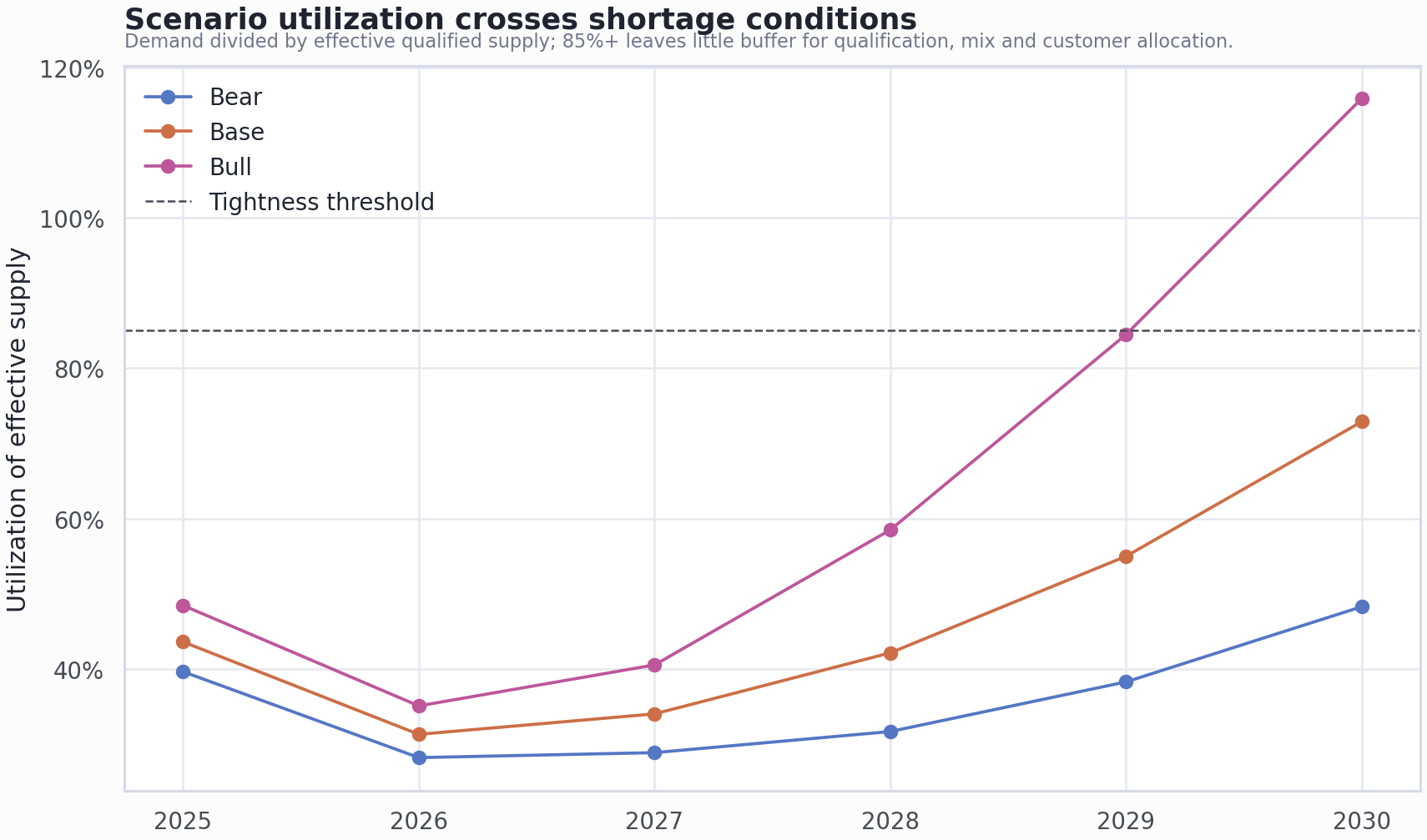
As a result, despite explosive demand, supply never really becomes tight. This is obviously bad for AXTI. In a way, it is kind of the opposite of memory, which is a market with much more modest demand growth but extremely inelastic supply, as it takes years to bring on a new fab and is much more capital intensive. The market structure of memory, despite lower demand, is perfectly ripe for a massive shortage. Indium Phosphide substrates, despite having much faster demand growth, is not.
This teaches us an important lesson: the bottleneck is not always the upstream-most component. A shortage could, in fact, be somewhere in the middle of the supply chain if the upstream inputs are abundant and the scarce “magic” is added after the fact. Now let’s look at this scarce middle.
MOCVD Tools Supply/Demand Model
The MOCVD tool market is literally only Aixtron.
If you listen to enough earnings calls, you will know their capacity forecasts are approximately 1 billion in total revenue per year or 240 tools per year. However, this capacity is expandable. They are currently working a one-shift model, but they can instead work two shifts or weekends if demand necessitates, leading to higher effective capacity. In addition, they’re building a brownfield plant in Italy and a greenfield plant in Southeast Asia, which expands their capacity to 300 (after the brownfield plant) and even higher (after greenfield).
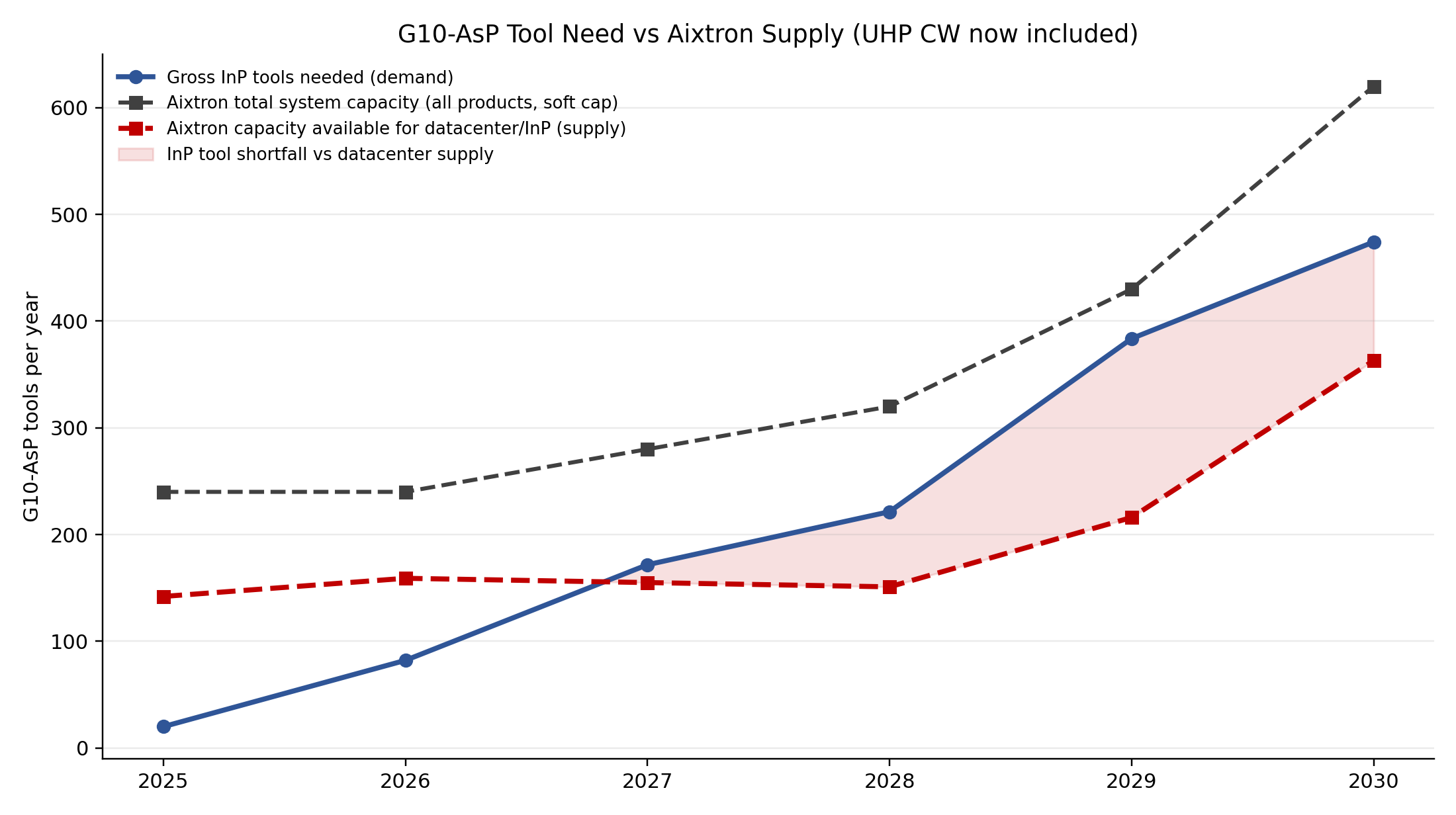
So the supply curve ends up looking something like this. However, not all those tools will be available for Indium Phosphide. Aixtron has a big power semi business, which will likely inflect with the advent of 800 VDC.
But notice demand is actually overwhelming enough that my model shows we will shift into a shortage by 2028! How come we will be short MOCVD machines but not substrates?
The simplest explanation is to blame it on China, but there’s actually a clever structural logic here that I figured out because I am a genius. Currently, MOCVD tools being shipped are all new shipments specifically for Datacom. Every incremental tool shipped is needed because of data center lasers — there is an existing installed base that produces legacy telecom devices which aren’t compatible with these new datacom lasers.
However, because substrates are a flow rather than a stock, the non-data-center shipments recur every year. This is why the “other InP uses” bar in our very first demand chart is so much bigger than the EMLs and CWs for data centers.
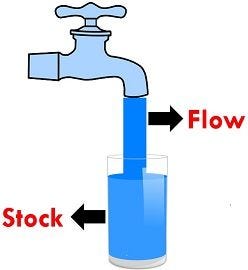
This means that demand quintupling matters way more for total MOCVD tool demand than total substrate demand as the base that you are quintupling is pretty much the entire pie rather than just a tiny slice of that pie.
InP Device Supply/Demand Model
Finally, let’s talk about InP devices. This is your Lumentum, Coherent, Nokia, etc.
This is a bit different because not all devices have fungible capacity. A fab qualified for ordinary EMLs cannot immediately pivot to making ultra-high-power CW lasers or InP PICs and vice versa.
Which results in the obvious outcome: some products can be in massive shortage while others are in crazy over-supply.
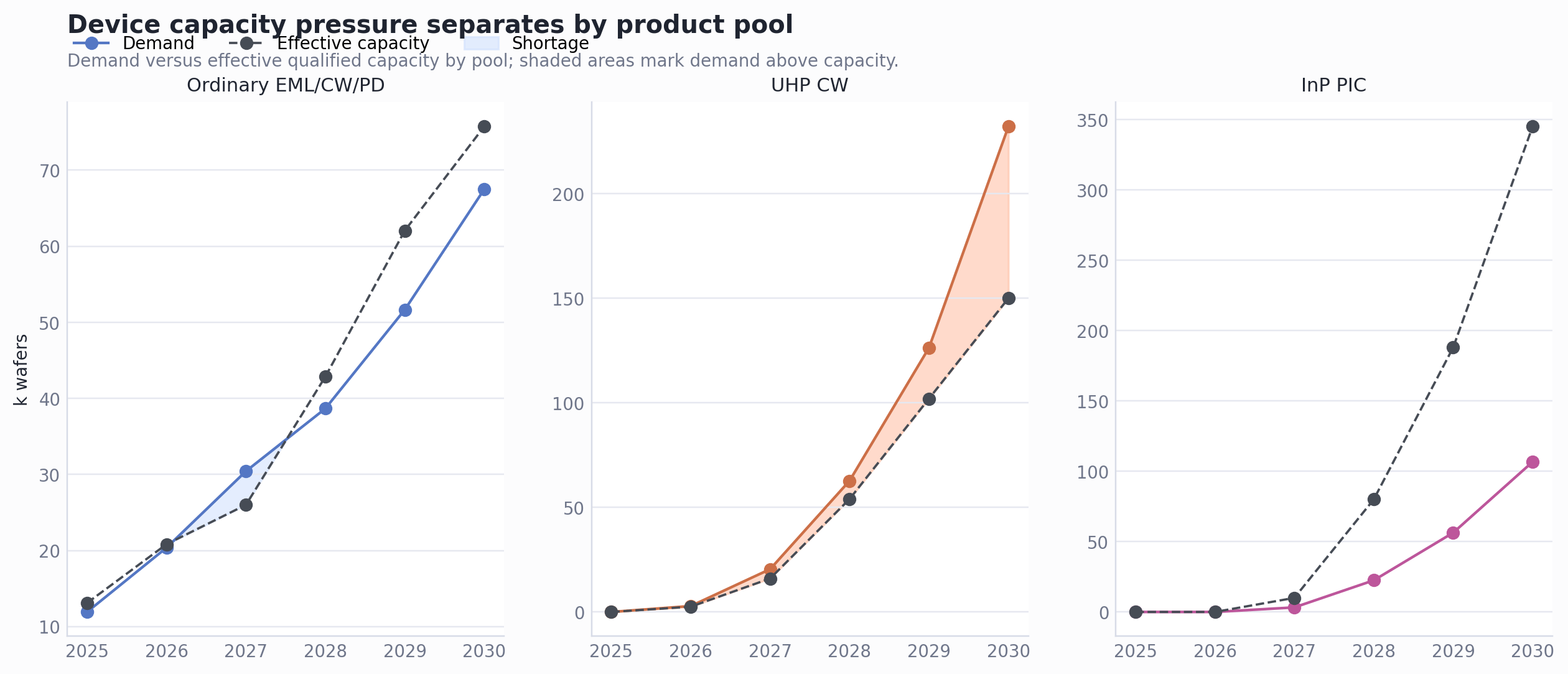
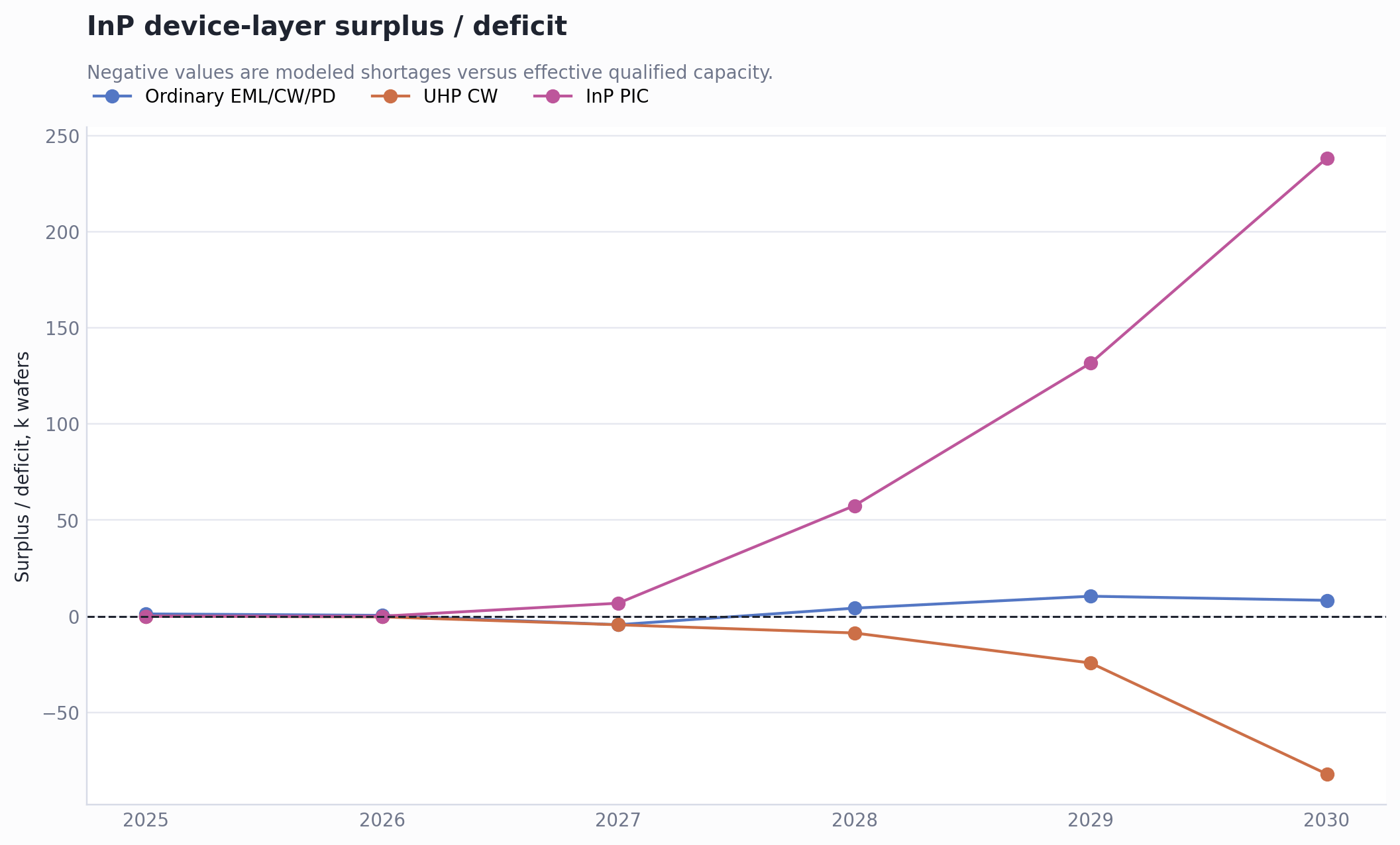
The Indium Phosphide PICs capacity is dominated by Nokia’s San Jose Fab. Nokia has by far the highest amount of capacity for this component (8 / 55 / 110 / 175 k wafers for 2027–2030). Coherent is a fast follower, ramping to 55k wafers with their 6 inch process. If demand for coherent light transceivers surprises to the upside, it is Nokia that wins disproportionately (alongside Marvell who supplies DSPs.
And yes, ultra-high-power CWs are, by far, the component that will be the most short. The mechanism is pretty simple: these are probably the hardest type of lasers to make, so the qualification process is brutal. Currently, only Lumentum has lasers that can meet the very demanding bar.
In addition, others may be able to qualify, but if their process quality isn’t nearly perfect, they can only achieve the right specs by enlarging the die size and thus reducing output. It is a brutal (very attractive) market.
diesize too big for InP PIC?